



The British nonwovens company recently received a royal opening of its new state-of-the-art facility in Bradford, UK. Managing director James Taylor provides Jessica Owen with the guided tour.
Texfelt is a British nonwovens business, which has been owned and operated by the Taylor family since 1995.
The company has recently just celebrated the official opening of its new manufacturing facility in Bradford, UK, a day made even more special as the ribbon was snipped by the Princess Royal.
But the business wouldn’t be where it is today if it wasn’t for the family’s long and rich history within the textile industry.
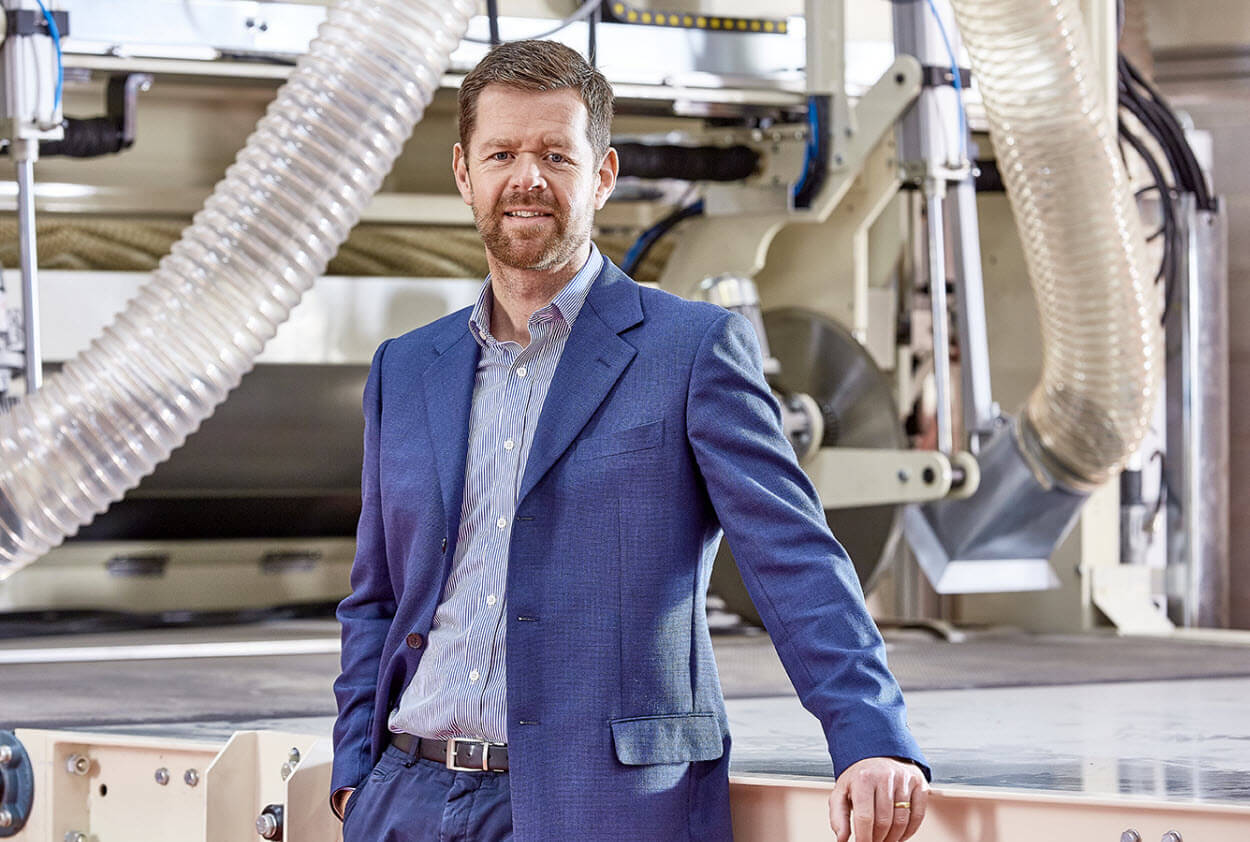
James Taylor, managing director at Texfelt
“My family has been involved with textiles for more than 170 years,” says Taylor. “But it was in 1944 that my generational growth of the business really began.
“My great grandfather bought a mill called James Robinson and Sons, which was located at Smithy Place Mills in Huddersfield. He bought it for him and his son, my grandfather, to run after the second world war as it had been closed during the war effort.”
This business specialised in fabric dyeing and finishing and also in shoddy manufacturing. Then, in 1965, Taylor’s father left school and joined the business having completed his ATI at Huddersfield Polytechnic, which is now the University of Huddersfield.
At this time, the James Robinson business was struggling, and Taylor’s father pleaded to his dad to keep it going. The family took advantage of some grant funding that was available for textile companies at the time and began to focus more on shoddy manufacturing as the dyeing and finishing side was too risky in terms of making profit.

The company's new 60,000 sqft factory in Bradford, UK
“They were manufacturing on commission and they were dyeing and finishing the material for someone else,” says Taylor. “It was difficult to make a profit because there was always this fear that if there was a fault in the cloth, they could quickly lose a year’s worth of profit.”
Then in the late 60s and 70s, the synthetic fibre market began to soar and so the business branched out into producing synthetic fibres and stockholding them in the UK for supplying upholstered furniture and bedding-type markets.
“That was when the business began to grow quickly. It moved up to the Euroway Industrial Estate in Bradford, where we built some more warehouses, and that business is still owned and operated by us today. It’s called James Robinson Fibres,” Taylor explains.
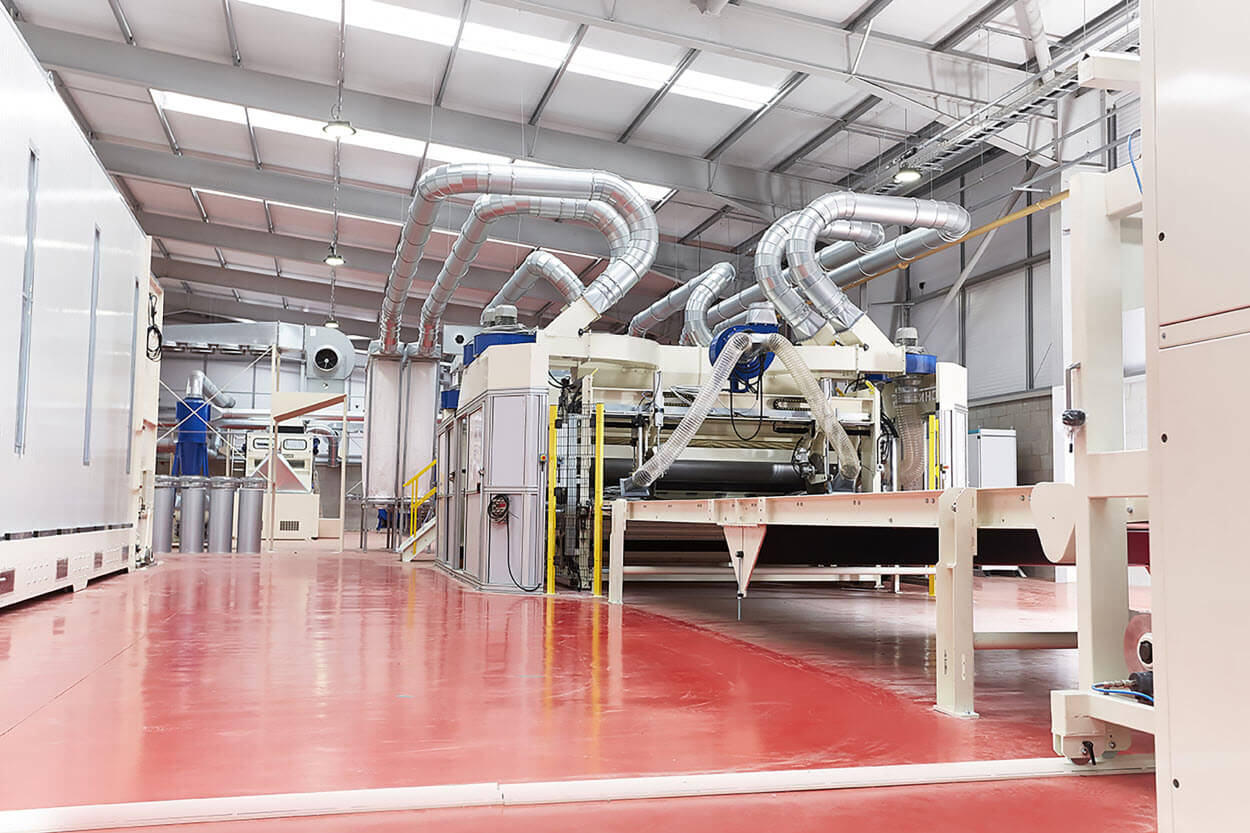
The factory was officially opened on 15 July 2019 by the Princess Royal
Fast forward a few decades to 1995, the business began trading with a needlepunch underlay company called Texfelt, which was based in Dewsbury. Long story short, Texfelt got into financial difficulty and the decision was made for James Robinson to take on the business and its debt.
“I was 21 at the time. I had completed a Higher National Diploma in Business and Finance and was slowly working my way up through my family’s company,” explains Taylor.
“I was about to take on the Canadian market from a sales point of view, but when this happened, my father gave me the opportunity to take the business and see what I could do with it.”
Within 18 months, the Taylor family took a business with around £80,000 worth of debt and made it profitable.
At this point, Texfelt focused on the flooring industry, establishing markets in the Middle East and Asia. Unfortunately, however, over the last 15 years the UK flooring industry in particular has declined due to the rising popularity for underlay made from polyurethane foam.
“The decline in the felt business got to a point where we had to choose either to close down Texfelt or to reinvest in manufacturing,” says Taylor.
“As I had an early background in manufacturing, I was very keen for us to reinvest so we could safeguard those jobs.”
Springbond
As previously mentioned, Texfelt’s newest product is called Springbond. It was launched in November 2018 at The Flooring Show and also in the Middle East at The Hotel Show.
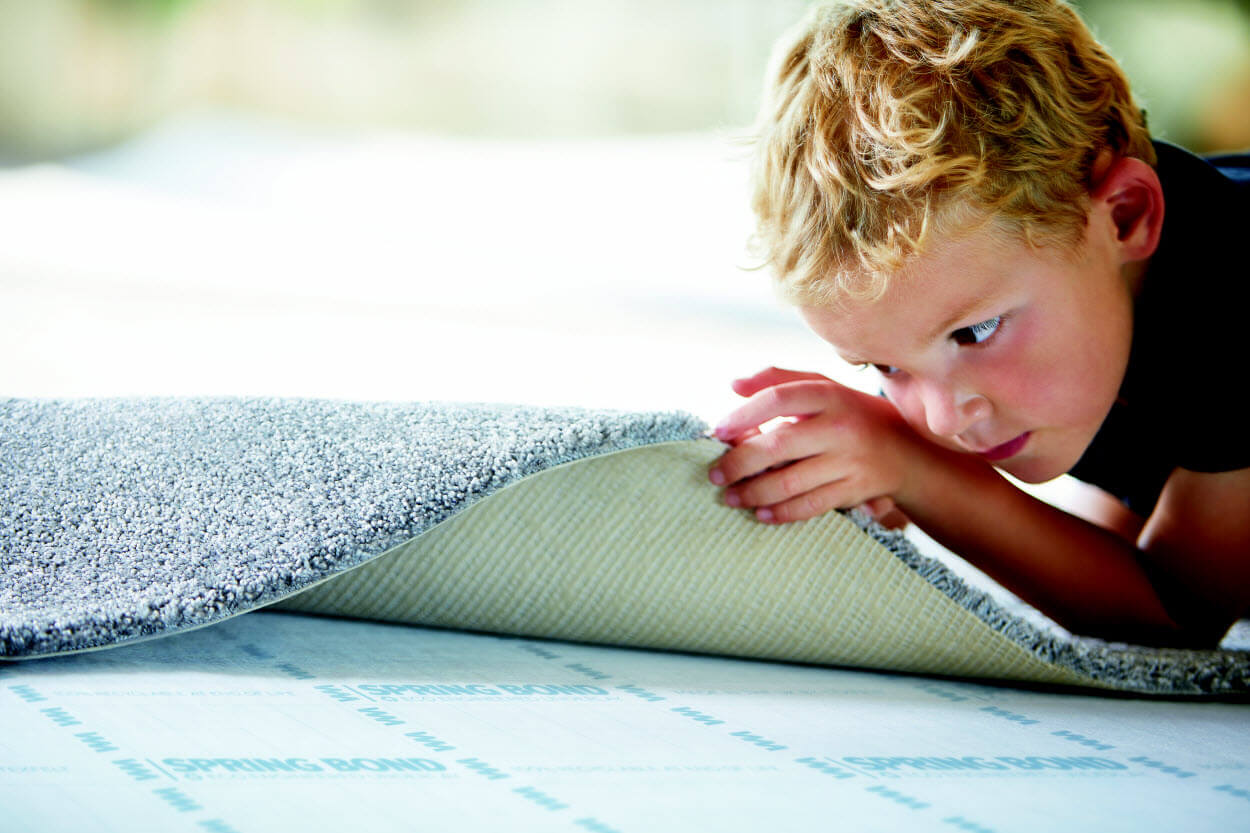
Springbond is Texfelt's newest product. It is an eco-engineered carpet underlay
Springbond is an eco-engineered nonwoven, which is primarily aimed at the carpet underlay market. At least 85% of the material is made from upcycled single-use plastic such as plastic bottles and at the end of its lifetime, it can be 100% recycled into PET again.
“Each 15 sqm roll has up to 180 500 ml single-use plastic bottles. If you take an average house in the UK for example, that equates to around 900 bottles that have been saved from floating around in our rivers and oceans,” Taylor explains.
Texfelt has introduced Springbond at precisely the right time, as sustainability is on everyone’s minds. And it isn’t just the environment that this product is benefitting; it is also chemical-free and can be used as a replacement for polyurethane foam.
“It’s no secret now that polyurethane foam is bad for your health. Volatile organic compounds (VOCs) are released from this material, which can affect human health.
“In the UK, we rely on foam for furnishings and for underlay, but Springbond can be used as an alternative in all of these markets. The industry is now waking up to this issue and we are ready to pick up that business.”
Unlike polyurethane foam, Springbond has an extremely low VOC level. The VOC test is conducted to BS EN 10580 over a 28-day period and in that time a material is tested for concentration levels. The maximum acceptable limit for the combined total VOC count is 21,000 µg/m³, and in Springbond's case, the test was cut short after just three days because the permitted 28-day requirement level had been met and would not go above 42 µg/m³.
There are three different options of Springbond carpet underlay – 9 mm, 11 mm and FR. The process of manufacturing this textile is very flexible and so the density can be varied.
Springbond FR is a double stick underlay system used primarily for commercial contracts. The material is naturally flame resistant, so there is no need for harmful chemical additives, and it has been accredited by some top UK and Middle East manufacturers such as Ardex, F. Ball, Uzin and XChem.
What’s more, Springbond is currently waiting for approval for BREEAM accreditation. This means that it would be the first underlay to be accredited for use in sustainable buildings.
“This is a really important step for us, and we are hoping that this will springboard Springbond into the building sector,” says Taylor.
Inside the factory
Inside Texfelt’s new factory is a unique production process that is the result of a collaboration between four different manufacturers.
“Nobody else has a machine quite like this. It has taken a while to get it right, but we now have a system that is fully automated, and the different systems are able to talk to each other to create our products such as Springbond.”
At the start of the line, three different types of recycled fibre are blended with thermo bonding fibres. The thermo bonding fibres are mainly virgin fibres, which are very technical, and essentially the outer core melts and creates the adhesion points to hold the other fibres together.
“The reason why Springbond is not 100% made from recycled materials is due to this thermo bonding fibre. We are now starting to replace some of this with a recycled bicomponent fibre, but at the moment, the recycled version isn’t of the same quality and performance,” Taylor says.
Afterwards, the weight of the fibre is then regulated, and more blending occurs until it then goes to the forming section. Next, a combination of both a carding and airlay technology is used to give the material a z-shape structure – this is what gives Springbond its resilience.
“If you’re going to make a product that can stand up against foam then it has to have the same resilience. So, we created these z-shapes in the product, which act like little springs and it’s those that give resilience to the product.”
The material eventually comes out as a uniform web, which is then essentially baked in a three-oven chamber. After cooling, the product requires cutting and finishing and then it is packaged up and ready to be sent to the customer.
Taylor says that the process is very much like baking a cake – “You take your ingredients, blend them together, you form it, put it in the oven and then bake it.”
Inspiring a workforce
One topic that Taylor and I discussed during my visit was about apprenticeships and inspiring young people to choose a career in textiles, specifically nonwovens.
He continued to tell me that his son, the fifth generation of the family, in fact joined the company last year.
“He has enrolled on an apprenticeship degree at Leeds City College. He is working with us three days a week and, over the three years, he will do various roles within the business. At the end, he’ll come out with a BA (Hons) Business Enterprise Management degree and a chartership will likely follow that.”
Taylor is also hoping that the company’s new state-of-the-art facility will inspire more young people to work in nonwovens.
Texfelt did have four or five attempts to get apprentices into the old factory when it was based in Elland, but they would apparently come in for a day and then not turn up after that.
“Young people don’t recognise textiles as a future industry. But now, if I was a young lad and I was taken into our new nonwoven factory, I’d be thinking ‘wow, I can do something with this’."
Another reason why it is important to get youngsters into textiles is because there will soon be a risk of losing knowledge from those currently working in the industry. Many valuable workers will soon be retiring and so the next generation will need to help fill that gap and learn the tricks of the trade.
“We have some senior members in our team who are coming up to retirement. They have assured me that they have no intentions of retiring but we need to make sure we pass their skills on.”
As Texfelt now evolves, the hope is to create more jobs, create more shifts and double up the workforce. Taylor says that the company would encourage apprentices to get involved with this.
“We have the capacity to add another two shifts, and this could create between 12-20 more jobs in addition to the 13 jobs we have safeguarded and created as a result of our recent investment.”
As for the future, the plan now for Texfelt is to build up sales and recover that £9m investment.
“We are not out of the woods yet, but there is a hell of a lot going on,” says Taylor.
The company once supplied products to Buckingham Palace, and with the help of the Royal opening of its new facility, perhaps it could supply its eco-engineered underlay to the Royal Family in the future.
“That would be the icing on the cake,” says Taylor.
Have your say. Join the conversation and follow us on LinkedIn