



Sponsored by Taiwan Textile Federation
- 367 exhibitors from 10 countries with 896 booths
- More than 41 brands from 10 countries with 400 online and offline business meetings
- Bringing together 15 exhibitor image videos, 11 seminars, and 10 new product launches and fashion shows
The 2022 Taipei Innovative Textile Application Show (TITAS) came to a successful close on 14 October 2022. The event was organised by the Taiwan Textile Federation (TTF) in partnership with the Bureau of Foreign Trade (BOFT) and Ministry of Economic Affairs in Taiwan. A hybrid event, TITAS was a three-day physical exhibition that ran from 12-14 October. TITAS Virtual then ran for another month online, helping exhibitors reach more buyers and expand business opportunities.
In total, TITAS showcased innovations from 367 international exhibitors across 10 countries, including Taiwan, the United States, the United Kingdom, Switzerland, Sweden, Italy, Japan, South Korea, China and Hong Kong with almost 900 booths. The physical event saw over 33,000 visitors through its doors during the three-day exhibition and TITAS Virtual saw almost 37,000 visitors from across the globe.
Innovation and sustainability were the key overarching themes powering TITAS 2022. The exhibition’s scale exceeded that of TITAS 2020, bringing together leading textile industry players and 24 textile associations and research units. The grand event showcased the strength of innovation and research in Taiwan’s textile industry and demonstrated its cohesion.
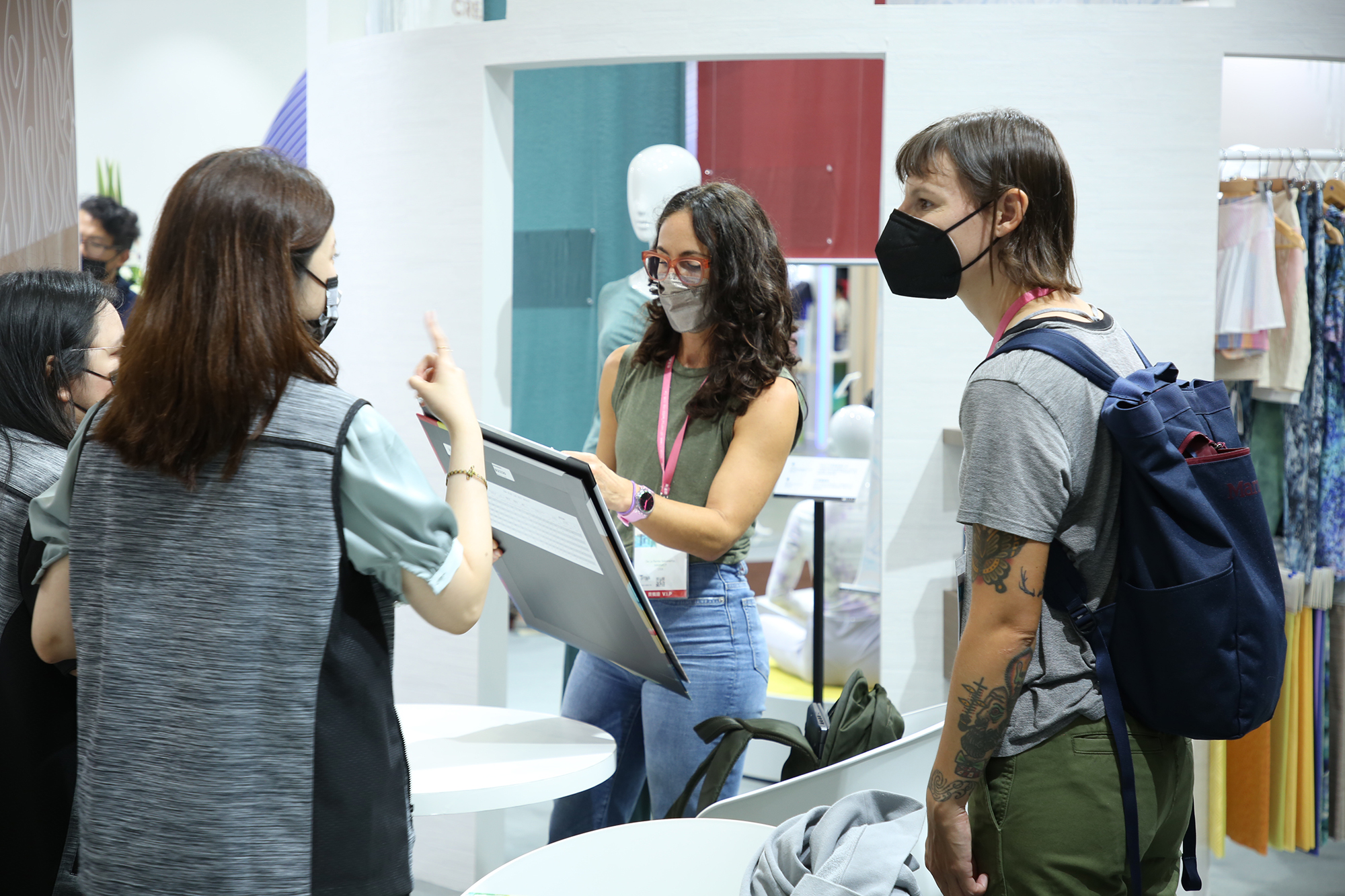
Networking at TITAS 2022
Maximising business prospects by integrating the physical and virtual
A hybrid event, TITAS’ online visitors are also well thought of. TITAS adopts various digital technologies to create a digital, interactive and intelligent exhibition format. ˙
- TITAS VR Online exhibition hall: A live version of the physical exhibition presenting both panoramic and detailed views of the show. Launched this year, the new feature aims to provide a true-to-life experience of the show with a tour for those international professionals who were not able to attend TITAS in-person. Viewers could virtually visit exhibitor’s individual booths and access relevant information including company profiles, e-catalogues and contact information.
- TITAS Online Show: This 24/7 online platform serves as a marketplace for visitors to source the latest products from TITAS exhibitors - anytime and anywhere in the world. In addition to general product categories, products are also classified under five themes including Personal Protective Equipment, Functional Applications, Sustainability, Smart Textiles and Intelligent Manufacturing. There was also a Trend Zone: the Trend Zone online ran concurrently with the physical show.
- TITAS Live Stream: Live interviews from selected exhibitors on their innovations together with a guided tour of the company’s booth during the show on YouTube, Facebook and the TITAS website.
Additionally, TITAS was selected as a demonstration field for the EXPO-TECH Pilot Project for Digital Exhibitions of the Bureau of Foreign Trade. The project introduced a number of digital technologies to enhance the interactive experience of visitors. These include:
- 3D Hologram Hybrid Booth: TITAS introduced a new virtual reality (VR) hologram booth with 3D modelling. The technology adopts a unique holographic display of 3D textile models and interactive gesture recognition technology. It enabled visitors to view and feel the authenticity of the fabrics, while overseas exhibitors were able to showcase as if they were in a live setting.
- Intelligent Manufacturing Interactive Immersive Space: This space was designed to display six intelligent manufacturing processes including dyeing and finishing, production management, CAD design, cutting & printing, sewing & bonding and packing via VR technology. Providing visitors with an immersive exhibition experience, it combined advanced projection technology with digital interaction and space design.
What’s more, technologies such as epidemic prevention robots and interactive electronic maps were utilised. The implementation of these technologies made TITAS a green exhibition that combined environmental protection, epidemic prevention and artificial intelligence (AI).
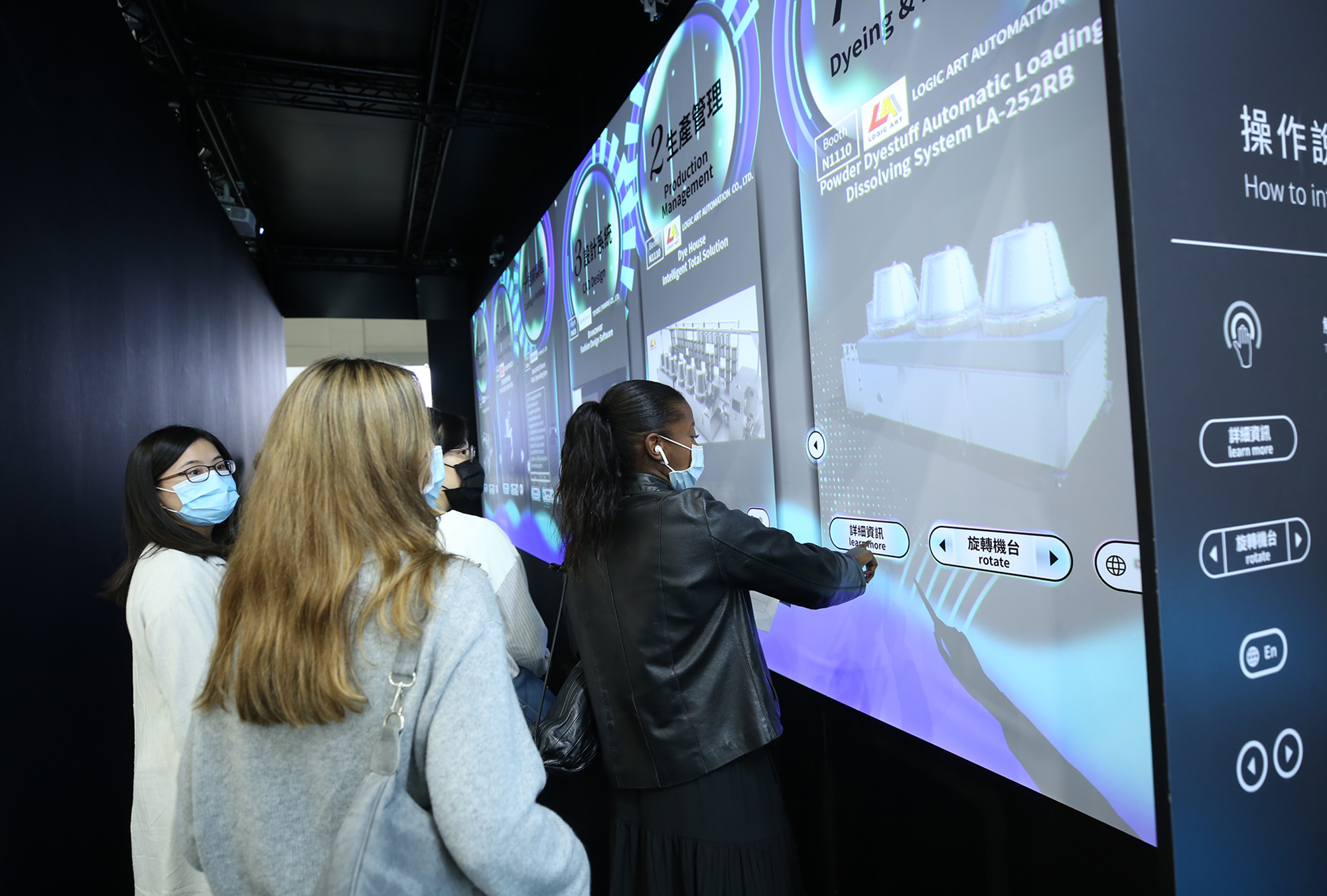
Digitalised technologies at TITAS 2022
Key themes
With the announcement of the "2030 Sustainable Development Goals" (SDGs) by the United Nations in 2015, industries have been guided by joint sustainability targets. This is especially as the EU’s European Green Deal revealed 2050 carbon neutrality goals, ensuring no net emissions of greenhouse gases (GHG) by 2050. The US has committed to an ambitious and achievable goal to reduce net GHG emissions to 50-52% below 2005 levels in 2030. The issue of “net-zero carbon emissions” has become the best challenge for companies to strengthen their supply chain, carbon management and improve business resilience.
This year, TITAS continued to promote five core themes: Sustainability, Functional Applications, Personal Protection Equipment, Smart Textiles and Intelligent Manufacturing. Sustainability though, was the critical message of the event as it is the core of the industry’s future development. The highlights include:
Sustainability x Functional Applications
Carbon neutrality and reducing carbon emissions was a critical component of exhibitors’ offerings. Suppliers or brand owners are actively establishing a green supply chain that combines environmental protection and functionality. The Taiwanese textile industry creates multi-functional textiles with high-performance properties through innovative technologies under the premise of sustainability.
For example, Far Eastern New Century focuses on sustainability with its most recent textile innovations. At TITAS 2022, the company presented new materials and product solutions. Among these innovations was the FENC® TOPGREEN® rTEX Spun Yarn. This yarn is made from textile waste from the factory floor. The result is a 100% recycled pre-consumer polyester and 100% recycled preconsumer cotton yarn that is free from any chemical treatment. Additionally, FENC® TOPGREEN® Bio3 PET utilises LanzaTech cutting-edge biotechnology that transforms industrial waste gas into low carbon MEG, which then turns into brand new polyester. Capturing and reusing carbon emission, FENC® TOPGREEN® Bio3 PET Filament and Textiles reduces the company’s carbon footprint.
Elsewhere, Formosa Chemical & Fibre Corporation (FCFC) used chemical dispersion technology to mass produce recycled nylon 6 chips, particularly on waste fishing nets and oyster ropes. FCFC has adopted recycling technology at marine debris cleanup areas to chemically extract recycled CPL with quality similar to that of newly-produced CPL. The dope dyed nylon fibre, developed by FCFC, is used in the production of fishing nets and marine leisure ropes, which can reduce the wastewater from the dyeing and finishing process and the burden on the environment.
Formosa Taffeta launched a new generation of eco-friendly fabric - bio-based fabrics, including Bio-Nylon 56, Nylon 410 and Nylon 11. These three types of biomass nylon are all produced from biomass materials refined from plant matter instead of traditional petroleum-derived raw materials. These new products allow industry to reduce petroleum consumption and lower greenhouse gas emissions, while producing fibres with the same unique qualities as original nylon types.
As well this, Eclat Textile launched innovative eco-friendly fabrics under its new value proposition “Materials with purpose”, as it continues to grow in to the activewear sector. The company’s Primefit Zero material is a stretchy textile with a fine furrow structure composed of highly compressed strands of flexuous yarns. The material maximises stretch capabilities and inhibits the loss of elasticity for a longer life cycle. It is also 100% recyclable.
With net zero carbon emissions in mind, TITAS exhibitor LIBOLON (Lealea Group) has developed a green circulation concept using an economical circular water system, green recycling fibre products such as its RePET® eco-friendly polyester recycled yarn and its ReEcoya® recycle dope dye yarn. LIBOLON has also expanded the production of BOPA (biaxially oriented polyamide) for materials in the electronic and functionality film industry.
Another exhibitor, Shinkong Synthetic Fibers, also focused on sustainable topics at TITAS 2022. Amongst its offering at the event was its yarn made from recycled garments. Using specialised technology, Shinkong is eliminating textile waste by taking garments, (that would otherwise have gone to landfill or be burned), back to the material stage to elongate the yarn lifecycle. The company also showcased its biodegradable polyester yarn and is working on initiatives to develop its carbon neutrality.
Meanwhile, Zig Sheng says its sustainable yarn lowers manufacturers’ carbon footprint. Its Netup nylon, made from recycled fishing net, Revert nylon, a low-carbon recycled yarn which turns nylon waste into nearly 2,400 tons of yarn every year, and its high flexibility, low fibre-shedding yarn, Soufflex are great ways to improve environmental footprints. These yarns were exhibited at TITAS 2022.
Yi Shin says it is dedicated to developing environmentally friendly biodegradable materials, including biomass yarn Magic BIO from agricultural waste, Magic CAC from sustainable forest farms, and Magic BEC - a decomposable material for improving environmental pollution. All of which were showcased at TITAS. The company actively participates in carbon reduction actions and starts carbon inventory related operations.
Grandetex launched a new yarn with both green economy and functionality. A cocoa yarn, named Secao®, it uses the local materials in southern Taiwan to solve agricultural waste and implement circular economy initiatives.
Also, Paiho showcased how it utilises paper fibres and recycled yarns to launch a unique plain weave textured fabric to implement sustainable fashion ideas. The special plain weave textured fabric, made of environmentally friendly paper fibres and recycled yarns, has a unique moisturising feel and is durable. It has passed rigorous wear and tear resistance test and can be applied to a wide range of industries.
Exhibitor Jintex Group is committed to Green Chemical Solutions, it says and launched five themes at TITAS 2022. These are: JINTEX Bio – a series that uses plant oil and natural waste to replace petrochemicals as a raw material to produce chemicals for textile use; Protection is a range that uses materials with a low carbon footprint and without any PFCs, and Touch is series of hydrophilic softeners that uses a variety of soft hand-feel formulas to create a unique hand feel. And Moisture is a series with “excellent moisture management”. Whilst its “JINTONE dyes” series is a range of dyes with high dispersity and washable properties.
TITAS 2022 also saw Everlight Chemical launch a number of dyeing solutions that can save water and energy and reduce emissions for improving business competitiveness, including: Everzol ERC Solution (energy saving and emission reduction dyeing solution), Everzol reactive dyes (functional dyes), Everjet inks (digital textile inks), Everacid acid dyes (low waste acid dyes for nylon), Evereco PUR adhesives (environmentally friendly solvent-free adhesives) and Evertex textile auxiliaries.
San Fang Chemical as invested in yarn, film, sporting goods, medical materials and other application fields, setting itself a target for 2025 which includes saving water by 36%, reducing waste by 5%, reducing CO2 by 27%, increasing solvent-free products by 30%, and having 100% recycling rPET nonwoven products. The company’s key products include PASHRON® TPU yarn, Qtan® TPEE Elastic Fiber, Profios® Dope dyed yarn – all of which were promoted at this year’s TITAS.
Chain Yarn pursued a number of sustainability goals at the event. These included reducing the impact of pollution, simplifying manufacturing processes and producing certified raw materials. The company used waste recycling technology to launch its GREENLON® environmentally friendly recycling and waste reduction series, to be used in technical textiles and clothing applications. Also, Chain Yarn’s GREENLON® dyefree/eco pro specialised dope dyed system adds nylon masterbatch in the spinning process to achieve good colour fastness and customised colour.
Sustainability x Intelligent Manufacturing
In the past, the textile industry has been dependent on water and energy in virtually all steps of the manufacturing process. Climate change and the ongoing energy crisis has brought challenges to the industry with limited energy and resources. By creating a recycling system, reducing time and energy-consuming production processes – and using green energy – Taiwan's textile industry must achieve sustainability goals.
Exhibitor New Wide Group aims to reach the “Science Based Target (SBT)/1.5°C target” set in the Paris Agreement, in 2022. The company expects to obtain the verification by the end of 2023. New Wide Group continues to fulfill its social responsibility and improve its supply chain. The company’s digital “Intelligent-manufacturing Data Control Centers (IDCC)” have been set up at factories in China and Vietnam to track production and performance data in real-time with the aim of achieving an efficient, smart and sustainable production process.
Phuoc Dong New Wide (Vietnam) purchased I-REC (International Renewable Energy) verified energy to fulfill RE100, 100% renewable energy. In terms of products, the main showcase focused on NaiaTM Renew, a new age eco and luxurious fabric of di-acetate cellulose. All eco-tech products include Naia Renew, BioMass, bio-degradable and recycled materials, to provide innovative and eco-friendly products & services for clients.
Everest Textile exhibited after its completion of its transformation to a low-carbon economic model through the circular economy and energy transformation. This not only improves the efficiency of the company’s original production equipment, but also further builds on its solar energy and smart grid manufacturing. Everest develops innovative high-performance and sustainable fabrics, including carbon capture, bio-based, recycling and bio-based composite PET high performance products, the company says. It also showcased its carbon capture polyester yarn, bagasse biobased polyester yarn, E-2000 recycled polyester composite bio-based polyester eco yarn, recycled fishing net nylon yarn, recycled high tenacity nylon 6,6 (Cordura® re/cor®), Morphlon® Waste Shoe material recycled yarn and pineapple fibre yarn.
Additionally, the Taiwan Textile Research Institute (TTRI) exhibited research and development projects in high-end textiles, environmental sustainability, digital innovation and smart textiles and training. The organisation’s highlighted products included deodorisation polyester masterbatch and fibre; 2DF high colour fastness dope dyed fluorescent fibres; PCM-long term thermal control technology; generic ECO elastic conductive slurry; precision exercise assistant clothing and force detecting and responding textiles.
Meanwhile, OSHIMA Taiwan is a leading smart equipment supplier to the garment industry. In partnership with the TTRI and textile producers, the company has developed “the first truly capable domestic fabric inspection machine”. OSHIMA EagleAi is the first AI fabric inspection machine to master knitted and stretched fabrics while simultaneously maintaining fabric tension within 2%. It continues: “Our neural network has already learned all the most common fabric flaws, including flux spots, flux contamination, colour spots, colour contamination, filth, oil contamination, holes, knots, folds and colour differences, weft defects, warp defects, hooked yarns, among others.” The technology averages an overall accuracy rate of more than 90%, an accuracy rate of 94% and a recall rate of 86%. The biggest advantage, however, is that the technology can detect over 70% of unfamiliar fabrics in four hours or less, even without prior fabric data input.
Also, exhibitor Logic Art Automation is committed to providing the industry with a total solution for intelligent manufacturing (LA-Total Solution) and has become the world's largest ODM equipment manufacturer for drip machines. Showcasing this at TITAS, the company has long invested in "textile printing and dyeing equipment and automatic integration of the whole factory", changing the inherent mode of traditional industries, creating a smart production model for customers.
Kaulin MFG (SiRUBA) devotes itself to developing the sewing industry with various sewing machine products that can be applied to numerous sewing procedures. The company promoted its best-selling overlock and interlock sewing machines, computer-controlled bar-tacking and button-holing machines at TITAS 2022. It also released a full line-up of automatic sewing machines combining higher positioning accuracy and craftsman’s touch, to fulfill customers’ needs in a range of categories such as knitwear, jeans and sportswear.
Also in the sewing machine arena, Ching Chi Machine specialises in the manufacture of high-performance industrial sewing machines through its Kingtex brand. The automatic sewing equipment “special for knits and sportswear” was recently launched. The launch included its round neck, bottom hemming, flat bottom and cuff hemming and overlock back-latch. When it comes to the garment industry, sewing automation helps to save on labour costs and improve efficiency.
Functional Applications x PPE
In recent years, the demand for protective textiles with safety protection functions, comfort & aesthetic appeal has been increasing. TITAS showcased a variety of protective textiles for medical use, specialised apparel and sportswear.
For example, Tex-Ray – a company dedicated to research and development, especially in smart textiles and functional, antimicrobial and sustainable materials – showcased its latest innovations. These included the company’s patented high-resolution and environment-friendly printing technology HD ECOPRINT. This is a revolutionary eco-dyeing process Ecoloration technology. The company also exhibited its TFresh Antimicrobial Materials Series, amongst other technologies.
To help protect the ocean, SINGTEX a manufacturer of functional fabrics, launched its 13th generation of S.Café at TITAS 2022. The S.Café Ocean environmental technology ocean coffee yarn takes recycled PET bottles from the ocean and combines them with coffee yarn technology (TW I338729). Not only does this innovation reduce waste but it also has odour control and quick drying properties. The company also promoted its STORMFLEECE fabric at TITAS. STORMFLEECE replaces the traditional knitted fleece with single-layer weave fleece. The compact structure of the weave fabric can reduce the flow of microfibres into the ocean during the washing process and uses solution dyed technology to save water resources, according to SINGTEX. Additionally, the company’s STORMEGA product uses fabric to create an air layer. This 3D air layer can capture and maintain body temperature without using fleece.
Also at the show, Light Textile showcased its LIGHTEMIS technology, launched in 2021. This is a fine denier yarn combined with elastic with reflective properties. It can be used in apparel and footwear, providing safety in the dark with high comfort.
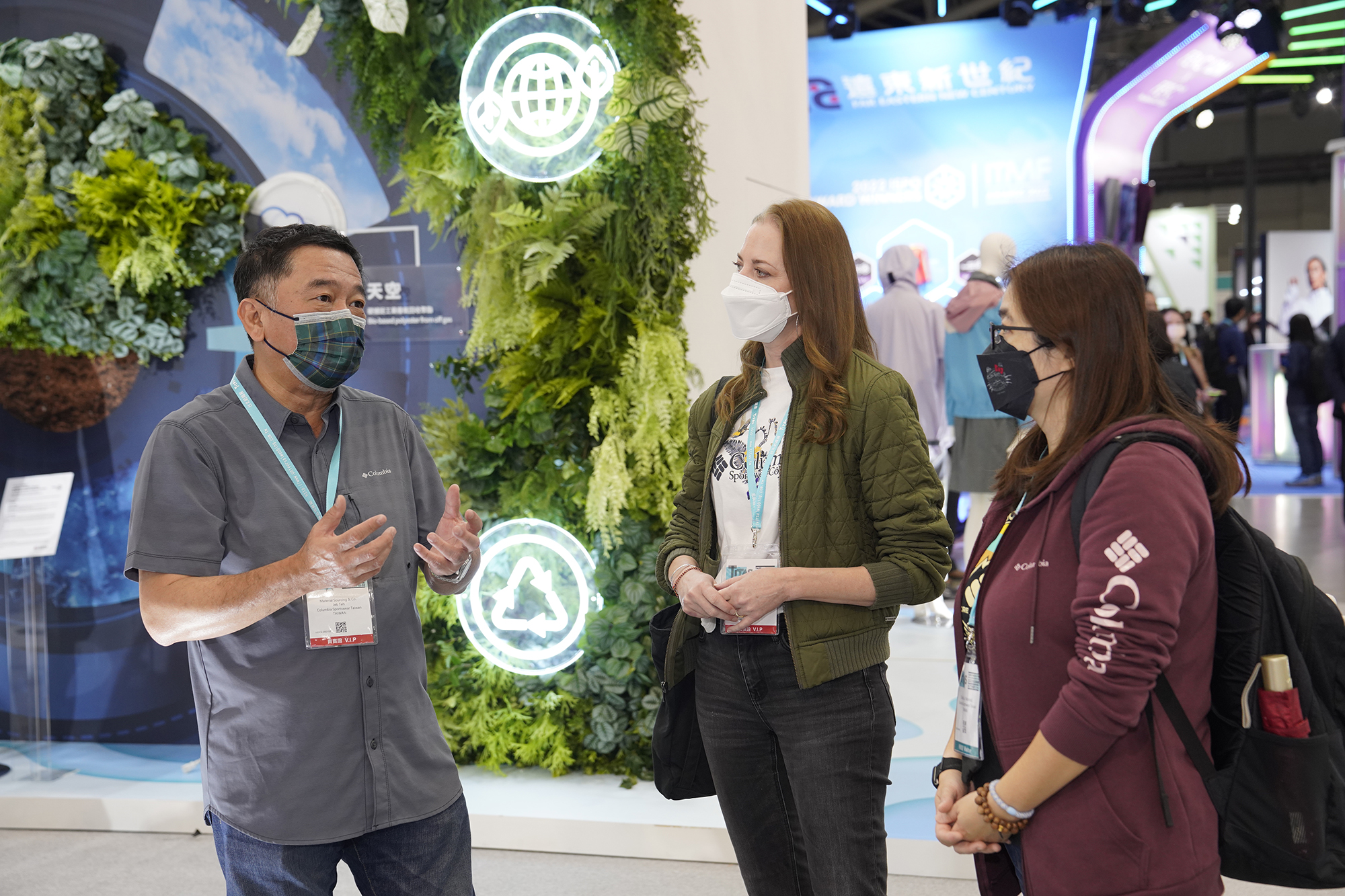
Discussions taking place at TITAS 2022
Educational sessions deliver innovative technology
TITAS held a number of forums and seminars related to circular textiles and sustainability. It saw both local and foreign experts discuss issues relating to the circular economy in the textile sector as well as textile technologies. In addition to the Circular Textiles Forum "Taiwan Textile Industry on Its Way toward a Circular Future", there were also 11 professional seminars on textile technologies that share technical industry knowledge. In addition, TITAS 2022 saw 10 product launch activities and fashion shows presented by Taiwan Paiho and Cotton Council International, among others.
Connecting Taiwan to the world
The Covid-19 pandemic caused international exhibitions and networking opportunities between buyers, suppliers and innovators to stagnate. In a bid to improve buyer-supplier communications, TITAS invited more than 41 brands from 10 countries to conduct hundreds of online and in-person meetings with exhibitors. Buyers came from countries such as the US, Canada, Germany, Italy, Japan and South Korea. This season’s procurement focused on multifunctional woven and knitted textiles that combine sports, outdoor leisure, fashion, household use, baby strollers and competition use. These sought-after materials boast properties including moisture-wicking, waterproof and moisture-permeability, anti-UV, far-infrared, insulation and temperature regulation, deodorisation, antibacterial, antifouling and high strength and wear resistance properties.
The next edition of the annual show, TITAS 2023, will be held in Hall 1 of the Nangang Exhibition Center on 17-19 October, 2023. With the strong support of the Bureau of Foreign Trade, Ministry of Economic Affairs and the industry, the Taiwan Textile Federation is confident Taiwan will increase its market share and competitiveness in the global textile industry, so that Taiwan's textiles can continue to shine in the global market.
Have your say. Join the conversation and follow us on LinkedIn