


-
Contents
Overview
Geographies
Hoka’s production locations
Products
Footwear analysis
Special requirements
Activity analysis
Apparel mix
Innovation
Cielo X1
Hoka TC
Lifestyle & gorpcore appeal
Environmental, social and governance (ESG) strategy
Materials
WTiN examines high-flying footwear and apparel brand, Hoka, analysing its supply chain geographies, current product mix and commitments to sustainability.
Overview
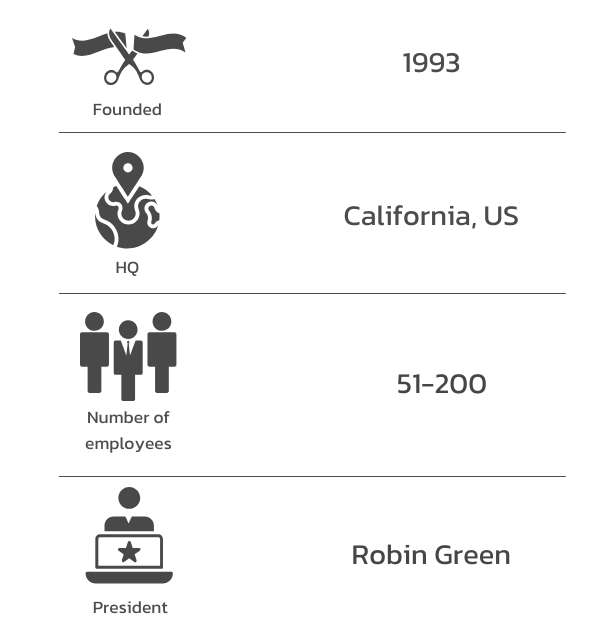
Founded as Hoka One One by the French duo, Jean-Luc Diard and Nicolas Mermoud, the performance running and outdoor brand launched in 2009 with the debut of the Mafate shoe [1]. Engineered to improve the experience of running in mountainous technical terrain, the Mafate exhibited a voluminous rockered midsole, a strong emphasis on cushioning and a lightweight construction – all geared to propel a runner’s forward momentum on the trail [2].
Fast forward to 2024 and Hoka has leveraged its maximalist performance heritage and emphasis on comfort to appeal to a wide range of consumers, from ultra runners to streetwear enthusiasts.
Its early and successful divergence from its downhill trail-running roots has been of great benefit to parent company, Deckers Brands, who acquired Hoka in 2012 for a reported sum of US$1.1m [3]. Since, the brand has managed to accrue healthy growth and positioned itself as one of the group’s strongest assets, particularly in recent years: as of Deckers’ latest fiscal quarterly report (FYQ4), the performance brand achieved net sales of US$429m, which is almost a 30% increase on the year prior [4].
The view from a full fiscal year perspective (ending 31 March) appears just as positive. Reports from May last year indicate Hoka’s net sales topped US$1.413bn – an almost 59% increase from fiscal year 2022’s US$892m [5].
Wholesale assumes the largest share of these sales, growing by 47% to US$926m [6]. However, the brand’s direct-to-consumer (DTC) avenues demonstrate far stronger fiscal year-on-year growth, at 85% – the largest of all the group’s subsidiaries [6]. This figure, alongside claims that DTC growth remains a long-term priority across the portfolio, may also indicate a corresponding investment in relevant infrastructure and marketing efforts to enable this growth [3], [6].
In this Company Intelligence feature, we plan to dissect the elements crucial to Hoka’s growth, including looking into the brand’s product and innovation strategy, sustainability ambitions and supply chain.
Geographies
Deckers Brands and its subsidiaries serve a wide span of global markets covering North and South America (NA); Europe, the Middle East and Africa (EMEA) and the Asia Pacific Region (APAC) [7].
In terms of manufacturing, its geographical scope is significantly narrower; as of October 2023 reporting, aside from a single supplier in the Dominican Republic, all tier one (T1) suppliers are situated in Asia [7], [8]. Of these, China, Vietnam and Cambodia hold the greatest significance in terms of supplier representation.
The group’s fiscal year 23 (FY23) Creating Change report (figures from April 2023) illustrates a slightly more diversified tier two (T2) supply network [7]. As well as a repeat of many of the T1 regions, it shows a spread of suppliers in Austria, Germany, Italy and the UK.
The Creating Change report also references a more contemporary manufacturing dataset, available here, which details all T1 suppliers across two product distinctions – footwear and apparel, home goods and accessories – as of October 2023 [8].
Hoka’s production locations
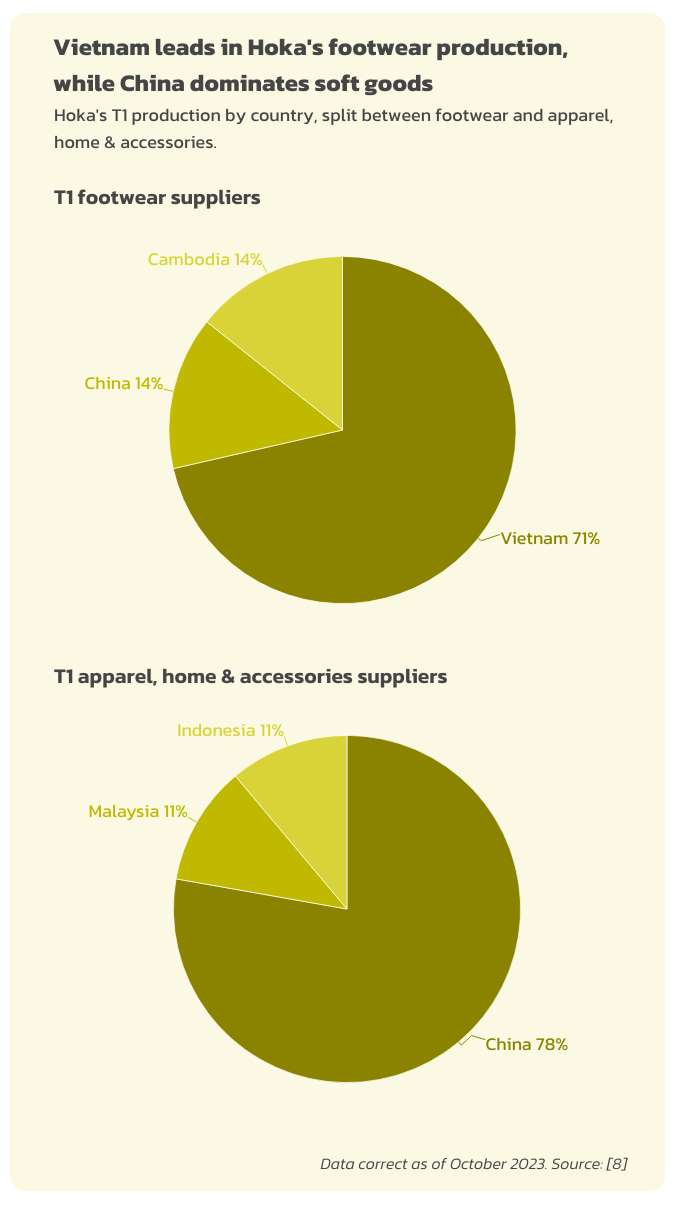
According to this dataset (correct as of October 2023), the group makes use of a total of 21 T1 suppliers for its footwear production, with the overwhelming majority serving UGG [8]. Hoka follows with a third of the listed suppliers catering to its products.
The regions making up this share are reflective of Deckers’ wider T1 supply chain, with only a shift in order: Vietnam leads with five suppliers while China and Cambodia each have a single manufacturer [8].
Vietnamese suppliers include the likes of Al-Nu Sporting Goods, Capital Concord Enterprises and Flourish Thrive Developments [8]. The listed Chinese supplier, Henan Prosper Skins & Leather, also caters for UGG, Teva and Deckers X-Lab – the group’s experimental performance line. Cambodia, meanwhile, is represented by Shoe Premier International, which also produces footwear for fellow sister brands UGG and Koolaburra.
Analysing apparel, home goods and accessories, Hoka is served by nine distinct suppliers: the majority are situated in China [8]. Otherwise, Prolexus Berhad and PT. Pancaprima Ekabrothers are the sole respective Malaysian and Indonesian suppliers, relevant to Hoka’s soft goods production – both exclusively producing for the brand from Decker’s wider portfolio.
Products
Hoka has built on its trail and road running heritage, expanding to complementary hiking, lifestyle and training segments across men’s and women’s categories, with some unisex product crossover. These categories offer footwear, apparel and accessories. The brand also has a dedicated children’s shoe line [9].
Examining its US DTC ecommerce site (correct as of March 2024), Hoka has a greater split of men’s footwear to women’s. This reverts for apparel & accessories, where there’s a greater proportion of relevant products for women. Despite differences in product volume, both categories share the same pricing range across genders: apparel and accessories span US$14-$298 and footwear US$60-$275.
Footwear analysis
The footwear category – Hoka’s core competency – is fractioned into 12 sports and function segments [9].
Lifestyle carries the widest range of products and product pricing – reflective of its wide appeal and use case – with 88 styles for men and 80 for women. Across both gender categories, the premium pricing reaches lower bounds of US$60 and a ceiling of US$250.
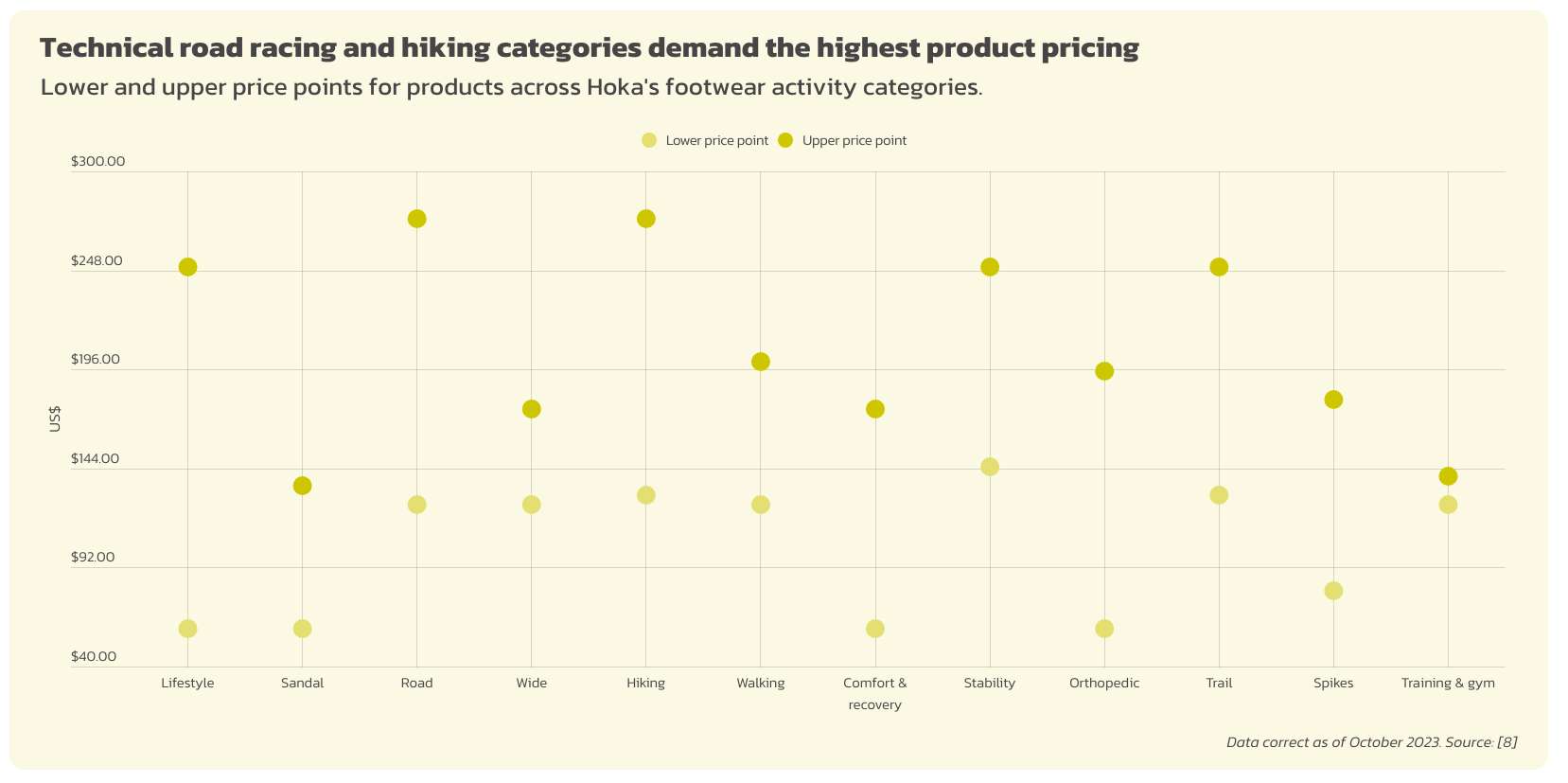
Aligning with the brand’s historic focus on road racing, the category has the largest pool of products relative to the other sporting focuses. Reflecting its technical orientation, the category also carries an elevated price range, starting at US$125 and resting at US$275.
The premium shoe for both men and women is the unisex Cielo X1, which features elements typical of a contemporary road running shoe, explored further in the Innovation section. Notably, hiking demonstrates a similar pricing trend, also offering a premium shoe at US$275.
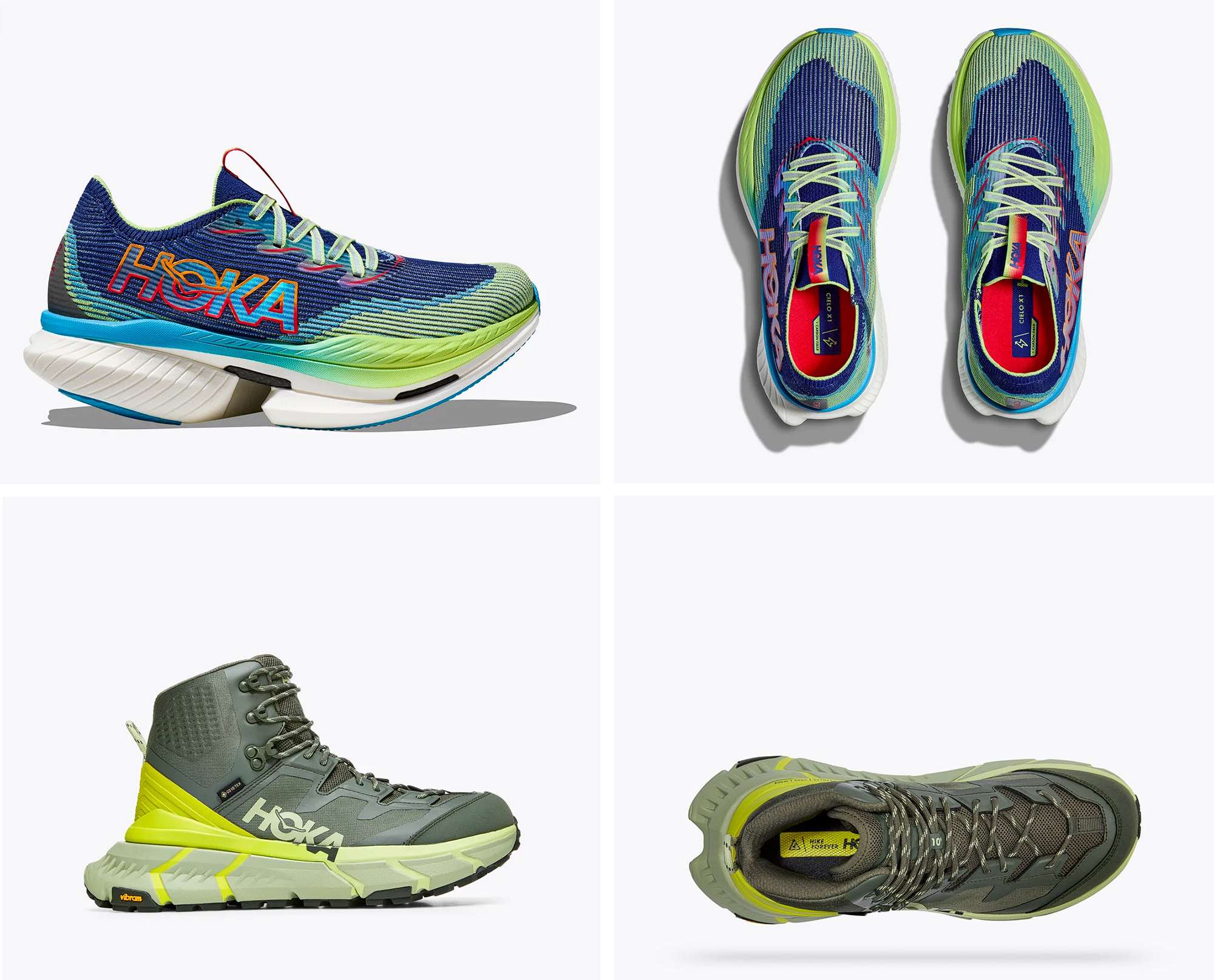
Both the Cielo X1 shoe (top) and TenNine Hike GTX boot (below) are currently the brand’s highest priced shoes, retailing at US$275.
Source: Hoka
The TenNine Hike GTX makes use of Vibram and Gore-Tex components to deliver on the environmental performance required of a hiking shoe, while still demonstrating typical Hoka design language. Namely, the presence of a pronounced midsole, which in this case, is intended to provide both cushioning and leverage in rocky, difficult terrain. This functionality is reportedly aided by the Hubble heel design – a proprietary design that sees the sole extend behind the foot.
Special requirements
In addition to the brand’s athletic and lifestyle categories, Hoka has several product categories dedicated to comfort requirements and wear preferences, such as wide and stability-orientated shoes.
Hoka has also pursued recognition from the American Podiatric Medical Association to illustrate its footwear’s orthopaedic benefits. Currently, the brand highlights 16 orthopaedic styles, including the popular performance models Bondi 8, Clifton 9 and Hoka’s recovery-centric ORA sandal.
In addition to showcasing relevant styles, the brand’s dedicated orthopaedic page includes testimonials from medical professionals to bolster credibility with consumers.
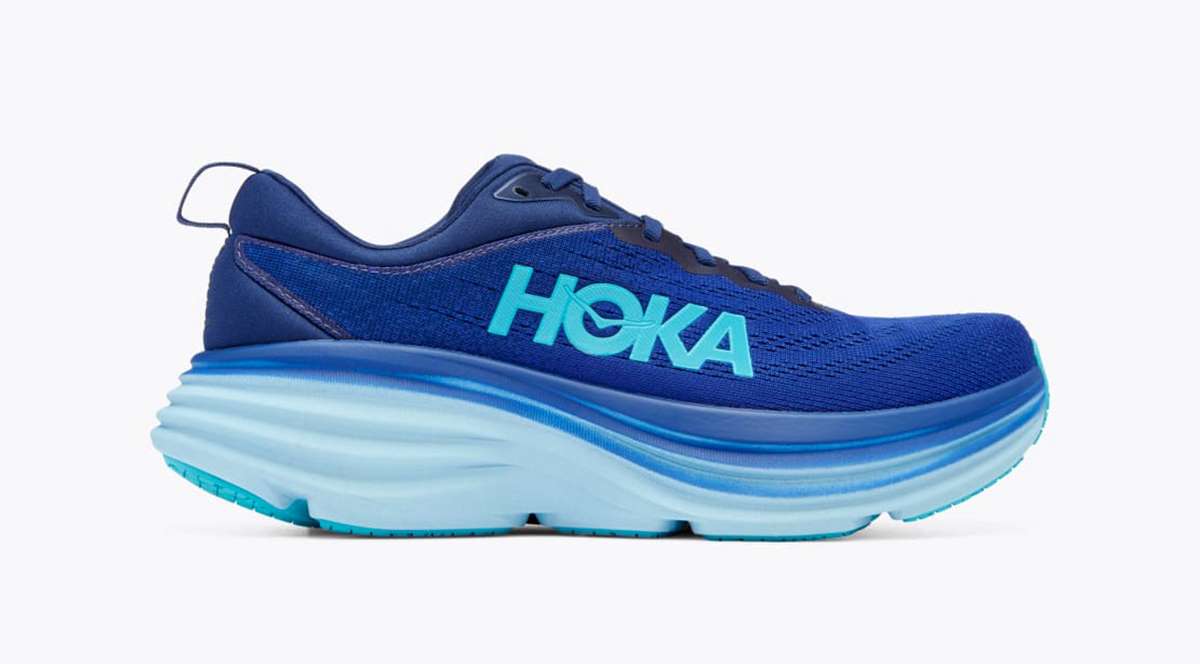
HOKA’s Bondi 8 shoes are marketed as orthopaedic styles.
Source: HOKA
Activity analysis
The brand highlights seven sports and lifestyle categories: everyday running, race, trail, cold weather running, hiking, walking, gym & training.
Products may appear across multiple activities, however, the vast majority cater to various running specialisms, with perhaps the broadest in application – everyday running – holding the widest portfolio of apparel and footwear.
Popular shoe models such as the Bondi 8, Clifton 9 and Graviota 5 assume a strong proportion of the category’s available products, supported by a number of layering clothing pieces. With “everyday” alluding to a generic use case, the segment displays one of the broadest price ranges of all the activity categories, starting at a US$14 sports sock to the US$295 Ultralight Waterproof Jacket, shown above [9].
Aside from a few select apparel items, such as the Ultralight Jacket, footwear dominates much of the upper end of the category’s pricing, reflective of Hoka’s prioritisation of technical performance footwear.
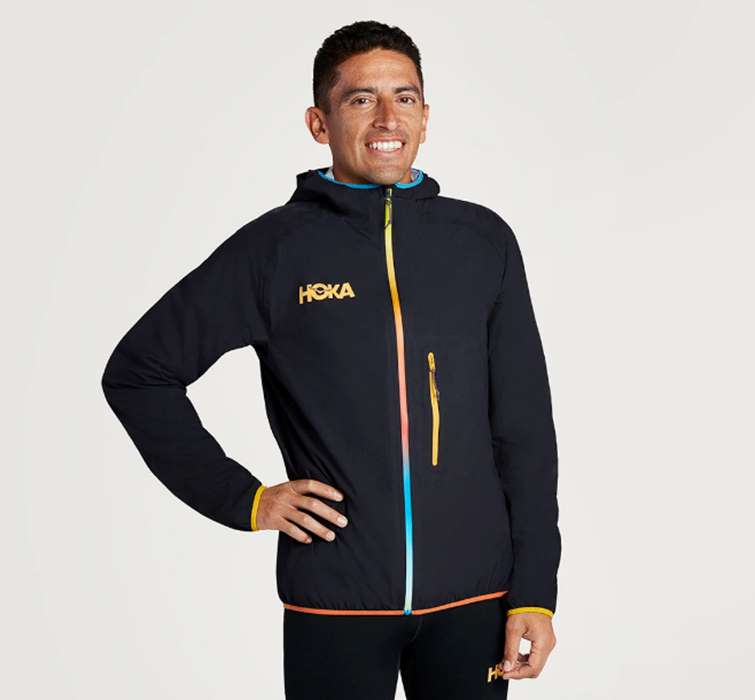
The Ultralight Waterproof Jacket, which retails for US$295.
Source: Hoka
Interestingly, the brand has also dedicated a product category to nursing and medical work, acknowledging Hoka’s growth with such professionals [9], [10]. Its focus on securing orthopaedic and podiatry validation may have assisted in appealing to this group.
Apparel mix
As well as the brand’s primary footwear focus, Hoka has built a portfolio of auxiliary, complementary apparel & accessories.
Again, products may appear multiple across multiple categories. However, on the surface, the women’s category appears to have a larger count of styles, aided by dedicated, gender-specific products and categories – such as sports bras.
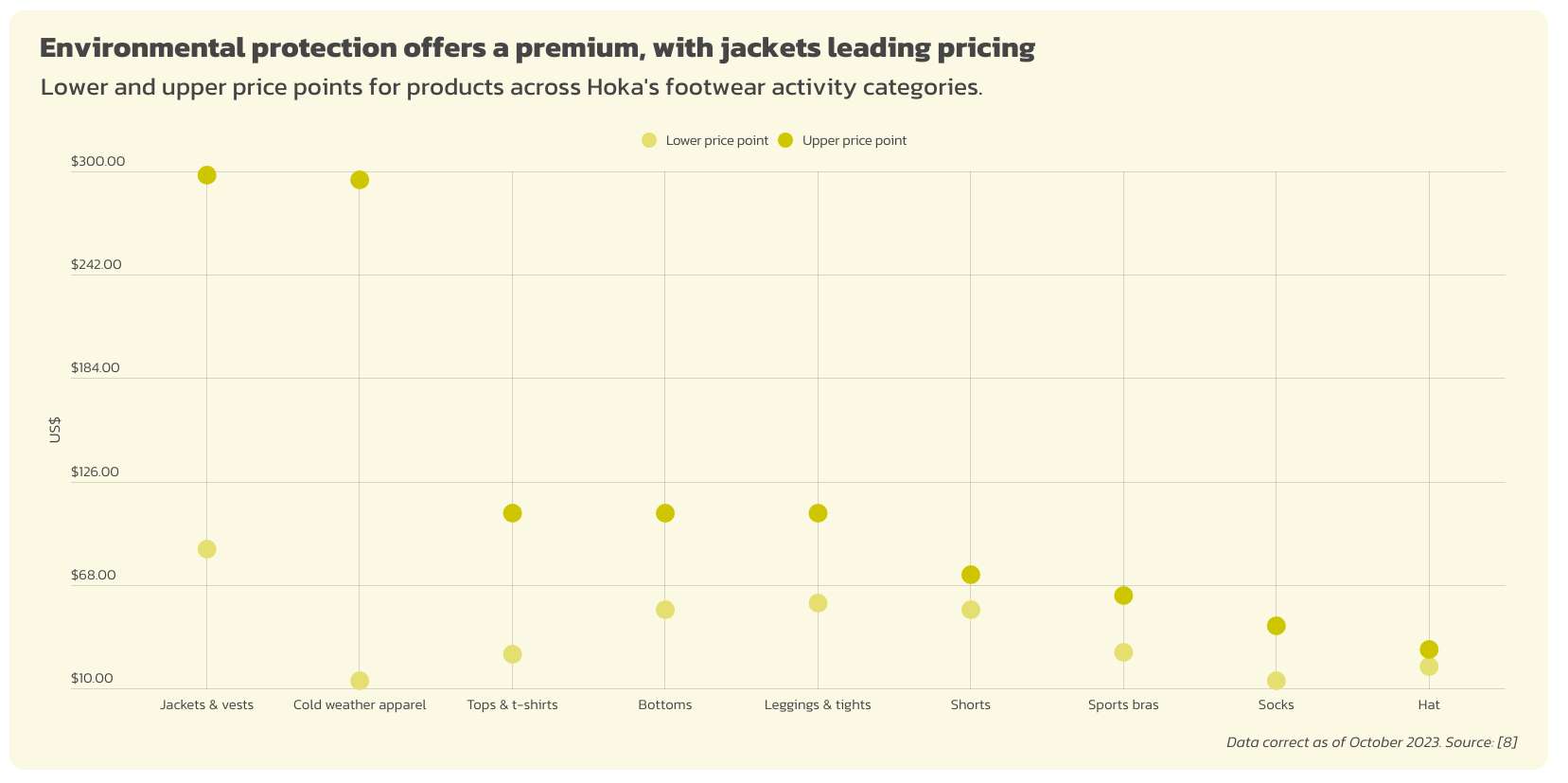
Reflecting their technical traits and more advanced constructions, jackets and cold weather apparel have the greatest pricing range and ceiling.
Innovation
Having developed a number of hero shoes, such as the Clifton and Bondi styles, there’s a clear push from Hoka to incrementally improve its key ranges. This includes updates to fit, technology and shape, as well as seasonal colourway changes and aesthetic refreshes. However, fresh shoots of innovation are also apparent, with focuses on performance and sustainability.
Cielo X1
The Cielo X1 is one such example, with Hoka this year (2024) adding the so-called super shoe to its road racing range [11]. Priced at US$275, it looks to compete with the most premium styles on the market, offering the same quintessential technical features expected by performance-centric consumers.
This includes a winged (both on the carbon plate lateral and medial sides) – said to be an upgrade on the brand’s previous plate technology – situated between two layers of PEBA midsole. The latter follows Hoka’s PROFLYX midsole construction, with the combination of design and materials intended to deliver a responsive and propulsive ride feel [11].
Hoka has also deployed its signature MetaRocker sole profile in the Cielo X1, furthering the pursuit of a smoother, quicker stride transition, with a 7mm heel-to-toe drop [11], [12]. In a bid to reduce weight, both the midsole and outsole have been strategically pared back, and there’s an absence of non-essential areas.
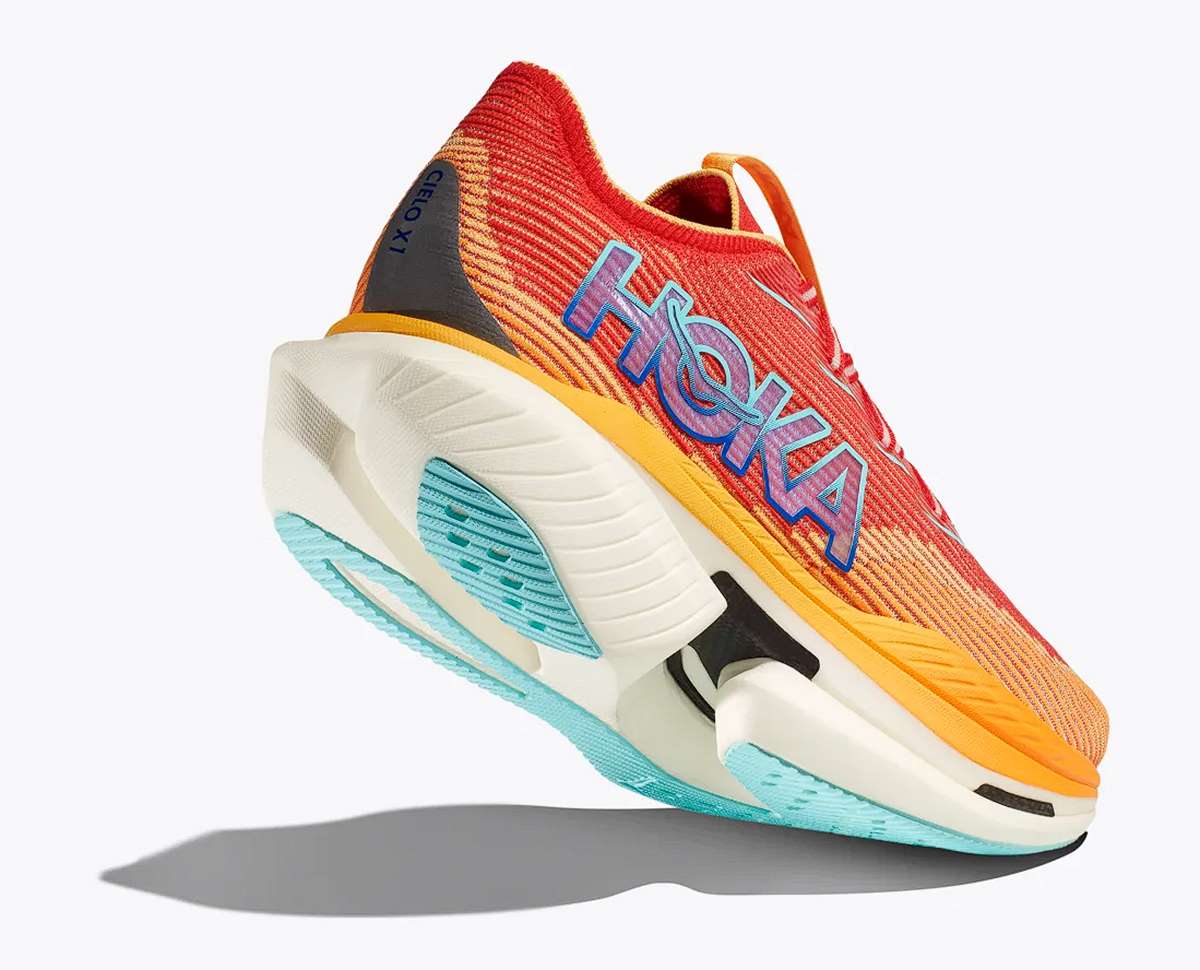
The Cielo X1 shoe features several weight-saving cutouts in its sole mid- and outsole. Source: HOKA
Hoka TC
As part of its “Yes to Less” campaign efforts, Hoka introduced the TC 1.0 – a lifestyle shoe intended to headline the brand’s efforts towards more sustainable product design. This includes a particular focus on material selection, most notably with the sole package: the TC 1.0 makes use of a 30% sugarcane-based EVA insole and a Vibram Ecostep Natural outsole [6], [12]. The latter claims to contain up to 90% oil-free ingredients and is coloured with 100% natural pigments. Alternatively, the upper comprises 100% recycled polyester, but the origin of the recycled content is not specified.
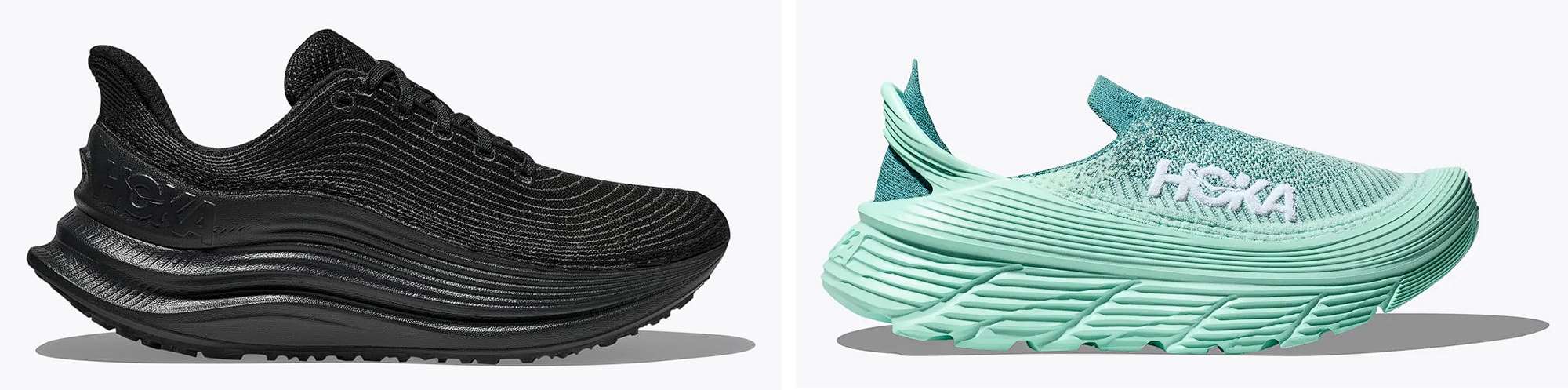
(Left) The TC 1.0 shoe. (Right) Restore TC. Source: HOKA
A slip-on style, the Restore TC, followed the trainer. It is marketed as a comfort and recovery shoe, adopting a high stack, plush sole.
The shoe also marks an evolution in the TC’s sustainability efforts. The Restore features an outer jacquard knit and inner textile comprising 73% and 83% dope-dyed polyester, respectively – a colouration approach offering water-savings on conventional dyeing procedures [13].
Within its construction, the Restore also makes use of a 100% recycled Strobel board, as well as adopting the same 30% sugarcane-based insole material as the TC 1.0. However, unlike the original, which made use of a Vibram compound sole, the shoe utilises a 20% sugarcane-based EVA outsole [12], [13].
Lifestyle & gorpcore appeal
Additionally, Hoka – like peers Salomon, Asics and Saucony – has managed to gain a streetwear influence, its maximalist appeal attracting more casual consumers.
This has been somewhat aided by the brand’s collaboration strategy, which has ranged from large luxury brands to select designers. Recently, these span the likes of Moncler, retailer END, streetwear label Hidden Characters and independent designers Nicole McLaughlin and Jean-Luc Ambridge.
The TC range has been no exception. In early 2024, a distinct TC 1.0 shoe with BLACK Comme des Garçons was revealed following Paris Fashion Week, with release anticipated for late in the year [14]. The shoe appears to have few changes to the original – the greatest discrepancy being the addition of several gold loops.
While largely a lifestyle offering, as with other performance-first brands, Hoka has largely leaned in on its technical credentials through its partner collaborations, leveraging the rise of gorpcore.
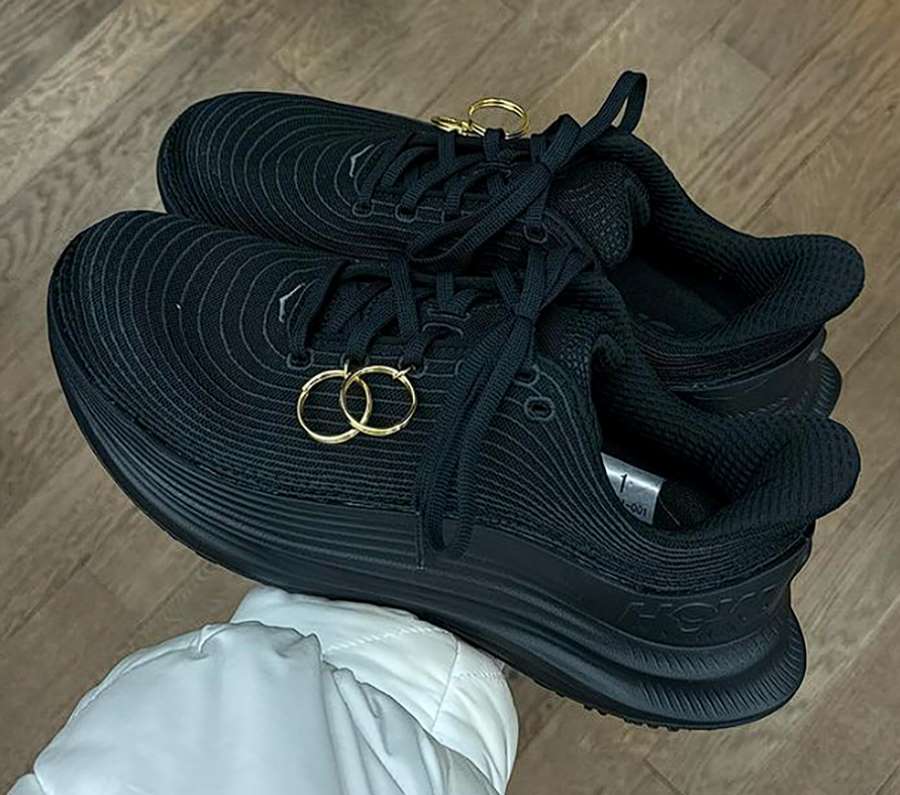
The revealed TC 1.0 Hoka x BLACK Comme des Garçons. Source: trobrillants (Instagram)
For instance, END Clothing’s collaboration centred on the Mafate Speed 2 and Kaha Low shoes, preserving many of the technical qualities found in their conventional models.
For the Mafate Speed 2, this includes Hoka’s no-sew SpeedFrame construction and a MetaRocker sole profile while the Kaha Low maintains its protective Gore-Tex bootie [15], [16].
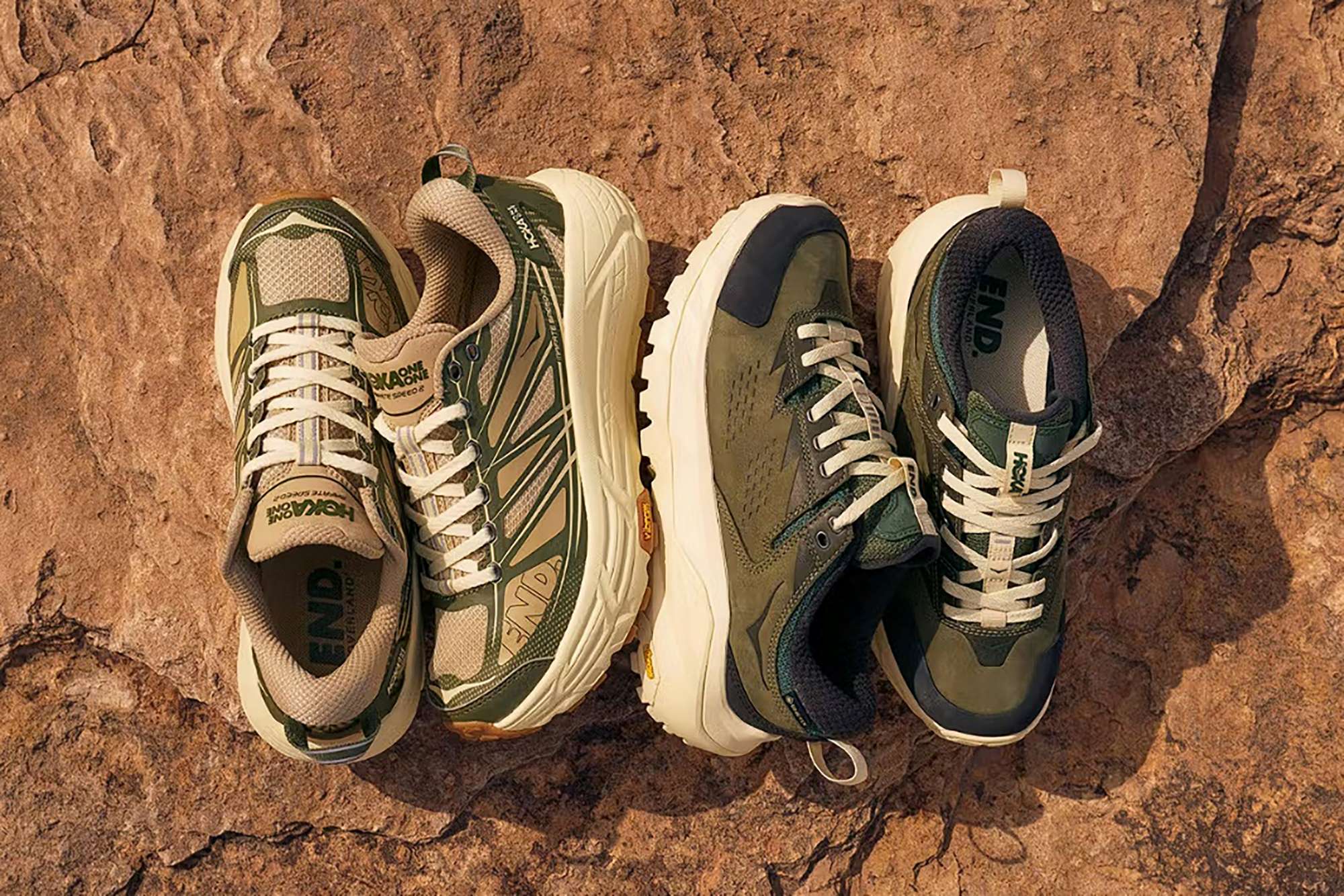
HOKA’s collaboration with British retailer, END, centres on the Mafate Speed 2. Source: HOKA, END
Both also feature the use of Vibram’s Megagrip outsole, engineered specifically for enhanced grip, tying into the styles’ original activity purpose, despite the streetwear orientation.
Environmental, social and governance (ESG) strategy
In its FY23 Creating Change corporate and sustainability report (covering the period 1 April 2022 – 31 March 2023), Deckers Brands illustrated its 2023 ESG priorities in respect to business and stakeholder importance [7]. These reflect across the group’s portfolio of brands, including Hoka.
Among its top concerns were business ethics & compliance; human rights and forced labour; anti-corruption and ethical supply chains [7]. Alternatively, specific lower priority concerns include marketing and labelling; biodiversity, deforestation and land use; conflict materials and the circular economy.
Regardless of rank, the group’s identified priorities reflect in its listed sustainable development goals (SDG), which in turn look to comply with those of set out by the United Nations. The table below demonstrates each of these SDGs and which UN counterpart they relate to [7]:
| Focus | Deckers SDG | Relevant UN SDG |
| Materials | Maximise the amount of preferred materials in Deckers Brand products. |
12 – Responsible consumption and production |
| Waste | Sustainably reduce waste generated at owned and partner facilities, primarily through refuse, reduce, recycle and reuse strategies. | 7 – Affordable and clean energy 12 – Responsible consumption and production 13 – Climate action |
| Water | Reduce water consumption and improve quality throughout the group’s operations and the communities it operates within. | 6 – Clean water and sanitation |
| Climate and clean energy | Reduce energy consumption and carbon emissions throughout Deckers Brands operations. | 7 – Affordable and clean energy 12 – Responsible consumption and production 13 – Climate action |
| Chemistry and consumer safety | Reduce or eliminate hazardous chemicals throughout Deckers Brands operations. | 3 – Good health and wellbeing 6 – Clean water and sanitation |
| Human rights | Positively impact the communities in which the group operates, including assuring “industry-leading” human rights practices within its supply chain. | 3 – Good health and wellbeing 4 – Quality education 5 – Gender equality 10 – Reduced inequalities |
| Gender equality, quality education and reduced inequalities | Promote diversity, gender equality, female empowerment and inclusion for all. | 4 – Quality education 5 – Gender equality 10 – Reduced inequalities |
The report also highlights progression across several areas relative to these goals. Concerning FY2023, Deckers reports the below progression in regard to its environmental sustainability targets [7]:
- A 50% greenhouse gas (GHG) reduction in absolute scope 1 and 2 emissions compared with its FY19 baseline.
- An approximate 15% reduction in GHG emissions’ physical intensity (kg of CO2 / pair of footwear), compared with FY22.
- An about 9.5% reduction in energy usage of around 9.5% per pair of footwear (MJ / pair), compared against with FY22.
- A near 14% reduction in water usage per footwear pair (litres of water / pair), compared with FY22 figures.
As well as setting group-wide targets, each brand within the portfolio carries specific operational targets. These centre around materials, climate and clean energy, water usage and waste. For the purpose of this analysis, we’ll be looking exclusively at materials targets.
Materials
All materials used across the entire Deckers Brands’ portfolio are split between fibre and non-fibre classifications [7]. The vast majority are the latter in respect of footwear product, coming in at approximately 76% of the segment’s total.
As may be expected, for apparel, accessories and home goods, these figures reverse – here, almost 97% of materials are fibres [7]. And further, UGG accounts for the majority usage of these materials, at 94% of the total footprint. Hoka meanwhile – the only other brand with soft goods lines in the portfolio – utilises shy of 6%, indicating a far smaller emphasis on respective apparel and accessory products.
Returning to footwear – Hoka’s primary focus – the make-up of fibre materials demonstrates a prominence towards polyester, with virgin content accounting for 36% and recycled polyester or rPET 28% [7]. Non-fibres are instead dominated by a key midsole ingredient – ethylene vinyl acetate (23%) – followed by various upper and component materials utilised more regularly by the likes of UGG and Teva – cow leather & suede and sheepskin, coming in at 14% and 7% respectively. Smaller allocations of other key footwear compounds such as polyolefin elastomers (POE), polyurethane (PU) and thermoplastic polyurethane (TPU) make up a notable portion of the remaining materials share.
Preferred materials
Many of Deckers’ materials-centric targets revolve around pivoting these ingredients to a preferred variant, such as selecting recycled polyester over its virgin counterpart – akin to the preferred materials advocated by the Textile Exchange (TE).
To validate the transition to preferred materials, Deckers has secured various certifications and standards for said materials, such as the TE’s Responsible Down Standard, Recycled Claim Standard (RCS) and Responsible Wool Standard (RWS) [7].
The table below indicates how the preferred label is determined across various material categories [7]:
| Category | Preferred equivalent | Examples |
| Synthetics | Recycled or biobased variations. |
|
| Manmade cellulosic fibres (MMCF) | Water or chemical-saving products and those compliant with Forest Stewardship Council standards – either virgin or recycled. |
Deckers indicates that Lenzing products are compliant, listing:
|
| Natural plant-based fibres | Virgin cotton sourced from farms utilising sustainable crop growing practices, recycled content or less intensive natural fibres. |
|
| Animal (wool and down) | Recycled variations or certified virgin content. |
|
Deckers’ brands’ materials goals progression
As of FY23 reporting, 36% of footwear materials fall under the group’s definition of preferred. Its target is for said materials to hold a 55% share of all footwear materials (both fibre and non-fibre) by 2027 [7]. With Hoka assuming close to 36% of the portfolio’s fibre and a third of its non-fibre footwear materials by weight (FY23 figures) – succeeded only by UGG – the brand has great sway in the success or failure of these goals.
Below, FY23 progression is marked against the set target for a number of the group’s footwear-centric materials goals [7]. A more comprehensive listing of targets can be found in the Creating Change report.
| Ambition | Target year | Progress as of FY 2023 | Required average annual progression to meet target (Target-current/years to target) |
| 60% of all fibres used in footwear will be made from preferred materials. | 2027 |
54.63% |
1.34% |
|
50% of all non-fibres used in footwear will be made from preferred materials. |
2027 |
30.49% |
4.88% |
| 100% of all plant and plant-based fibres used in footwear will be made with preferred materials. | 2030 |
80.52% |
6.49% |
| 100% of all MMCFs used in footwear to (1) originate from sources that legally harvest, source, transport, and export timber and (2) meet Decker’s preferred manufacturing standards for MMCFs | 2026 |
97.54% |
1.24% |
| 65% of all co-polyester fibres and films in footwear to originate from post-consumer, post-industrial or renewable resources. | 2030 | 43.81% | 3.53% |
| 20-25% of bottom units utilise biobased compounds, plant-based and/or recycled materials.* | 2030 | 10.45% | 1.59% (to lower target) |
| 25-30% of all EVA used in bottom units will feature recycled materials and/or biobased compounds.* | 2030 | 12.11% | 2.15% (to lower target) |
| 15-20% of all materials used outside of EVA in bottom units will feature biobased compounds, plant-based, and/or recycled materials.* | 2030 | 9.15% | 0.975% (to lower target) |
| 25% of our footwear materials that have the ability to use more preferred finishing methods will do so.** | 2027 | 19.83% | 1.72% |
* Deckers’ usage of “bottom units” involves midsoles, outsoles, insoles, topsoles, sockliners, die cut/cut and buff, arch cookies, wedges, moulded heels, foam and moulded uppers, moulded rubber, rubber sheets and performance plates – exclusive of auxiliaries.
** This is inclusive of pigment dyeing methods, bleach-only methods and undyed materials, such as greige.
-
References
[1] HOKA, ‘About Us: Who We Are’, HOKA.com. Available from: https://www.hoka.com/en/gb/meet-hoka.html [Accessed: 6 March 2024.]
[2] HOKA TV, HOKA | The Rundown (2018). Available from: https://www.youtube.com/watch?v=RudON4Pq-3c
[3] Stebbings, H. and The Twenty Minute CV (20VC), ‘20VC: From a $1.1m Acquisition to $1.4bnBN in Revenues; The Meteoric Rise of Hoka Running with Deckers CEO, Dave Powers’, The Twenty Minute CV (20VC). Available from: https://www.thetwentyminutevc.com/dave-powers/ [Accessed: 6 March 2024.]
[4] Deckers Brands, ‘Deckers Brands Reports Third Quarter Fiscal 2024 Financial Results’. Available from: https://ir.deckers.com/news-events/press-releases/press-release/2024/DECKERS-BRANDS-REPORTS-THIRD-QUARTER-FISCAL-2024-FINANCIAL-RESULTS/default.aspx [Accessed: 6 March 2024.]
[5] Deckers Brands, ‘Deckers Brands Report Fourth Quarter and Full Fiscal Year 2023 Financial Results’, Deckers Brands. Available from: https://ir.deckers.com/news-events/press-releases/press-release/2023/DECKERS-BRANDS-REPORTS-FOURTH-QUARTER-AND-FULL-FISCAL-YEAR-2023-FINANCIAL-RESULTS/default.aspx [Accessed: 6 March 2024.]
[6] Deckers Brands, ‘Deckers Brands: 2023 Annual Report’, Deckers Brands: 2023 Annual Report. Available from: https://s25.q4cdn.com/376120126/files/doc_financials/2023/ar/2023_annual_report.pdf [Accessed: 6 March 2024.]
[7] Deckers Brands, ‘Creating Change: FY 2023 Corporate Responsibility and Sustainability Report’. (2023) Available from: https://deckers.com/sites/default/files/pdf/Deckers%20FY23%20Creating%20Change%20Report.pdf [Accessed: 7 March 2024.]
[8] Deckers Brands, ‘Manufacturing Geographic Locations (All)’. Available from: https://www.deckers.com/sites/default/files/pdf/Global%20Manufacturing%20Locations.pdf [Accessed: 11 March 2024.]
[9] HOKA, ‘HOKA.com’. Available from: https://www.hoka.com/en/us/ [Accessed: 12 March 2024.]
[10] Harmanci,R. ‘How Did Hokas Become So Popular?’, The New York Times. Available from: https://www.nytimes.com/2023/04/05/style/hokas-fashion.html [Accessed: 18 March 2024.]
[11] HOKA, ‘HOKA Announces Launch of the Cielo X1: A Pinnacle Expression of Pure Race Speed’, PR Newswire. Available from: https://www.prnewswire.com/news-releases/hoka-announces-launch-of-the-cielo-x1-a-pinnacle-expression-of-pure-race-speed-302050483.html [Accessed: 8 April 2024.]
[12] HOKA, ‘Cielo X1’, HOKA.com. Available from: https://www.hoka.com/en/us/race-shoes/cielo-x1/1147910.html?dwvar_1147910_color=CSSL [Accessed: 8 April 2024.]
[13] HOKA, ‘Restore TC’. Available from: https://www.hoka.com/en/us/recovery-comfort-shoes/restore-tc/1134532.html [Accessed: 9 April 2024.]
[14] Smith, M. ‘COMME DES GARÇONS’ HOKA SNEAKER COLLAB IS EXTRA NORMAL’, Highsnobiety. Available from: https://www.highsnobiety.com/p/comme-des-garcons-hoka-tc-1-0/ [Accessed: 9 April 2024.]
[15] HOKA, ‘HOKA x END. Mafate Speed 2’. Available from: https://www.hoka.com/en/gb/lifestyle/hoka-x-end.-mafate-speed-2/1155750.html [Accessed: 9 April 2024.]
[16] HOKA, ‘HOKA x END. Kaha Low GORE-TEX’. Available from: https://www.hoka.com/en/gb/lifestyle/hoka-x-end.-kaha-low-gore-tex/1155730.html [Accessed: 9 April 2024.]