


The Textile Innovation Podcast speaks with Dan English, CEO at sporting goods manufacturer VOORMI.
Voormi is merging advanced textile innovation with new technology to create sustainable, high-performance apparel. In this episode English delves into the company’s Mij™ innovation, a wearable technology that tracks thermal stress in real-time.
Mij has been designed to help individuals better manage their body temperature for optimised health. Using advanced senor-based textile technology Mij is integrated into everyday garments to monitor body temperature and humidity continuously, giving users real-time insights into their personal ‘thermal performance’.
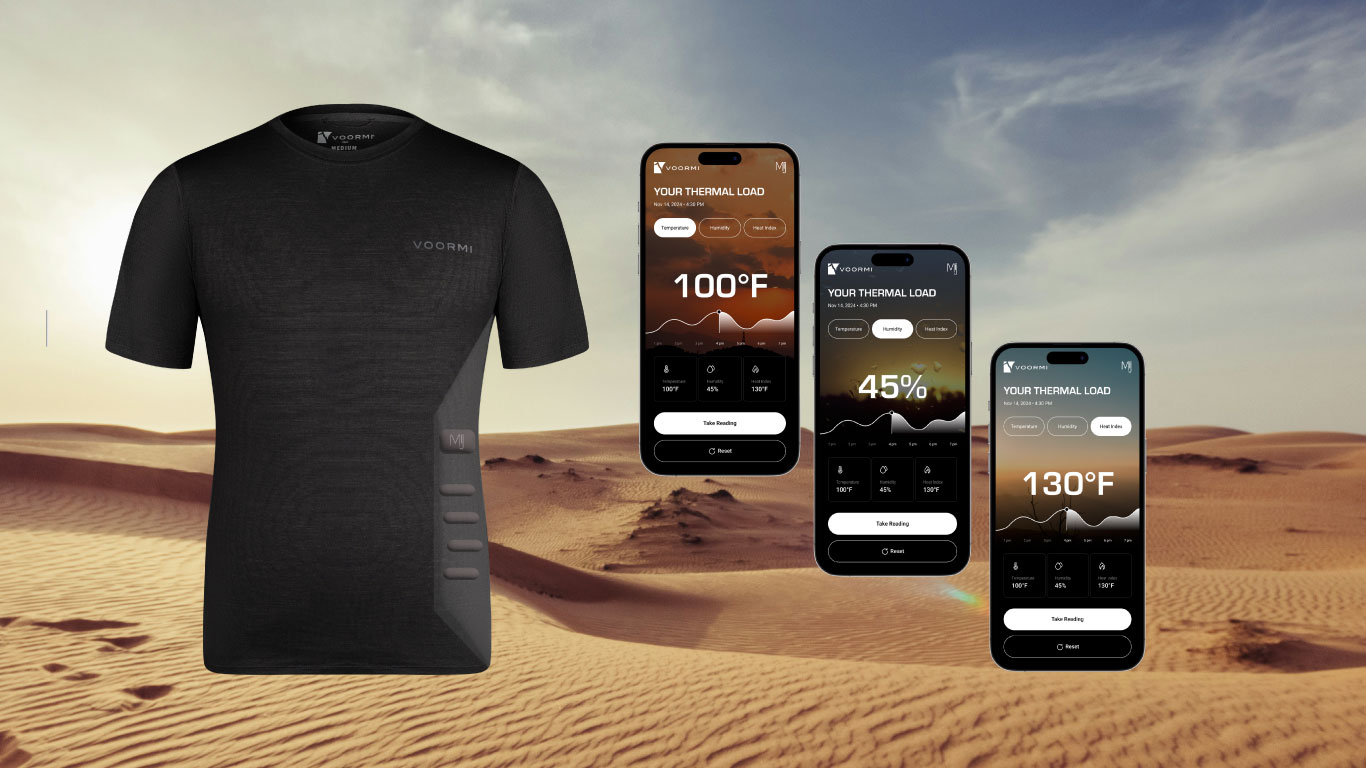
VOOMI's Mij innovation is a wearable technology that tracks thermal stress in real-time. Image - VOORMI
English explains how Voormi is committed to solving problems, pushing boundaries, and empowering its customers with apparel that can adapt to the world and environment.
Delving performance and sustainability, he also touches upon smart textiles and the challenges and opportunities when it comes to developing and implementing sustainable technologies. To learn more please visit voormi.com.
You can listen to the episode above, or via Spotify and Apple Podcasts. To discuss any of our topics, get in touch by following and connecting with WTiN in LinkedIn, or email aturner@wtin.com directly. To explore sponsorship opportunities, please email sales@wtin.com.
Have your say. Join the conversation and follow us on LinkedIn
-
Transcript
This transcription has been AI generated and therefore may have some inaccuracies.
Ep. 124: Sustainable wearable technology advances
The Textile Innovation Podcast speaks with Dan English, CEO at sporting goods manufacturer VOORMI.
WTiN: Hello and welcome to Textile Innovation, hosted by WTiN. My name is Abi and I'm the Features Editor and your podcast host. Each month we will be joined by a special guest. So join me and my colleagues as we deep dive into what's new, what's interesting, and what unmissable innovations have hit the market recently. We cover everything on the podcast, from sustainability to startups and the latest research and development. Plus, we quiz the experts in the field about their products and ideas across the huge spectrum that is the textile industry. So no matter what your interest is, WTiN have you covered and we can connect you to everything you need to know right here from our central hub in the UK.
In this episode, I am joined by Dan English, CEO at sporting goods manufacturer Voormi. Based in the US, Dan has a background in technology. Voormi was created to merge advanced textile innovation with cutting-edge technology to create sustainable high-performance apparel. In particular we discuss Voormi's Mij technology which tracks how your body generates stores and releases heat in real time to help you regulate your temperature. We also touch upon some of the challenges and opportunities in the textile industry when it comes to developing and implementing sustainable technology.
Hi Dan, thank you for joining me on WTiN's textile innovation podcast. Please could you tell me about your background and what led you to founding Voormi?
English: Hi, certainly. My name is Dan English. I have been associated with the technology industry since I was 20 years old and I started my career in the computer industry and have spent almost 28 straight years in that industry and then took a six year break into a consumer branded industry that I really focused on apparel. And that is when kind of the light bulb went off in my head as far as, it was like, wow, the world that I grew up in since I was 20 years old was full of innovation and rapid pace. And you know what Moore's law was alive and well, where you obsoleted what you did yesterday and the process, everything doubled in in animate automation and processing speed, et cetera, et cetera. But the world of textiles and apparel was old and slow. And people define innovation as the next colour of blue. And then big brands really relied on textile mills and all around the world to really drive innovation. But innovation was really only driven from a level of price points for the most part. And I look at the world of textiles and apparel and think, my gosh, it's probably the only thing in our lives that hasn't changed. I mean, how we communicate together, transportation, healthcare, everything around us has changed except for the clothes and the textiles that we do, you know. And so the technology background really was the driving force of, you know, how do we do things different in the world of textiles and apparel.
WTiN: That's crazy when you say it like that, that it's only textiles and apparel that haven't changed. When you put it into that perspective, wow. So please could you tell me more about Voormi? What does the company offer the textile and apparel industry in terms of innovation?
English: Yes, certainly. Voormi, we were founded with the whole genesis of doing something different. We challenged the normal process, supply chains were challenged, fibers were challenged, functionality of clothing, the expectations out of clothing, the durability, all aspects of it. And so we created Voormi as a way to showcase what an engineer in a different perspective could look like. And so from the very beginning, we were really focused on driving a level of innovation. We did not chase price points. We did not drive cheap products, if you will. We did not even look at fast fashion you know we challenge every aspect of the process and so for me was our way to do something new and unique and interesting and showcase it all the naysayers out there. People said, you can't do this, you can't do that. And then with the expectations that we can actually do something interesting and then license the technology to market leaders down the road.
WTiN: It's really interesting, thank you. And could you comment on what the ideal innovation ecosystem looks like to you and further explain how you have set Voormi up in this way?
English: Yeah I think you know I think it's a great question because one of the key differences I see in the apparel and textile industry is exactly what you just asked is is why is the innovation completely different from the tech industry and other really advanced industries compared to the apparel or textile industries? The tech industry looks for breakthrough technologies. They either fund it, they maybe put it off to the side and feed it and feed it and feed it, to make sure they overcome the obstacles. They're not really worried about bringing things to market rapidly, or disrupting the so-called mothership, the big brand. They feed and incubate technology rapidly within their house. They don't outsource that level of innovation. The apparel and textile industry, they don't do that. You know, they have a few people that's really focused on maybe how do I build a better fiber cheaper? But at the end of the day, they rely on a third party to develop their, you know, potential solutions to maybe bring it to market. And so the level of innovation and sophistication doesn't exist anymore in the big apparel brands. They just don't. And I know we know most of them and and some of them have little departments, but for the most part, they're focused on, you know, what they see today. And in the tech industry, they bring people in, you know, that have a different perspective. The apparel and textile industry only hire people, for the most part, from that industry. So you only know what you know. Great people, but they only know what they know.
And where the tech industry, they hire a variety of diversity from a thought diversity point of view in order to, you know, to bring unique solutions to the market. So I see that as completely different as we set up Vormi, we set up with that type of approach. I brought in people that really didn't know anything about textiles. I myself really didn't know much about textiles. And then we brought in people that knew a lot about textiles. And we brought in people that are electrical engineers, chemical engineers, and also very technical people with software. And we think that has allowed us to really take a completely different approach. And that's how we've set it up. We really modelled it after the tech industry.
WTiN: It's really interesting about cross-collaboration and bringing in people from different areas and how that can add value to the textile supply chain. And just kind of leading off of that, how do you define the human textile interface? And just kind of thinking about what you've said previously, what do you believe is at stake if we don't evolve the way we think about apparel and textiles?
English: Yeah, I think, you know, when we look at the textile and human interface, I really think about this, today's quest for better health and wellness, and where we see this emerging technology of the rings and the bands and the smartwatches that are monitoring various biometric data. And I think about that, as best way to describe it is, how do you de-medicalize the medical world? And I think the accessory business, the rings and the bands and watches, have done a great job with bringing something, accessory that you can wear to begin to measure your sleep and heart rate and all kinds of interesting things, right? And then each of us can adapt and evolve that data, and help utilize that information. We think that is just the very beginning of awareness. What those accessory pieces cannot do is they cannot drive change. They can record data, they can collect data. It's kind of like driving in your car, looking in the rear view mirror while you're driving. That's what these accessory businesses are. They collect data, it's about yesterday. We think that data is critical. Biometric data is super critical for a variety of things which we can talk about. But that biometric data should drive change. It should drive immediate change and you know based on what you need is from a personalisation point of view. So we think collecting biometric data and then driving that to a better health and wellness in a very dynamic state is the future of what we call the textile human interface because now we can. We should be able to change the characteristics of my clothing. I should. Frankly, I should never experience cold or hot again. I should not when I go on a big business trip. I shouldn't have to, or a vacation, I shouldn't have to take a big, a luggage, a large duffel bag of clothing for just in case. I don't know if it's going to be hot, cold, windy, rainy, or whatever the case may be. I shouldn't have to do that. Or I shouldn't have to change, you know, bring five color of T-shirts. You know, my shirts should change color based on my personal desire if it's during the day or if it's in the evening or whatever it should be much more dynamic for us.
I think about our homes we walk into our houses a lot of people have so-called smart homes the thermostats are set exactly the way you like it you know and it's it's dialed up and ramped up for your comfort when you arrive and when you depart it reduces the heat mattresses you know you can have different numbers of your do you like a firm mattress or a soft mattress and so you think about the world around us i mean each of us have a phone and within two minutes of receiving the phone we all customize that interface with that phone, right? So we do that in our lives, except for clothing and apparel. And what do we do? We buy more, we just buy more, you know? And so we think it's critical that the human and textiles and apparel begins to interface in such a dynamic way that brings huge value to each of us from a personalization point of view.
WTiN: I absolutely love that. If we could like have clothes like that, you said like reducing luggage and everything, that would just like the ideal. Going forward could you tell me more about Voormi’s Mij technology and how that works?
English: You bet. So, Me, we pronounce it Mij, M-I-J, is an application that we have created of a way to communicate with your clothing, with your shirt. And so we have flexible hybrid electronics inside your clothing. So I have one here, I know you can't see it, but it's a piece of soft electronics, sensors and antenna on a piece of substrate film. And that is embedded without glue seamlessly inside a thin t-shirt or you know heavier weight shirt and it measures a variety of things and we're today we're measuring stress thermal stress specifically so that's your temperature between your skin uh and the shirt that that buffer of air, right, against your skin, and also the humidity. And then, and what that does is it allows us to predict thermal stress.
We've all experienced being hot or cold. That's the ultimate representation of thermal stress. But thermal stress, in addition to having death capability, it can have cognitive ability, it can have other kind of body functions that are negative. And so what we're trying to do is provide a level of predictability to keep you out of thermal stress. So I think about the best way to think about this is occupational safety. How do you keep workers safe? So if you're working in a heated environment, an oil well, or if you're a soccer or football player, and or some, you know, highly aerobic activity, hockey, whatever the case may be, how do you maintain the ultimate performance, right? And by doing that, you have to maintain and regulate your heat and that heat stress. And so we have the ability to communicate with our phone, with our shirt, and begin to measure that, right? And then what we'll do in the future with our shirt and begin to measure that, right? And then what we'll do in the future is base that, that information is processed with using two different computing techniques. One is called the edge computing, which is real time computing. And the other one is artificial intelligence, which is a learned approach over time. So each of us, you know, our clothing, our phones learn about what we like and will help maintain that. And so me is a Dutch word, really for me, for me in Dutch means for me. And so we believe the future of clothing is truly a personalized experience where, you know, my clothing becomes comfortable for me. It's whether it's it keeps me at the right temperature. It's the right fit. It's the right color. It's etc. Etc. So we believe that Voormi and our Mij application is a gateway to true personalisation of clothing.
WTiN: I absolutely love that. I feel like we need that for our office sometimes. And what opportunities, obviously I could probably answer this myself, it's vast, but what opportunities does this offer the fashion industry and how does Mij build upon Voormi's existing offering?
English: Yeah I think if I look at the industry, the apparel industry as a whole, you know there's over a hundred billion garments made every year and it was like why do we need that? You know we each have a closet full of clothing that you know we really don't need. And I contrast that with the wearable device market. Last year there was over a billion wearable devices sold around the world. A billion. Well there was a hundred billion garments sold last year. And I think about what drives the most value, you know, my accessory business that measures my sleep, my other biometric information, which is critical. It helps me give a good insight to my health and wellness, what I'm trying to achieve. And the clothing industry provides either some level of privacy or some level of protection against the elements. That's it. All right. And so the opportunity is to seamlessly merge and integrate the ability to bring biometric information inside clothing, but then more importantly, begin to change that clothing based on your biometric data, right? And so we think the future is fantastically awesome. I mean, it's really interesting as I think about the next decade in apparel. I think it's going to be exciting. I do think some of the brands, most of the brands that we know today around the world may not be relevant a decade from now, even the great big ones. Because if I look at each industrial revolution over the years, typically the leader in one industrial revolution doesn't carry forward to the next one because they can't obsolete existing revenue vectors, right? And so typically it's an outsider that comes in. And I think about today, you know, we're in the fourth Industrial Revolution and you think about all the things that's driving that fourth Industrial Revolution with AI and IoT and big data and various advanced materials and biotechnologies and the whole combination of digital and physical convergence. Ah man, and we can all name dozens and dozens and dozens of companies that drive that as a representation, but yet I challenge anyone to name me one apparel company that represents any of the key attributes in the fourth industrial revolution. And so we think that, you know, really driving this advancement in apparel and overall textile technology. So I mean, I know we're talking about apparel and overall textile technology. So I mean, I know we're talking about apparel today, but I think about the world of textiles and you look around your office and your home and you think about all the things that are really textile driven. You know, your window coverings, your car interior, all kinds of things. I mean, my keyboard is material driven. I mean, all the things, and you think about what could happen if textiles as a whole had advanced functionality like everything else around us, right? And so as I think about apparel, I'm really looking at the, you know, textiles as a whole, and the opportunity to take a beautiful substrate in textiles and be able to create a level of service and capability that improves everybody's life and all of us.
WTiN: Fantastic. And thinking about that, how scalable is Mij? And obviously you touched upon it then, but in particular in regards to the technology you have made, what impact could this have on the entire textile industry, not just apparel?
English: Yeah, it's really scalable. Actually, you know, We have taken proven technologies with soft electronic inks and have figured out a way to put that inside textiles relatively easy, frankly, without environmental impact with glue or other challenging issues. And so we believe that it's quickly scalable and adoptable. So I can put a variety of sensors. Like we introduced at the Consumer Electronics Show in January our ability to measure thermal stress. And we'll be selling that to the consumers this year. And we have several great big projects underway associated with occupational safety. But beyond thermal stress, there's a variety of things that we can do and sensors that we can put those sensors in, into your clothing or into your shoes or into your window coverings or whatever the case may be, pretty easy. So it's really an exciting time to be able to bring this emerging technology inside something that touches each of us every single day.
WTiN: Wonderful and if you don't mind asking what were some of the challenges that you faced while developing Mij?
English: Yeah, I think you know the challenges. Every time you try to create when you try to create a new technology or a new industry, you're always up against I think about coming from the tech industry, I think about some of the famous discussions that has happened. People will ask, there's a famous story about, people asked Steve Jobs years and years ago, how do you handle user groups? And what did your user group say about this new technology? He said, I don't do user groups. They only know what they know today. What I'm trying to do is change the world. I think about the phone in that particular industry. What really created the phone evolution was the notion of how do I put a thousand songs in my pocket? that particular industry, you know, what really created the phone evolution was, you know, the notion of how do I put a thousand songs in my pocket, right? And that began to evolve over time and over time. And I think that whenever we're trying to evolve and change an industry that are thousands of years old, and there's supply chains built, and there's, you know, there's a process. It's one of the third largest industries in the world. It's deep in tradition and process. That is hard. So innovation is hard. And that's why it hasn't happened before. It's going to happen because the world recognizes that textiles is the best way to interface with the humans, or the humans can interface with textiles. It's always going to happen. It's either going to be led by big tech companies that understand that each of us are a walking repository. Each of us is an enterprise. Think about the data that each of us generates. Think about the shopping of the future, how we buy things in the future. I can begin to request things that are personalized for me. Right? And so, so it in the industry that you participate in, but yet really bring in a completely different industry, a completely different approach in the tech approach with speed to market, new expectations, new supply chain, challenging the norm, and always up against kind of the traditional thought process. So that's the hard part, but it's also the fun part. But it does take longer, it has been a challenge and I think it's a very difficult process to go do something new. I think about Tesla in the EV market as an example, changing the norm and how you buy a car. Is there really an engine? No, there's no engine. You know, what's the trunk in front of me? It's supposed to be my engine. I mean, I think about all those discussions and transformations that people went through, you know, when they changed the form factor from a traditional, you know, fossil fuel vehicle to more of an EV approach. And I think we're in this similar situation. It's like the expectations of clothing should be different. And like any early technologies, there's been a lot of start and stops with different people trying to put gimmick or trying to put industry or electronics and sleeves or clothes and those are gimmicky. I mean, those are just gimmicky. There's a there's an old saying in the technology world. That is hasn't been adopted in in the in the apparel world, but it's really it's a truism and it goes like this. This is the most profound technologies are those that disappear. They weave themselves into the fabric of everyday life until they are indiscreet and undisguisable from it. So you think about the things that we've embraced with technology are the things that don't feel like technology, right? If it's hard, if it's complicated, if it's, ah, I don't really adopt it, I don't use it, right? The things that we use in the advancements are the things that are easy to use and they bring immediate value. And I think that's what has been missing in the apparel and some of the technologies we've taken. Some of the brands have taken a very similar approach what has been missing in the apparel and some of the technologies we've taken. Some of the brands have taken a very similar approach that has been done for hundreds of years and try to put electronics on top of clothing and it doesn't work. It's gimmicky, it's just not durable, it's not washable. And then, and so it's taking a different approach. How do you bring that into and weave it in and make it disappear and you're still able to wash your clothes, wear your clothes, go play rough in your clothes and not worry about the sensitivity of data collection.
WTiN: That's amazing, that leads me on really nicely to my next question. That's fantastic about the invisibility of things and if you look at Voormi’s wider range of product which incorporates obviously things you touched on before, such as thermoregulation through airflow. Can you tell me how you have embedded this technology into garments in this invisible way? Is it all through the film that you showed me earlier?
English: So we started with a technology that we developed called CORE, C-O-R-E, technology. What that allows us to do is to begin to manipulate the airflow, right? And so I think about scuba diving and diving, you know, how do you, you know, you put a wetsuit on in order to protect you against the cold water that you're swimming in, right? How does that do that? It takes water in, it warms the water, it manipulates the water. So it begins to manipulate and change the very element that it's trying to protect you from, right? So we did the same approach with air and with our core construction so by allowing us to integrate a substrate or a film in a particular way without glue We actually stitched through it around it through it. We poke millions of holes in that substrate. And then through another patented process, we begin to reseal the holes around the yarns in a particular way that allows us to have small amounts of air flow passage. So we regulate the air flow while we protect against the air flow, right? And so it's a really interesting thing. But what that taught us is that we can put a very sensitive substrate inside of textiles that can bring a level of protection from heat and cold and wind and water to us. So having done that and creating the world's, what we believe is the most versatile pieces that, in fact, I have one on today in my office. It has the integrated film in it, the core construction. I'm in a nice office. I'm not hot, I'm not cold. It just regulates the air flow really, really nice. Now I could take the same technology and embed my hybrid or my Flexible hybrid electronics on that same substrate right so now I have a protected since a sensitive electronic Circuits and and whatnot inside my clothing while at the same time I'm regulating airflow. And then tomorrow because of this technology I'll take that information from my app my me application and on my core construction technology that has this integrated substrate throughout my textiles and begin to manipulate and the airflow through the clothing dynamically so I can become you know if I need less airflow I can do that if I have I need more airflow it will that. And so it allows us to build the next level of innovation on top of apparel.
WTiN: That is amazing. And obviously, I said about before, but how do you balance that with the durability, washability, and daily wear that we've come to expect from our everyday textiles?
English: Yeah, and that's a critical must for us and so we believe that you shouldn't have to compromise durability. It should last you know I'll say forever but it should last for a long time. We should not have to take any special care of it; it should just treat it as normal. We do believe the future of textiles and apparel, how we clean and take care of our clothing should evolve. You know, washing, drying, all the normal things that we do every day is pretty hard on everything, and it's hard on the environment, right? There should be really interesting processes when you hang your clothes back in your closet, it should clean itself, right? And so it's always should be ready to go. So we think there's a great opportunity for the evolution of how we take care of our garments. But today, everything is predicated on normal wash and wear, and that we believe that is critical. We believe we need less garments in the world, not more garments. We need less garments that can do more. And in order to achieve that, those garments have to be really durable and they have to last a long, long time.
WTiN: Thanks, Dan. And could I ask you, if we look 10 years into the future, what specifically might our clothing be doing for us that it isn't doing today?
English: Yeah, you know, I think it's going to be all that adaptive or dynamic clothing. It's going to be really exciting. We have some things working in our lab that changes colours. So if I'm in my office and I have a gray shirt on for the day and I didn't have a chance to go home before I have a dinner meeting with clients or other people and I can change my shirt to maybe a black or whatever I want, some other colour. Maybe I want something flashy. I think it's going to be I think it's going to keep us comfortable and provide a level of biometric data that is really not realized today. Because I can have thousands of points of contact on my body with sensors and I can measure a variety of things in real time, and I can take that data and activate it real time. And so I think that a decade from now, I think it's all about adaptive clothing, dynamic clothing, using clothing to demedicalise the medical world. I think it interfaces with our sleepwear or sheets or mattresses. I think it interfaces with our home. I think it interfaces with our cars. You know, I think that clothing is just one more interface to the world and that it is the closest thing to us as human beings and I think that it will be a representation of what we really want and it will be our key interface to our better health and wellness lifestyle.
WTiN: Looking specifically at right now and achieving that in the future, what do you wish the traditional apparel industry and the textile industry as a wider entity would stop doing and start doing instead?
English: Well, I think we need to stop making so much junk, right? I mean, the fast fashion is poison. You know, things that we wear one time in our lives and we get rid of it. I mean, there's all kinds of statistics out there that talks about, you know, 85% of the products you buy this year ends up in, you know, in a landfill in two years. And so you think about the waste nature of apparel. We were very conscious about that in our lives, you know, from paper cups to plastics to all kinds of things. We're very conscious about recycling and all those things. But yet we're not very conscious about the things that we buy from a clothing point of view. And I think that I think that the industry needs a leader. I think the big brands need to step up and be a leader in that environment. And I know there's brands that talk about recyclability, they talk about the environment, but at the end of the day, they're still making the same stuff that they've been making. And I think there's an opportunity for real leadership with big brands. Or there's an opportunity for the tech company to really come in and take the leadership position in the apparel world. And so we think that it's a time for change and I think it's gonna be interesting for sure, which brands and many brands that we know and love and have used for decades, in my personal opinion, may not be relevant in the next decade.
WTiN: How do you think that recent tariffs will affect the US supply chain? And is there anything in terms of regulations that you believe could push this ideal that you have spoken about?
English: I think, you know, today's tariffs, I think it doesn't bother me at all. I, you know, I have a US chain, a supply chain established already. We have a rest of world supply chain established. The notion that we have to build things in a different part of the world and ship it around the world is insane. It's just insane. And so I think that, again, we're very focused on today's world. And sometimes you've got to rip the Band-aid off you know to really you know fix the problem and I think that I think the tariffs will raise an awareness you know of how things need to be done and do I believe traditional textile manufacturing will come back the way it was all through the world? No, no, no, not at all. Is there an opportunity to create precision manufacturing? And what I'm talking about with integration of flexible hybrid electronics, having textiles and clothing do more for each of us? Yeah, I think there's a great opportunity to do that in each of our locations around the world. I think we should do that and customize it. Yeah, and I think the process, the supply chain, just think about it, the way we colour garments today is a joke. That should be illegal across the board. If you look at the way we dye fabric and and the waste even though there's some opportunity to recycle waste and people are focused on it it's a joke it's terrible right i think about how much money we spend shipping products around the world that's a joke. painful a little bit right now. But I think from an apparel industry, we need to really use this as a wake-up call to challenge everything we do with the supply chain. How do we do it better? Why do we always have to do it like this? How do we create precision manufacturing locally in different countries? And so I'm you know, I'm optimistic about tomorrow.
Yeah, a few things we have to challenge and we have to address, but I think, you know, anytime we change things, it's difficult and we should not be so short-sighted. I think, you know, as a world, we tend to have been, we've developed into an immediate satisfaction society. And I think that, you know, change takes hard work and it takes a little bit of time. And I think we need to be patient and really drive and not accept anything that doesn't, you know, that really doesn't drive the level of change that we want for future generations and expectations. I mean, the sheer fact that humans don't expect different things out of your clothing is mind-boggling to me. You know that we go to the store and we buy the same fleece jacket from whoever brand makes it and it's the same fleece jacket and we have five of them in our closet and it's just crazy that we don't expect different functionalities and we just buy on price anyway.
WTiN: Finally, is there anything else that Voormi is currently working on that you are able to share with me today? And wider, what is your vision for the company as you move forward?
English: We have a really interesting said, we're working on some dynamic colors, we're changing characteristics of air porosity through garments in a dynamic way. We're trying to create a safer work environment in different locations. I think we're really excited about the opportunities in front of us and the opportunities to work with big companies. We think the big companies can really accelerate and facilitate change in a big way. And I think that Voormi’s participation is really alongside with some big companies that really have the vision or they would like to go do something different, we welcome the opportunity to partner with those big brands to maybe think a little different than their internal R&D teams today. So yeah, we're excited about it. We're gonna keep driving hard. Voormi will expand, but we're gonna do things that are different and our products will be different and so that's what you can expect out of Voormi.
WTiN: Oh amazing, I'm really excited to see what comes in the future. Thank you so much for speaking to us today Dan.
English: Thank you, I appreciate the opportunity.
WTiN: Thank you so much for listening. If you have any questions or want to learn more, you can follow us on LinkedIn at World Textile Information Network, or you can contact me directly at content at WTiN.com. If you are interested in sponsoring an episode of the podcast, please content at WTiN.com. If you are interested in sponsoring an episode of the podcast, please email sales at WTiN.com. Thank you and we'll see you next time.