



In October 2025, manufacturer Coats announced ‘proof of concept’ sewing threads made from chemically recycled textiles – a move that the company says asserts its commitment to transforming the industry. Otis Robinson speaks with Adriana Morasco, senior vice president, apparel commercial at Coats to find out more.
Otis Robinson (OR): Tell me more about the textile-to-textile (T2T) recycled sewing threads that Coats has developed.
Adriana Morasco (AM): At Coats, we believe circularity is more than a concept; it’s our commitment to transforming how the apparel and footwear industries operate. Our new T2T sewing threads are a direct response to the growing need for sustainable materials that don’t compromise on performance. These threads are made by reclaiming textile waste, everything from cutting room scraps to end-of-life garments and regenerating them into high-quality polyester threads through a chemical recycling process. We’re launching two new threads. The first is called T2T Epic. It’s a strong thread made mostly from recycled textile content, about 60-80%. The second is T2T Gramax. This one has a textured feel and is made entirely from recycled textile waste. Both are engineered to match the strength, durability and colour fastness of our standard threads, and they’re designed to run on existing sewing lines without any need for machine adjustments. This means brands can adopt circular materials easily, helping them move faster toward their sustainability goals while maintaining the quality and efficiency they get from Coats.

Adriana Morasco, senior vice president, apparel commercial at Coats
OR: How long have these been in development, and what bottlenecks did you have to overcome to perfect the technology?
AM: The journey to bring T2T threads to market began at our Sustainability Hub in India, where our R&D and product teams worked closely with brand partners to move from lab concepts to real-world applications. Developing these threads meant overcoming several complex challenges. One of the biggest was making sure we had a steady, high-quality supply of textile waste for chemical recycling, since the supply chain for these materials is still in its early stages. We also had to ensure that the recycled polymer we produced could deliver the same colour performance and mechanical properties as virgin materials – this involved extensive testing and process optimisation. Through strategic supplier partnerships, controlled trials and ongoing feedback from pilot customers, we were able to continuously improve the product to what we have today – we’ve seen a lot of really positive feedback from customers so far.
OR: The threads are made from post-industrial and post-consumer textile waste. How is this waste collected, sorted and recycled into threads?
AM: Our approach to T2T recycling is built on strong partnerships and robust traceability. We work with certified collection partners around the world who gather both post-industrial waste (like factory off-cuts) and post-consumer waste (such as used garments). These materials are then sorted, cleaned and pre-processed to meet the strict specifications required for chemical recycling. The sorted textiles are broken down into their basic polymer components and then recycled into high-quality polyester suitable for spinning into thread. This closed-loop process keeps value within the textile industry, complementing bottle-based recycling by creating a dedicated pathway for textile waste to be transformed back into new textile products. Throughout manufacturing, we use digital traceability and physical tagging to ensure that T2T materials remain separate from standard lines, giving our customers confidence in the integrity of the recycled content.
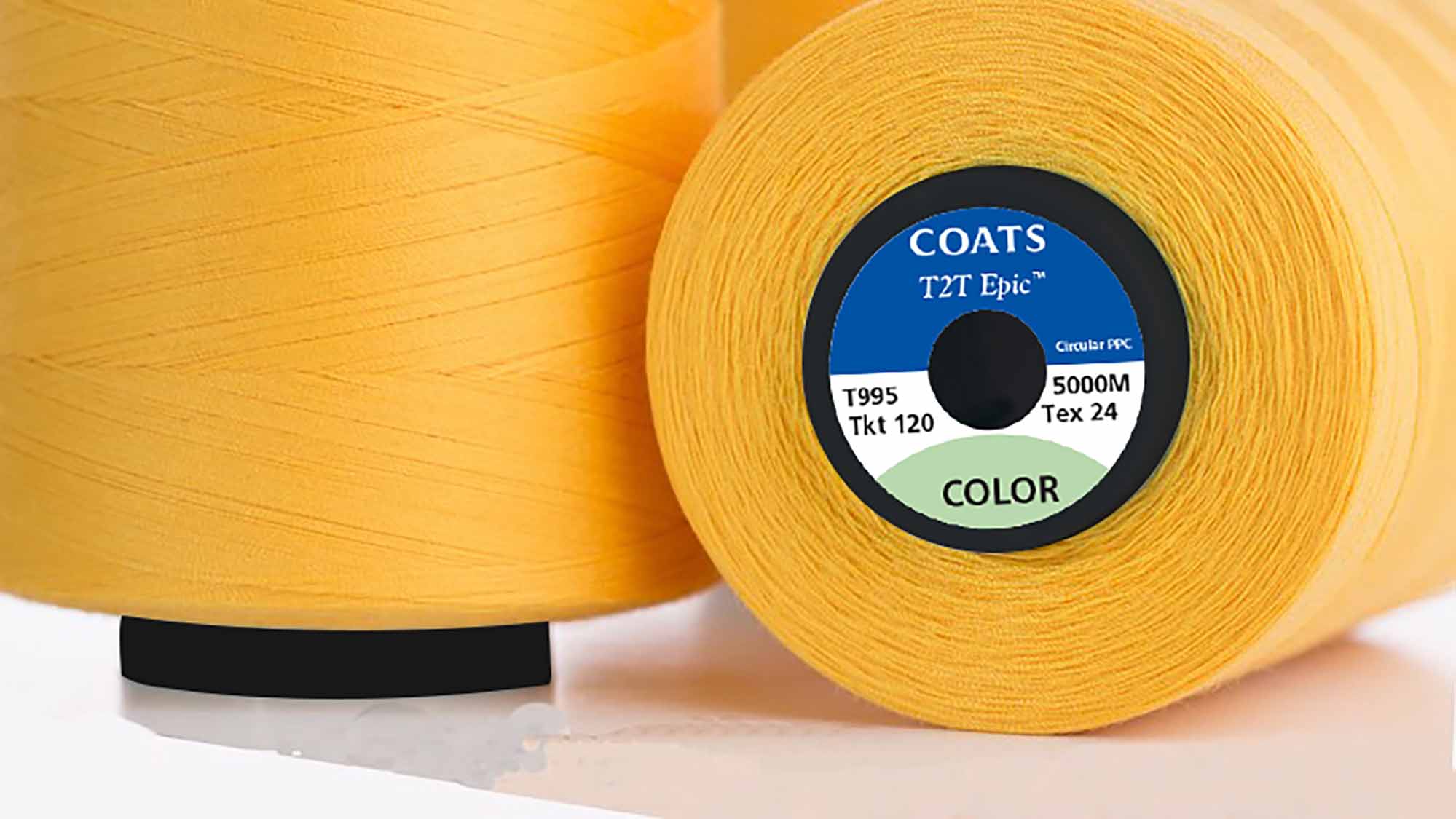
Coats' T2T Epic
OR: What drivers are pushing Coats – and the industry at large – to look towards textile-to-textile recycling, specifically?
AM: There are several key factors driving the shift toward T2T recycling. First, there is a clear environmental imperative: T2T threads help reduce reliance on virgin, oil-based materials and divert textile waste from landfills and incinerators, directly supporting climate and circularity goals. Second, supply dynamics are changing. Bottle-to-bottle recycling is increasingly prioritised in the beverage industry, which means apparel brands need dedicated textile feedstock streams to secure their supply of recycled materials. Third, both customer expectations and regulatory requirements are evolving rapidly. Brands are setting ambitious targets for preferred materials, and we’ve committed to increasing our own preferred raw materials mix to 60% by 2026. To date, 50% of the raw materials we use in Coats products are already recycled, renewable or bio-based. This innovation is part of our broader strategy to help customers meet their sustainability commitments and stay ahead of future regulations.
OR: Why are the threads currently in a proof-of-concept stage?
AM: We’ve chosen to launch T2T threads as a ‘proof of concept’ because we want to scale responsibly and ensure a positive customer experience from the start. The supply chain for chemically recycled textile inputs is still maturing, and we’re prioritising strategic brand partners for initial prototypes. By phasing our industrialisation and focusing on quality and traceability, we’re setting the stage for a smooth transition to larger volumes as the ecosystem strengthens.
OR: What evidence substantiates your claims that the threads deliver the same strength, durability and colour fastness?
AM: We’ve conducted extensive laboratory and production line testing to ensure that our T2T threads meet the same high standards as our conventional products. These tests have shown that T2T Epic and T2T Gramax match standard threads in terms of strength, abrasion resistance and colour fastness. In addition to internal testing, we’ve run pilots with brand partners in categories like athleisure and denim, and the results have been very encouraging. We’re committed to transparency and will continue to share data as we expand the range of shades and applications.
OR: If textile-to-textile recycled threads can offer the same features as virgin fibre threads, why is the industry so reluctant to adopt positive, sustainable change?
AM: While the benefits of T2T threads are clear, industry adoption is still uneven due to several practical challenges. The supply chain for textile-grade chemical recycling is in its early stages, which means the raw materials – meaning the recycled textiles – and the quality checks are still catching up. There is also a cost premium at this stage, as infrastructure and volumes are not yet at scale. These are normal growing pains for any new material stream, and our role is to help de-risk the transition by proving performance, building supply and working with partners to bring costs down over time.
OR: How is Coats helping to drive the industry towards Net Zero and circularity?
AM: We’re taking a multi-pronged approach to support the industry’s transition to Net Zero and circularity. First, we’re scaling up circular materials like T2T threads, which are designed to integrate seamlessly into existing production lines and help brands meet their circularity goals. We’re also collaborating strongly with suppliers and customers across the value chain to advance circularity initiatives. For example, we’ve worked extensively with raw material suppliers to make packaging materials circular and to develop new circular T2T materials. Second, we’re accelerating our own materials mix shift, aiming to reach 60% preferred raw materials by 2026. Third, we’re investing in innovation through our Sustainability Hub network, which brings eco-materials from lab to line and supports the development of new recycling technologies. Finally, we’re committed to integrity and transparency, participating in the UN Global Compaact, setting validated science-based targets, and embedding robust traceability into our systems. These efforts are all part of our broader mission to transform the global apparel and footwear supply chain for a more sustainable future.
Have your say. Join the conversation and follow us on LinkedIn