


In this special podcast series, we speak to the winners of the WTiN Innovate Textile Awards 2025.
World Textile Information Network (WTiN) is thrilled to announce the winners of the Innovate Textile Awards 2025. In this special podcast series we speak with the winners of the awards about the challenges, possibilities and successes of innovation within the textile industry.
In this episode, we are joined by Anna Talvi, senior research fellow at Robotics Living Lab (RoLL). RoLL won the Manufacturing & Supply Chain Award for its novel research facility designed to support innovation for onshore fashion production.
The award celebrates pioneering advancements in machinery, software and processing techniques that transform the textile & apparel industry. In this episode Talvi speaks through RoLL’s inception and how it develops robotic solutions for the fashion industry.
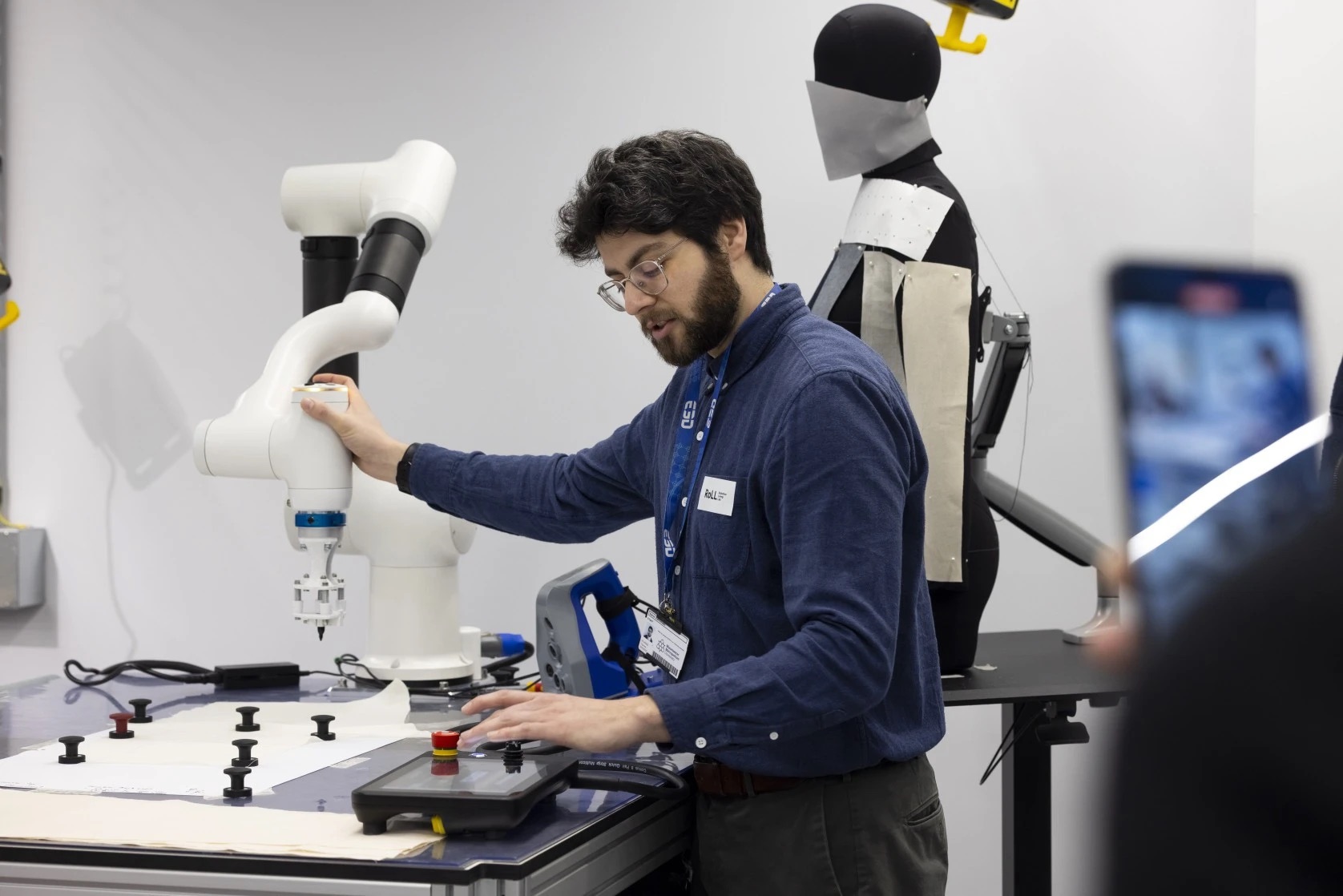
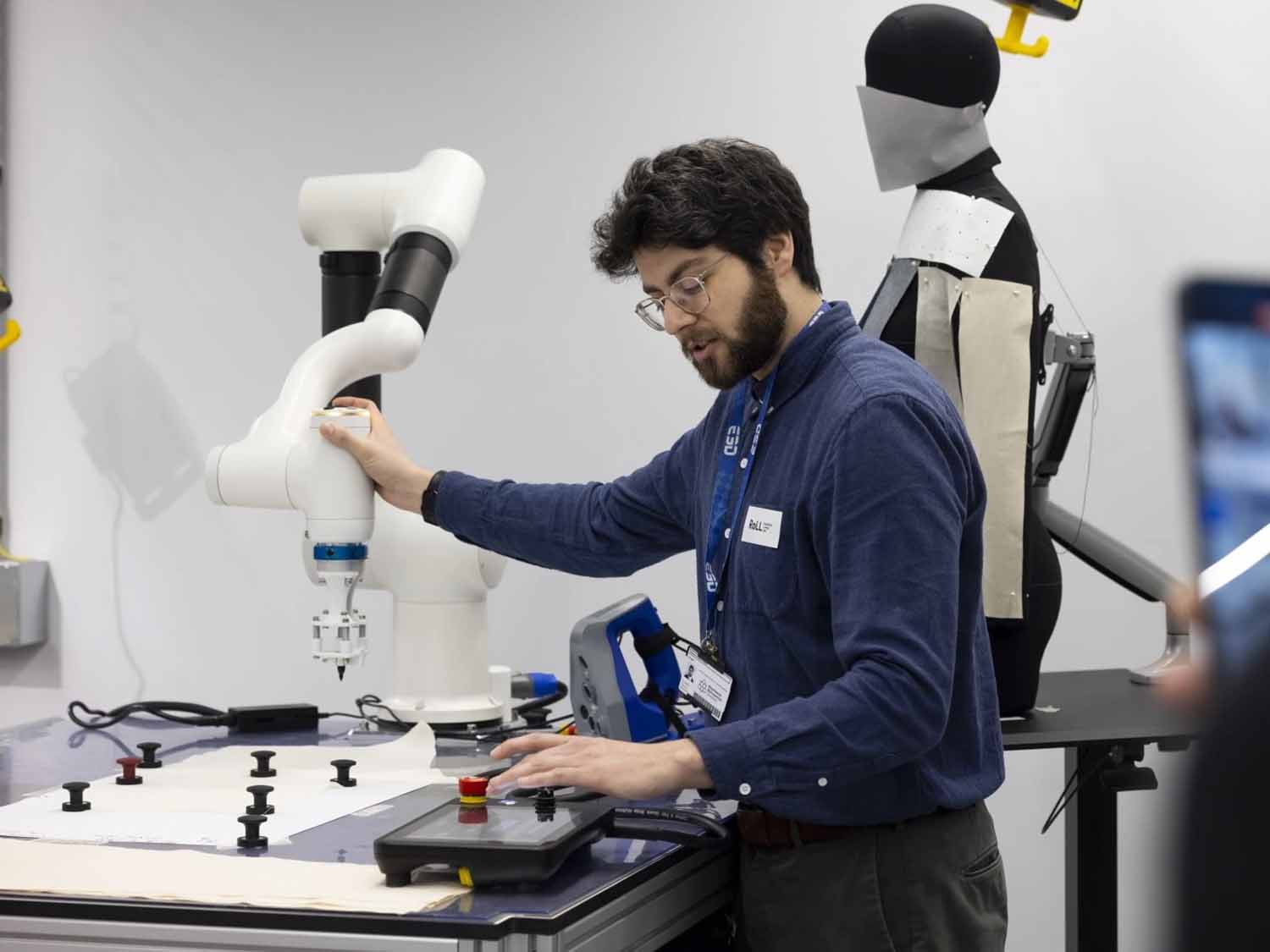
Robotics Living Lab won the Manufacturing & Supply Chain Award. Image - RoLL
The lab opened early in 2025 after it was awarded GBP£3.8m by the Arts and Humanities research Council (AHRC). RoLL explores more sustainable approaches for fashion manufacturing. It sees fashion researchers, designers and manufacturers working together with robots to create high-value, low-volume fashion. Talvi delves into how it is advancing robotics and how robots can be used effectively in fashion and textile supply chains.
You can learn more about RoLL at @robotics_living_lab.
WTiN announced the winners in a virtual ceremony on 5 December 2025, which you can now watch on demand at WTiN.com.
Have your say. Join the conversation and follow us on LinkedIn
-
Transcript
This transcription has been AI generated and therefore may have some inaccuracies.
Ep. 142: Manufacturing & Supply Chain winner
In this special podcast series, we speak to the winners of the WTiN Innovate Textile Awards 2025.
WTiN: Hello and welcome to Textile Innovation, hosted by WTiN. My name is Abi and I'm the Features Editor and your podcast host. In this special series, I will be joined by the winners of the WTiN Textile Awards 2025. The awards recognise and celebrate excellent leadership for innovation in the textile industry. And throughout this series, we will delve deeper into the challenges, successes, and possibilities of these industry leaders.
Today, we are joined by Anna Talvi, Senior Research Fellow at Robotics Living Lab. The novel research facility designed to support innovation for onshore fashion production, won WTiN's Manufacturing and Supply Chain Innovation Award. In this episode Anna speaks of the work the lab is doing to encourage localized design and automation in the UK. She also speaks about the role of robotics in textile manufacturing and touches upon the labs use of cobots.
Hi Anna, thank you for joining me on WTiN's Textile Innovation podcast and congratulations on winning our Manufacturing and Supply Chain Innovation Award in 2025. Please could you share with me the story behind the winning innovation and what inspired RoLL's development?
Talvi: Thank you so much. We are so pleased and I'm really, really grateful. It was such a wonderful surprise to us all. So our Robotics Living Lab, it was set up to help reshore UK garment manufacturing through robotics and automation and really explore what robotic systems for deformable materials handling might look like. The lab is really a testament to Professor Susan Bostoff-White's really long-time vision of what a future of technology enabled agile advanced manufacturing might look like. I guess to some extent, it also came from a place of frustration. Because while nearly every other industry has really embraced robotics and automation, and to a large extent, actually, these technologies have helped to inform completely new designs and completely new operating models. The textiles and garment industry, to a very large extent, still uses a lot of legacy technologies, and it's very labour intensive and very inefficient and wasteful in many ways. So it's not a very great place for people to work in nor the environment. So yeah, it came from a vision to really set the precedent and propose an alternative. And we're very, very lucky that Professor Postlewaite made this lab into reality, and that the lab is doing so well, and we've had a very warm welcome. So yeah, we're very, very pleased and excited about the prospects.
WTiN: Amazing, thank you so much. And you've just touched upon it then, obviously you mentioned about how legacy tech is like inefficient and can be wasteful so could you tell me a bit more about the challenge and the gap in the textile industry that Robotics Living Lab is addressing?
Talvi: So the textiles and garment industry it has one of the lowest uptakes of robotics and automation and at the same time, it's one of the most polluting industries. And the automation robotics that do exist in the industry, they're very heavily focused on low value mass production. And there is very, very little developed for the form of materials for deformable materials handling, such as real-time monitoring, robotic disassembly. And that's mainly because robots are not very good at processes that involve deformable materials.
For example, like textiles, yarns, anything like extruded filaments, because of the high level of unpredictability and un-uniformity with these materials, while something that's like a rigid object, it's much more easily programmable. So there is a large gap of knowledge we are trying to understand. And at the same time, when thinking about, for example, like gripping, like one of the basic tasks for textiles manufacturing, many of us don't actually realize when we pick up things with our own hands, how intricate the real-time feedback in the human hand itself is, because this really enables to grab and manipulate soft deformable materials really successfully. Robots are not so good with that, that when an object like change shape or is unpredictable, and also robots are not very good in environments that are not perfect, such as like small studios and small makerspaces, because you know, the surfaces are not completely flat and you might have like very limited space. So you have to like constantly repurpose that. So this is what we are really focused on, like robotics that are agile, collaborative, like modular, you can swap them around and swap the tool heads around really easily, reconfigurable, really the types of robots that small manufacturers really want to work alongside with.
WTiN: And just leading on from that, how do these robots that you are developing, forgive me if I'm wrong, but I believe they're called Cobots. I remember writing about them a few, about a year ago when you first launched. How do these Cobots and what you're doing at Robotics Living Lab, how is that going to disrupt the market and help progress the industry moving forward?
Talvi: Yes, that's a really good question. COBOT, it's a quite a new, interesting term, but what essentially it means that if you typically think about robotics and automation in manufacturing, you think about these big assembly lines where the human only goes to basically service the machine or if something goes wrong. But in a big picture, it's just a big factory full of robots. Cobots assume that they are safe, and the tasks are set up in ways that you can work collaboratively with them. So really take advantage of the things that the robot is really good at, like precision, for example, or like detecting mini details or defects. And also the tasks that the human is much better at, like decision making, some creative things, monitoring, like getting access to like very small spaces or very like in intricate tasks that our hands are still so, so much better than anything we can produce as an end effector. And I think also I would like to mention that one point of difference is we do not try to make an automated version of an existing manual process. We really try to think systematically and make sure that we apply systems thinking and we do not automate the process that shouldn't exist in the first place. We really take advantage of what the robot is really good at and what the human is really good at.
WTiN: And winning the Innovate Textile Awards is such a huge achievement, especially given the fact that, as we said before, you only launched in February last year. What does this recognition mean to you and to the whole team?
Talvi: We are really humbled and really, really grateful. And as I said, that came as such a wonderful surprise and really like a little motivation boost. As a young lab, it's not really always been very easy to challenge these age-old ideas, but this really encourages us to keep going and also to find other like-minded people, groups, companies and work with them collaboratively. We are so new, you know, we only opened, we only properly opened in February. So we have been open only for a year. We have so many like projects and things happening.
WTiN: I'm so happy to hear that. And this is probably quite a big question, but what was the biggest hurdle you faced while you were developing Robotics Living Lab and your cobots and how did you overcome this?
Talvi: I think one of the key challenges has been that to be able to do this we've had to bring together a highly interdisciplinary team. So this bridges skills and backgrounds from like mechanical robotics and textile engineering, machine learning, AI, and alongside that, like expertise from fashion and garment technologies and circular design and policy and human factors. So perhaps our team has really been challenged to really listen to each other a bit more carefully and perhaps put a little bit more effort into making sure that we really understand what someone from a very different field means. But yeah, our team is great and everyone's been really supportive and really enthusiastic. So I would say it's been more like an exciting challenge rather than a frustration.
WTiN: That's good. That's good to hear. And how did you ensure sustainability or circularity in your approach? And has sustainability and circularity been important to you, Robotics Living Lab?
Talvi: Yes, it was actually the one of the main drivers behind Professor Postlewaite setting up this lab. We currently ship senseless volumes of really cheap garments, a lot of it that no one really wants from the other side of the world. We actually don't even prototype much here anymore. Most likely the very basic shirt that we are wearing, just the prototype to make it itself has been shipped like three times back and forth. So we really need to bring back the capacity and skill to manufacture locally. And the core bottleneck is skilled labour and the expense of skilled labour. And this is what we believe where robotics and automation can really make a huge difference and really enable to bring back like even prototyping first, small micro factories first, and we hope that the big, it will grow and expand like that.
WTiN: Yeah, that's great. and you already mentioned when I asked you about hurdles and challenges you mentioned about key partners and brands and stuff so how have you collaborated with you know key partners such as institutions or brands to bring robotics living lab to life and how has it shaped that final space?
Talvi: Yes, I definitely need to express our gratitude for our main funder, the Arts and Humanities Research Council, and also the Cotton Textiles Research Trust, who funded our first robotic end effector. And there's been a lot of in-kind support from different stakeholders. For example, the Manufacturing Technology Center, the high value manufacturing catapult, our different research groups who've supported with ideas and research groups who've supported with getting different projects going. And yeah, definitely, we're very, very pleased that the SMEs that do manufacture here locally, they have been so engaged. They are really keen on working with us. We have several projects set up. And this is really, really exciting because we were slightly worried that robotics might sound a little bit too unfamiliar and you know, everyone needs to hit their production deadlines and everything, but they've been very, very open and collaborative. So yes, big, big shout out to those brilliant little companies.
WTiN: It's so exciting, there's only projects underway already. And so I know that part of the mission is to have SMEs come work in the robotics living lab. I think I'm right saying that. How have those customers or partners, however you best describe them, how have their feedback played a part in refining what you offer at the lab?
Talvi: Yes, I mean, feedback is really, really key. And we try to get as much feedback as early as possible, because most people, they don't really have had much engagement with robotics or what it's like. We are trying our very, very best to design our robotic tooling in ways that is really intuitive to use, that people without an engineering degree could learn it quite easily. So for example, if we develop like an end effector or a system and our technician from upstairs, you know, who's been fixing sewing machines all their life, if they find it too difficult to use, we've done a bad job, we'll go back and we'll improve it. And it's the same with the robotic systems, automated systems we develop with our industry partners. We get the technicians and we get the people in really, really early. We like to roll our sleeves up together with them and get a lot of really honest and really like raw feedback early on because this is how you build systems that really work for these companies that are not just like nice on pictures and press releases but really deliver an impact.
WTiN: And what advice would you give to any aspiring innovators hoping to make a mark in the textile industry?
Talvi: It's easy to give advice. The first advice is to roll the sleeves up and go on the floor and try to solve real world problems. I think the two main advice I could give is to think optimistically and critically at the same time. And secondly, from people in the garment and textiles industry, to really look out and learn from other industries. They have gone through a lot of similar problems that we are still facing and we can learn a lot from them and people are really nice. People love giving advice so yes to learn from other industries.
WTiN: I love that the cross-sector collaboration is something that I do get to hold a fair bit so it is really exciting to see that happening. And kind of leading off that, like what do you hope, what you are creating at Rottis Living Lab, how do you hope that will inspire others in the textile industry to prioritise sustainability or creativity, you're in both?
Talvi: Yes, so already in the near future, we really hope to inspire and also support a lot of small agile factories enabled by robotics and automation, making high value items locally, the upskilling the local workforce and teaching them some of robotics and automation skills can really boost what they can do and make them really, really competitive. And secondly, also, we hope to inspire some bigger players to start actively bringing back manufacturing to UK and Europe. Even if it's just starting with prototyping, even if it's starting with small processes, we'd really like to also support bigger players to do that. And thirdly, you mentioned cross-disciplinary collaboration and how important that is. We would like our work to foster more of that, the use of textile technologies in other industries in really meaningful ways. I've seen recently that there is a lot more interest into textiles from aerospace, automotive, medicine, construction industries. But I also see that fashion and textiles, we haven't been very good at documenting and sharing the very technical knowledge. And then I think that has resulted that textiles are often used like a substrate, rather than like a very highly programmable metamaterials. Textiles have so much more potential that is currently being used for. And I can see that it's begun to really being explored more and exploited more. But I really hope to see more of that because textiles are really the material of the future and it is almost in everything already and where it's not, it will be.
WTiN: Thank you so much. That's really interesting what you said about sharing and documenting what the industry is doing, which really leads me nicely on to my final question. What would you like the broader industry to understand about the importance of innovating in textiles today and the importance and potential that robotics could bring to the industry?
Talvi: I strongly believe that we need to really value and teach the technical textile skills more and better, especially like from the manufacturing perspective. You know, innovation does not happen behind the computer screen or like coming up with clever words. It really happens on the prototyping floor by people who learned through trial and error. So our technicians and machinists and the people who really understand manufacturing, they are the most valuable assets and their skills need to be valued and their knowledge need to be really brought to the forefront of decision making. This is really crucial for not only like robotics and automation projects to really define the scope. This is across the industry, this is also for the very creative ends of industry. The technical skills are really the enablers of all the innovation and we need to celebrate that more and we need to celebrate the people more.
WTiN: That's amazing, thank you so much Anna, thank you for joining me on WTiN's Textile Innovation Podcast and congratulations again on the win.
Talvi: Pleasure, thank you so much for having us and thank you for this recognition.
WTiN: Thank you so much for listening, if you have any questions or want to learn more you can follow us on LinkedIn at World Textile Information Network or you can contact me directly at content at wtin.com. If you are interested in sponsoring an episode of the podcast please email sales at wtin.com. We look forward to you joining us next time for the next winner in our special series.