
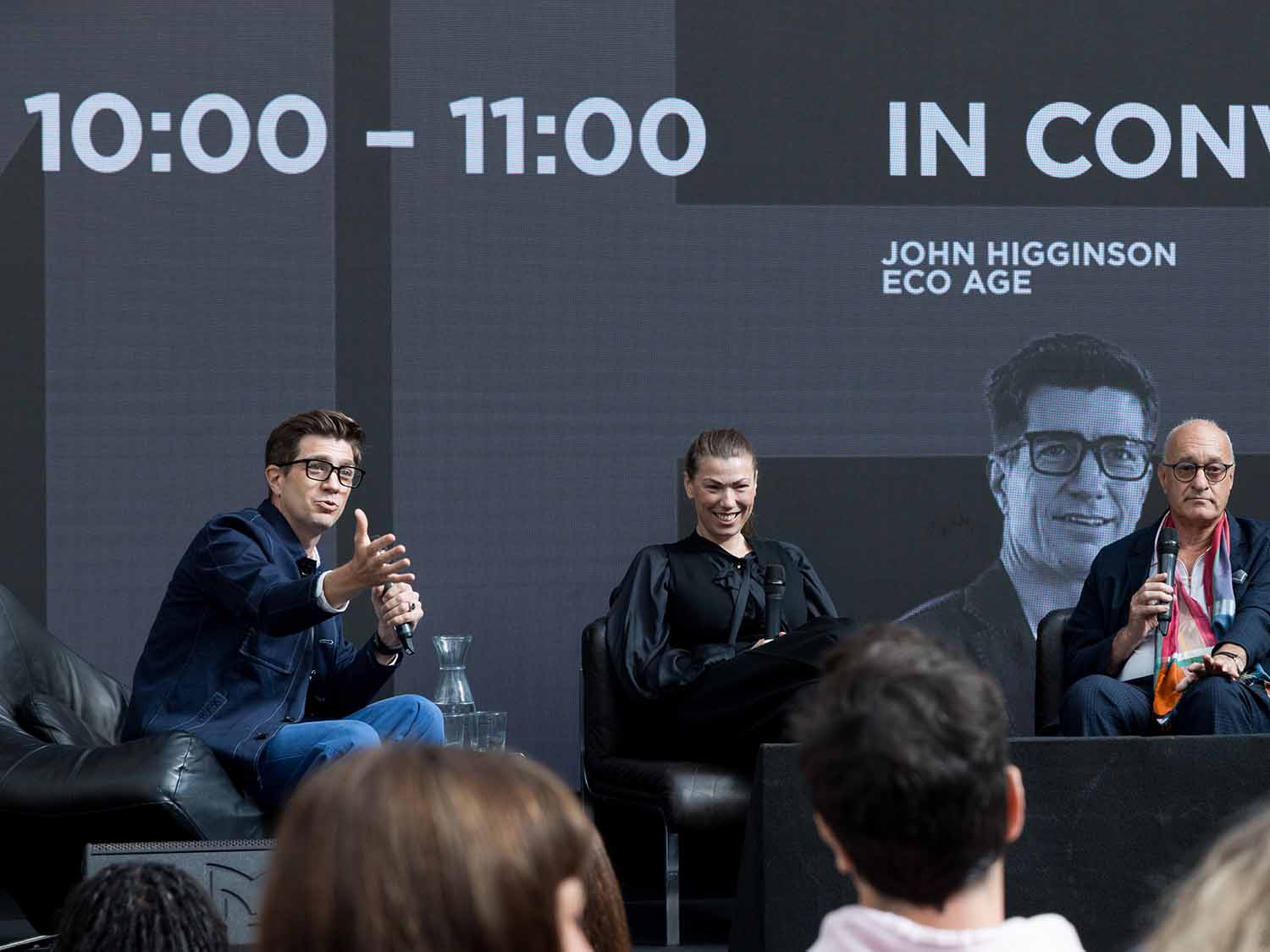


In this episode of WTiN’s Textile Innovation Podcast we speak John Higginson, CEO of Eco Age.
Welcome back to WTiN’s Textile Innovation Podcast. In our first episode of 2026 we are joined by John Higginson, CEO and founder of Higginson Strategy and CEO of Eco Age.
In today’s episode we focus on Higginson’s work with UK-based Eco Age – a consultancy and media platform focused on transforming the fashion and beauty industries towards greater sustainability. Throughout the episode we speak about the work that Eco Age does, who it works with and how it is informing consumers nation and worldwide.
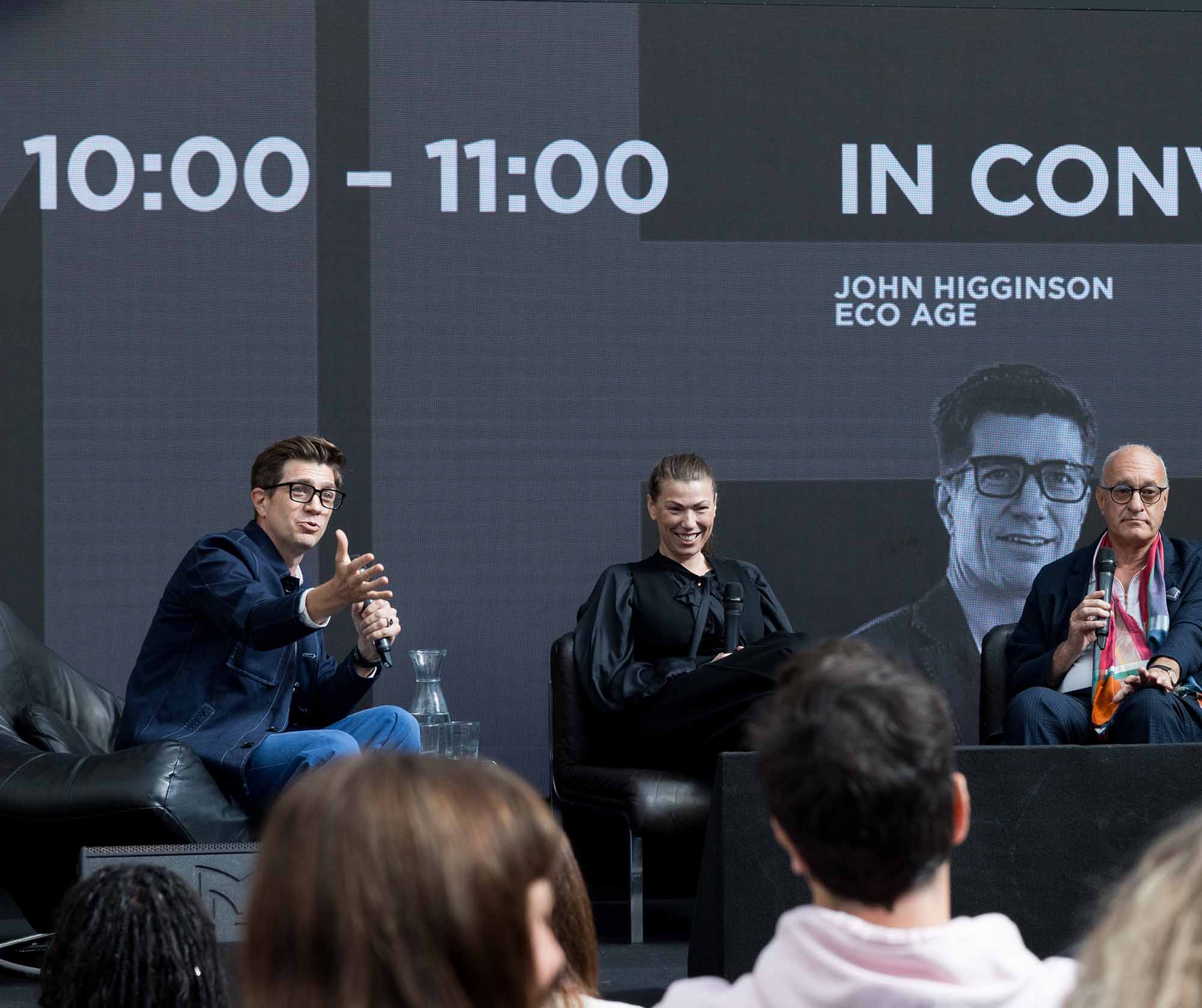
John Higginson, CEO of Eco Age, opening Manchester Fashion Week. Image - Eco Age
Higginson touches upon his background in politics and how legislation is powered by the consumer, plus how it will change the industry moving forward. He speaks about the power of collaboration and education for brands, manufacturers and consumers.
Additionally, we speak about the power of events such as The Green Carpet Fashion Awards (GCFA), which unites creative visionaries and industry leaders to celebrate excellence in innovation and transformative impact on a global scale.
There are many companies that Eco Age works with such as Textile Genesis, Sparxell and Healixa, which we also mention throughout the podcast.
If you would like to learn more, please visit eco-age.com.
Have your say. Join the conversation and follow us on LinkedIn
-
Transcript
This transcription has been AI generated and therefore may have some inaccuracies.
Ep. 139: Power of education and collaboration
In this episode of WTiN’s Textile Innovation Podcast we speak John Higginson, CEO of Eco Age.
WTiN: Hi, John. Thank you for joining me today on WTIN's Textile Innovation Podcast. Please can you tell me about your background in journalism, your efforts in sustainability and how this has led you to EcoAge?
Higginson: Yeah, well, thank you very much indeed for having me on Abigail, it's a great pleasure to be on here. Yes like you, well like you are now, I was a journalist once and took a very traditional path through local papers and then agencies. I worked in Los Angeles for a bit before moving to London and working on a number of nationals before ending up as political editor of Metro. And from here, I just got a real feel of politics and how it works as well as the kind of daily journalists. I was always daily rather than a Sunday journalist or magazine. So it was always that brand new story every single day, which is great for being able to work quickly, but absolutely useless at being in any way strategic. You just, every day is a new day, new blank piece of paper. So that was quite a hard move over as I moved over to PR and public affairs 15 years ago. I worked in a couple of agencies before setting up my first agency, Higginson Strategy, which I'm still CEO of. That's been going for nine years. That is an agency that concentrates on sustainability. It's got a really big niche in the plastic crisis and on the alternatives to plastic. That's where I first came into contact with EcoAGE, a really great agency working in the same space of sustainability, but with a slightly different bent in that it was all fashion. And then I took over as CEO of EcoAGE last year. And so I'm CEO of both agencies now and it's been really fun to just see the kind of the skills that I've got how they can be transferred into fashion. Essentially, you know, ultimately businesses work in the same way no matter what industry you're in. It's just about understanding more and more on the industry.
WTiN: That's really interesting, I can't get what you mean. I used to work at Mail Online and yeah, lots of stories every day.
Higginson: Yeah, and the Mail Online is the most read news outlet in the whole world and I was always taught when I studied journalism for my NCTJ that the best journalists in the world were the male journalists because they're very good at finding stories, being very succinct and you have to be really good at that. So a great place to be on Mail Online just to really understand what people want and how you can keep them interested. And that's what we're trying to do with EcoAge actually because EcoAge has got a couple of things to it. Really it works in some ways a bit like a media organisation. We are paying journalists for in-depth stories that go on the UKH website, because we're trying to do two things. We're trying to educate people about the fashion industry, about sustainability, at a time when there's a lot of disenfranchisement from the consumer who feels that quite often they've been sold lies, they feel like they've been, you know, all the stuff on greenwashing has all come out and what that's done is it's turned off a lot of people and you're seeing that coming through on politics where people say we've gone too far on the environment and we shouldn't be doing things. But ultimately people are good people and they don't want to destroy our planet, you know, most people if you got down to it would want to save our planet. You know, most people, if you got down to it, would want to save our planet. They wouldn't want to abuse other people through the clothes that they wear or the things that they do. And so quite often the reason people move just to cost and, okay, I'm going to go for the cheapest product or I'm just going to go for looks, is because they don't have enough information there and they feel, I don't know the difference between what's good and what's bad so therefore I do know the difference between what costs five pounds and what costs ten pounds or what costs fifty pounds what costs a hundred pounds. Everyone understands money and so when they don't understand other things they often fall back on going for cheaper because everyone knows that they don't have as much money as they want, they don't have as much money as they need and when you don't have real clarity on the other things that's what it falls back on and that's what we really want to help people out on and really understanding you know what is good, what can you what can you wear that makes things better, how can you wear things longer, how can you buy better? How can you make sure that the clothes that you wear are doing good for the planet, doing less bad for the planet, but you know ultimately that you're helping as most people want to do in making sure the planet is better for the next generation, is better for themselves, isn't you know killing species or poisoning rivers or poisoning air or poisoning people on the other side of the world.
WTiN: Now of course and the knowledge gap is something that we hear a lot about at WTiN that consumers might want to be sustainable but they don't even know where to start. So it's great that you are getting that out there with EcoAge. How are you trying to reach consumers? And also, two questions in one here. What shifts have you seen in the demand for sustainability messaging in recent years?
Higginson: Well, to answer the first question how we're reaching them, one of our main places that we reach them is through Instagram through to the consumers. We've got a very large and growing following on Instagram of around 170,000 followers on there. We've also got followers in other forms of social media, so Facebook to a kind of older audience, about 25,000. Instagram, we are reaching the kind of business partners through Instagram, because it's largely placed for work, we're about kind of 25,000 followers there. We're just starting on TikTok, but for us, that's a new medium. But really, Instagram is largely where I feel almost everyone that cares about fashion is on Instagram.
It's very visual. It's got that feel for it. It's a small format. And what we're doing is providing information that works within that format. So whereas we do long form copy that goes onto the website, we're breaking down that information for Instagram so that it goes on those reels and posts in a format the fashion consumers are able to read. And we're doing it in a way that it's not getting them depressed because we... That's good. Yeah, because our readers in general, the period when they're mostly on Instagram is about 5 o'clock 530. So we know that most of them have finished a working day that I've done 8 hours of work that I've probably had a stressful day. They're going on to Instagram quite often to get a bit of relief and if we immediately just bring them a whole load of bad news, they're gonna move past us and go to other things. And so we're trying to present that information in a way that's positive. We do a positive news Friday post every Friday where we're pointing out positive things that have happened in the industry. And those are some of our most popular posts. And we get lots more followers on the back of those because people want that good news. They do want to do something good. And so we found that if we just present people bad news, they don't necessarily like it.
You might get a big increase in eyeballs for that post alone. But it's not really something that someone wants to follow because you know in the world at the moment what we're finding is people are feeling less empowered from the world and so this is a way to make them feel more empowered and we feel that fashion is a really strong way that people can feel empowered because every time when you wake up in the morning you get the opportunity to put on clothes and make a positive choice from the moment you get up. And if you're putting on clothes that you know are good, that have been bought secondhand, or they've been well built and they're really well made, then you're making this positive choice that glows from the inside. It's not a kind of fake choice of, I'm gonna look good in an item of clothing that doesn't last very well for a short period of time. And so it's a way that we can get empowerment back to people where they can feel that they're making a difference on both equity, inclusion, and sustainability. One of the problems we have at the moment is the fashion industry. One of the problems we have at the moment is the fashion industry is one of the industries that has the largest amount of any industry really of kind of worker rights abuses and people being badly paid and so there's great choices that people can make when they say you know what I'm gonna buy better, I'm gonna make it last, I'm going to make it last, I'm going to think about what I do with it at the end, I'm going to make really conscious choices. And so it's a really exciting place for people to be because quite often it's people's first entry point into thinking about politics and thinking about the environment and sustainability and thinking about anything that they can do themselves.
WTiN: And that is great. I must say I moved out of London a few years ago to Bristol and here in Bristol we have a sustainability week which started with fashion. And I've seen over the last few years how it's grown. The conversations have grown very much following what you've just said. But for a minute, just moving away from the consumers, EcoAge often talks about what you call the credibility gap in the industry. How would you define that gap today and how is it affecting brand reputation?
Higginson: So this credibility gap has come from essentially fashion brands trying to take shortcuts and working on a consumer that most consumers they don't have deep level knowledge of the process of how their clothing was made, you know, how it was dyed, how it was pulled together, where it was sewn, where it was stitched, you know, ultimately the various things that go into it and even if you're in on the industry like we are, it's very hard for us to know. I doubt if both of us could trace each item of clothing that we're wearing and say, right, I could tell you exactly where this bit of cotton came from, this bit of wool came from, and even more so the amount of plastic that's going into it. Because what we find, you know, what we know now is that lots of the plastic in our clothing has come from Russian fuel because Russia has been selling the fuel to India, India has been making the plastic, the plastic's been turned into yarn and that will then go into clothing. So there's a whole global political reach that the clothes that we wear have. And so the gap comes from that lack of knowledge. And then the fashion companies will try and make a quick shortcut. So they will say to a consumer that is time poor and doesn't know, well, this item is recycled, so that's better, or it's out of recycled material, or it's recyclable, which means something different. It means you can recycle it at the end but almost no one says that they talk more about the input material yeah or they say it's sustainable and a lot of these terms they're kind of meaningless because what does sustainable really mean um you know if you take something that's recycled and you put it into an item of clothing quite often you turn it into something that can't be recycled again because you're mixing materials. It's very hard to take that plastic out when it's been mixed in with cotton or wool or anything else. There's been that gap and what that gap has meant is when the stories come out, and we've seen more stories as well on, you know, large luxury brands as well, having practices that aren't necessarily the right ones, then that's led to consumers hearing these stories and thinking, oh, the wool was pulled over my eyes. There was me paying more for an item of clothing because I thought it was good for the environment. And it turns out that I was being made a fool of because actually it wasn't better for the environment. And then this kind of, and then the consumer says well I'm not going to do that again I'm not going to be that fool again. So a lot of the work now that's happening in legislation around the world is actually closing that gap because instead of it being down to a brand to make a claim without it being verified. There's far more around traceability and actually having stamps of approval. So for instance, one of our clients, Alexa is very good at the traceability journey. So that if a brand comes to them and says, right, our end consumer wants to know that what we're doing is the right thing. They don't want us marking our own homework and saying, yes, it's sustainable. They need to know that someone else has come in and looked at this and right down to the fibre, can trace where it came from, all those different things. Those things are closing the gap. So we're from a kind of very low point at the moment where in sustainable fashion, we don't even like use them so we talk about future fashion, it's a really low point because everyone thought great okay I can use my clothing to make the world a better place and that they were being tricked and now we're at this point again that we're lower and we're moving back up again because that gap is closing now and narrowing because you can trust some of these things. We've worked with Textile Genesis. They do something similar on traceability and a lot of these firms, it's the consumer can look on the label and say, great, they've worked with them, therefore it's in the right place and I can trust it.
WTiN: Yeah, no, I get what you mean and as we've covered both Texel Genesis and Helexia on WTiN, I do know them well. No, it's fantastic. I was literally with my friend the other day and she picked up some clothing and was looking at the label, I think it was Oheotex, and she's like, oh what is this? And I was like, this is this and I was like this is good I'm like yes exactly.
Higginson: Yeah exactly and so that's what we're trying to do at Ecoage we're trying to do two things because our business model is we have to do we we well we have to do we want to do consulting for the companies that are making the fashion industry better so we want to be working with those traceability platforms we want to be working with those traceability platforms. We want to be working with a good brand. And we're promoting them through other forms of media, but at the same time, educating the consumer through the social media platforms that we use, through our own website, and through the events that we work on as well, so that the consumer is not just educated, but we also do it in a way that's highly aspirational so that it's not about you know you can either be cool and fashionable or you can be sustainable. Those things aren't you know binary. This should be about the coolest things in the world are the sustainable things because they look good and you feel good about them and their materials that the best designers in the world want to use because people want to wear clothing that doesn't destroy the world, make it worse, you know, all those things.
WTiN: Of course. And if you were advising, say, a brand or manufacturer who's trying to navigate circularity and traceability, whether they're trying to implement it or they're trying to show what they do, what guidance and tools would you advise that they use?
Higginson: Well I think Helexa as I've just mentioned is a brilliant one, Textile Genesis as well, those are really very good because it's right down to the DNA. We work with companies like Tasia Technologies, which has a biopolymer called Carmecane. What this does, it acts like plastic, but if you throw it into the ground or it ends up in the earth, it decomposes. It takes out that plastic from the fashion world and something like over 50 percent of the clothing that we buy now is plastic and that's partly because as we are moving away from fossil fuel cars and if you look around the world fossil fuel cars are being banned from in the UK they're being banned for sale from 2030 onwards in the EU it's 2035. The fossil fuel industry is looking for where do we sell our product. The product that they sell is plastic and the one area that they can sell into is the clothing industry and the fashion industry and it's you know very very hard wearing but to the level where it will last 500 years and it's and it's, you know, very, very hard wearing, but to the level where it will last 500 years and it breaks that down into microplastics that can be poisonous to us. So those are two really good ones that I mentioned there that I think any brand could look to and should get onto those platforms.
WTiN: Amazing, and you've just kind of spoken there, and you've mentioned before about obviously politics which you said which you described at the start. I come from a political background so I'm talking a lot of politics aren't I. No it's so important. I mean so I could probably answer this myself but you said obviously your background's in politics but how does EcoAge stay ahead of policy and regulations? Because obviously with the textile industry, with exports and stuff, there's regulations coming from so many different countries.
Higginson: I think this is one of the most exciting areas because I think fashion is completely entwined with politics. I pointed out there that even the plastic in our clothing has to do with the war in Ukraine. So Russia wasn't allowed to sell oil to other countries, so therefore it goes to India and therefore India sells it on to the fashion providers. The one thing about fashion that's really quite hard is materials and clothing and textiles move around the world. And so they move into different areas. And what countries find hard is if a country bans something, it can just go to another country quite easily. And it ends up still in the fashion supply chain. But what that country ends up doing is it ends up damaging their own industry. And so the politicians don't want to be damaging their own industry. So the way that we try to work very well is by educating the consumer, you're not just relying on the politics and legislation.
Legislation takes a really long time to get through, but consumers can make their changes instantly. As soon as the consumer knows something, they can vote with their feet on that next purchase. So quite often politics follows consumers. You need a kind of core wave of early adopters. And we're always trying to work on those early adopters of people saying, look, let's just educate you on what's happening here, so that you're not waiting for government legislation to come in before we can change things. We can, as consumers, change things straight away. We're all spending money every year on clothing that we buy. So we've got a lot of power in our hands. But that's not to say, that's not to offload it away from politics. So for instance, if we look at some of the say that's not to offload it away from politics. So for instance if we look at some of the politics that's coming through at the moment, extended producer responsibility is one bit of legislation that's happening at EU level, UK level and in the US and what that essentially means is the people that produce the clothing have responsibility for the end product. So that really hits hard on fast fashion, for instance. And we believe that fast fashion is really damaging because one, in order for the numbers to work on fast fashion, it uses a huge amount of plastic material. And plastic material is not great for a couple of reasons. One, it's potentially toxic. Two, it lasts a very long time, very hard to recycle, very hard to get rid of, quite often associated with quite low value items of clothing that break easily, and so there's a lot going to landfill. So for the fast fashion producers, once extended producer responsibility comes in, they have to pay the government more money for the actual dealing with the waste at the end because at the moment all of us consumers we end up paying for our own waste through our taxes. So if you decide that you're going to be really good and you're going to buy very little this year, and your neighbour is the opposite, they buy a whole load of stuff and they throw it out and throw it out. You pay your council tax, the council takes it away and you both pay the same council tax. No one's paying any different. But ultimately, the fashion producers aren't paying a penny, they just pay to sell to you. Once they've sold to you, they've got no responsibility, it doesn't matter what happens to that item. Under this, they will now be responsible. So if your items end up going to landfill, if your bin load is far bigger than your neighbors, they will be paying more for it. So that's a really important piece of legislation that's coming through. It starts in a number of US states, I think 12 US states next year. It's starting in the EU and it'll start in the UK as well.
WTiN: It's really interesting, I must say it's something that we are keeping our eyes on at WTiN. Obviously a couple of digital product passports as well. Yes that's another really important one exactly. It is, I was going to say to you that how data is now feels like it's so central to sustainability work. From EcoAger's standpoint, why does data matter and in what way can it be most effective for brands to use it? Probably touching a little bit upon what you've just said about responsibility.
Higginson: Yeah well I think look data is the one thing that has led to the biggest information gap and I can't think of any other industry where you just have materials flying around the world from large amounts of different places. So if you think of even one of the most simple clothing products that are out there, a cotton t-shirt, we've all got loads of cotton t-shirts in our drawer. It's one of the simplest products and I'm just going on the simplest one. I'm not even going to walk into a pair of trainers or some kind of jacket or something or a handbag. If you just think of a t-shirt it's got to be the cotton is grown somewhere and that has to be grown in a hot temperate area largely it can only be grown in an area where there's water scarcity anyway. You've got all sorts of things there. The cotton is then taken, it's then spun in a different country, it's then taken to a different country where it's dyed, it's then turned into a textile in a different country, it's then sent somewhere else to be sewn, it might be sent somewhere else to have a print put on it. So's saying, you know, so it's just a simple cotton t-shirt that might cost as an end product £10 or €10. That has gone all around the world and that's one of the most simple products out there. Without a data passport on there it's very hard to prove things. So a good example of what went wrong with the industry without data passports is about twice as much organic cotton was sold as organic cotton t-shirts as there was organic cotton grown in the world. So what that meant is there was an awful lot of fraud going on. So for instance, traditionally what would happen is in order to pretend something was organic cotton, someone would buy a ton of organic cotton. They then also buy nine tons, ten tons of non-organic cotton, and they'd sell all of it as organic cotton. And they'd show, here's my receipt. I bought some organic cotton. Therefore, this is organic cotton. Now that you've got digital product passports, you can't do that. If you bought one ton of cotton, you can only sell one ton of cotton, organic cotton. So that's just one example. And so the fashion industry, this would be an absolute game changer because suddenly you can't do those things and it's very hard to cheat the system. And that's really been one of the things that's been very hard for consumers, been very hard for the fashion industry because all the good guys, they end up at a disadvantage because someone who's actually really buying organic cotton, they're paying a heftier price than the company that's buying fraudulent organic cotton, they're paying a heftier price than the company that's buying fraudulent organic cotton at a lower price, and the whole industry then goes to the lowest common denominator, which is price.
WTiN: Yeah, and that is actually quite shocking what actually goes on in those practices. It's like you said, a cotton t-shirt is just such an essential that everybody has. You can see how people can really take an advantage of that. Just another point, could you maybe share a case study that shows how EcoAge's work has landed in practice within the textile sector?
Higginson: Yes, so just in terms of one of the things that we feel that we're very strong on is our network and so we're working with, we worked with Textile Genesis and Halexa and others to bring together at events, We're often working at trade events where we're trying to bring together C-level people. So, sorry, I'm talking in jargon already. I always hated it when journalists spoke in jargon, but what I mean from C-level, I mean people with chief in their titles. So chief executive and chief operating officer and even chief technology officer sometimes in some fashion brands. And we're getting them together and around the table so that the brands are meeting with our clients who are often sometimes the ones creating these, you know, in the case of textile genesis, a blockchain, so it's a bit like Bitcoin, you can really trace it, or Alexa, working with that traceability. And so that they can see, okay, this is how you're working, this is what this is doing, this is why the end consumer wants to see this, this is why the end consumer wants to see this, this is why you need to jump on board this now because legislation is coming down the line, you don't want to be, you know, no one wants to be the last one that's forced into doing something through legislation, you want to be at the forefront doing good things. And so our network and bringing people together through events has been something that we're very proud of in 2025, and we'll be doing a lot more of in 2026, working globally. And we're also looking at the Green Carpet Fashion Awards, which is an event that is then, that attracts people from that real, the end product end of fashion, the actual brands themselves and the celebrities and all those other people that are so integral in making sure that people are buying the products of the fashion industry, but we want to be making sure that we're working positively so that we're encouraging those consumers to buy really good things and working with the brands that are doing absolutely the right thing and working with all the different organizations through the value chain right down to the materials producers. And so we're working, another example is we're working with two materials producers, Sparkcell, who make sequins. I know them, yep. Great, and they did, you know, they've done a great collaboration with Patrick McDowell, the great British designer, on making a lovely item, clothing, because almost all sequins are plastic, right, because it's got that, it's just a little plastic circle. And so they look great. People love wearing them. People love the shine of them, but they're absolutely awful for the environment. So their product that's made out of a biomaterial that compost is a really great one for the fashion industry. That's a straight swap and so just promoting them through the media has been something we've been doing and Tasia Technologies who have also working with say sunglasses manufacturers on the plastic and sunglasses because you know huge amounts of of that you know Ray-Ban and others to make sure that sunglasses aren't plastic when they're when they're thrown away.
WTiN: That's really interesting. I actually saw the Sparksville collaboration at Future Fabrics Expo this year, which was great. Yeah, it just looked amazing.
Higginson: I've literally got off the call to Nina, who runs Future Fabric Expo, just before coming on this call with you. And you may have seen that they've just announced today, it's just gone out today, that that's moving from London to Brussels. I don't know if you saw that. But we're just talking about how we can work with them on Future Fabrics Expo and do something exciting there, because that's a really exciting move for them. Part of that move is about moving to the consulates where lots of the, you know, fashion brands and companies are moving to where they are. And again, it's just about collaborating, how can we elevate everything that we're doing?
WTIN: Yeah, we were kind of gutted it was leaving theUK, but at the same time can see why they're heading to Brussels. So, yeah, really excited for next year because this year it was amazing. It was just absolutely jam-packed.
Higginson: Yeah, yeah, it really was. It was great.
WTiN: It was. And as we head into 2026, how, kind of going back to what we spoke about at the beginning, but how do you think brands and manufacturers should be evolving their communications to maintain credibility and meet those rising stakeholder expectations?
Higginson: Well look, we've already talked about those companies that really should be business as usual for them now to make sure that they are fully traceable. And so for them, it's a nice quick shorthand. It's like for us, Higgins and Strachan is a B Corp. It's a nice shorthand for people to say, OK, this is a business that's done the work in the background. I don't need to therefore check everything. For the consumer, the consumer who's buying an item of clothing, they don't really want to be looking up every item on a label and seeing is that good or bad. They don't want to be doing all that research. They want a nice quick shorthand. So the companies that are doing good should be the first onto these platforms because for them, they're already paying more for something that's organic. They're already paying more for the product to be of whatever quality that they're paying for. So they should want that verification to be there. If they're not exploiting workers, they want to pay because their competitors, if they're exploiting workers and they're buying low quality and they're not buying the right things those competitors have got advantage over them at the moment if they've got consumer that doesn't know anything then the consumer then the company that can do it more cheaply is going to be an advantage so it's a great advantage for the good companies to do the right thing and start tracing and show that. And I think through the work that we're doing, we're going to be showing consumers more and more these are the things to look out for. So those consumers can say, great, I want to do the right thing through the clothing that I wear and through the beauty products I use as well. And I'm going to do that and they'll be happy to be educated when we're doing it in a fun way. When we're showing that the clothing that we're showing them is cool and makes them look good and is still nice. It's not about sustainability at the cost of fashionable clothing that makes you look good.
WTiN: Amazing. And then my final question is, as you move into 2026, what conversations are you hoping to have? And is there anything that EcoAge is doing that you would like to tell our listeners about?
Higginson: Yeah, so conversations I'd love to have are around moving away from the idea that ESG, environment, social governance and all those things are bad for business. There's been a kind of feel this year as Trump has got into the White House and we've seen governments around Europe turn more right-wing on social issues but I don't think when you get down to it, when you get down to individual level, people still want these things, people still believe deep down that they're good people. And so what will be exciting in 2026 is to see those believe in sustainability, that believe in rights, kind of finding their feet again. I feel like a lot of them feel like they've been kind of knocked over and they don't really know where they are in 2025. And it will be good to kind of see that growing up. And I think that's a good, that would be very exciting. And I'll enjoy having those kind of conversations as positives rather than as kind of negatives. And, you know, at the end of the day, I'm gonna be working in sustainability for the rest of my life. It's not gonna change. The world is not going to be working in sustainability for the rest of my life. It's not going to change. The world is not going to, climate change is not going to have been dealt with in my lifetime. The world is not going to, so you know, it's a bit like a recession. You never get a straight line of it's going in the right direction all the time. Every now and then, the area that you're working in is going to take a hit, and I'm just saying it is a hit, but it doesn't change the fact. Just because Trump doesn't believe in climate change doesn't mean it doesn't exist. And so there's gonna be lots of jobs for those of us that have decided that we're gonna dedicate ourselves to sustainability. Those jobs will continue. They'll grow stronger. And we'll see a curving off as the work that we're putting in now is going to see this line going in the right direction in terms of climate change. Those numbers are going to start going in the right direction. And people are going to start feeling more positive. And the more that the fashion industry can prove its credentials, and a lot of fashion brands out there, you know, from, you know, Dior, Prada, all these different ones, they have great people in them and they want to do good things as well. And they know that the people that buy their products want to do good and they're paying high prices for it so it's massively in their interest so there'll be this um there'll be a real feeling about how do we build sustainability and how do we build good into our product and how do we communicate that to our customer who's who's who's gone off things that was one of the questions wasn't it yeah the second one was is there anything that you'd like to highlight to our listeners that Ecoage will be doing in the coming year? Yeah well I almost, I don't want to jinx it, we do want to bring back, so we didn't have the Green Carpet Fashion Awards this year, we had it last year, we're in advanced talks to bring it back next year. It's our flagship event and one that both terrifies me and excites me at the same time in terms of you know how do we pull it off but there's a huge amount of goodwill and we're working with some really good people that want to see it pulled off and it's something where it brings together people from the worlds of fashion and well as well as entertainment and that's something that I can't guarantee yet but I want to see that in 2026 and everyone who's been working with me knows that I've been trying and working with some absolutely brilliant people. EcoAge has got a really strong, talented team that I've just been amazed by the talents of. And I think next year we'll be building into, we're looking to get some of the really cool brands that we love, that we love to wear. And I'd love to get a few of those as clients in 2026. So watch this space.
WTiN: Oh gosh, so exciting. Fingers crossed for the awards. I did notice that we hadn't seen them this year. So yeah, fingers crossed for that. Thank you so much, John, for joining me on WTAN's Textile Innovation Podcast.
Higginson: Thank you so much for having me. It's been great talking to you.