




-
Understanding the commercial readiness scale
WTiN’s Commercial Readiness Scale gives an indication of what stage of commercialisation a product is at. It ranges from Emerging: a research stage development; Scaling: the product is being produced on a small but growing scale, and Commercialised: the product is well-established and ready to purchase.


Spanish companies PICVISA and GIRBAU have integrated artificial intelligence (AI) textile sorting technologies into a new Northern Europe facility. WTiN investigates how AI has advanced in textile recycling.
PICVISA, a specialist in artificial intelligence (AI)-based optical sorting technologies for the reuse and recycling of materials and GIRBAU, an industrial laundry and automation solutions provider, have collaborated to advance the full automation of post-consumer textile sorting lines.
The Barcelona, Spain-based companies together will contribute to the launch of a new plant in Northern Europe. Girbau’s automated feeding and separation system, Sortech, will be combined with Picvisa’s textile sorting technology, ECOSORT, into a single continuous and fully automated line.
Silvia Gregorini, business development at Picvisa, says: “The Girbau collaboration and our Northern Europe plant is our most significant milestone to date – it is our eighth Ecosort deployment in Europe and our second turnkey textile sorting facility on the continent.”
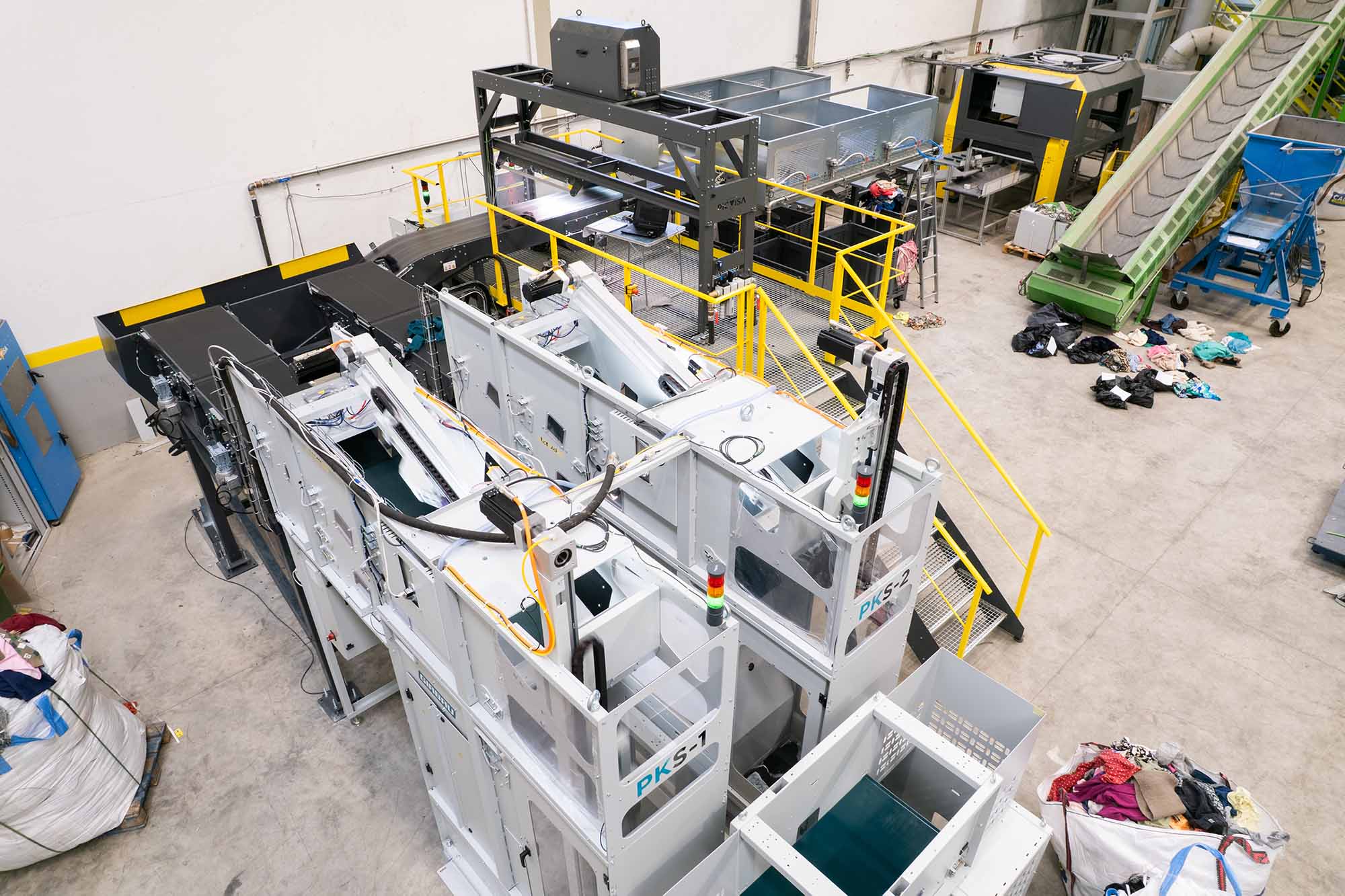
PICVISA and Girbau drive the industrial automation of post-consumer textile recycling with a new plant in Northern Europe
The need for automated recycling plants
Gregorini tells WTiN when looking at the bottlenecks in post-consumer textile sorting lines, the feeding stage stood out as a “critical, unsolved challenge”.
“Girbau had already solved that problem in industrial laundry,” she says. “Applying their expertise to textile recycling is a natural step and a global opportunity, aligned with their mission of generating a positive impact on people and the planet.”
In Europe along, 12.6 million tonnes of textile waste is generated annually. While some is redirected towards re-use, only 7% of this total is currently recycled, with just 1% in a closed loop to produce new textiles.
Gregorini further explains: “The bottleneck has always been that sorting lines are enormously labour-intensive. Our collaboration with Girbau creates, for the first time, a single continuous and fully automated line – from garment feeding right through to optical sorting and classification.”
The objective of the collaboration is to optimise the initial phase of the recycling chain, which has traditionally been the most labour-intensive.
There are three major challenges to overcome, however, according to Gregorini. The first is volume and the quantity of post-consumer textiles, which is rising since the EU now requires all its member countries to implement systems to manage 100% of their textile waste, which Gregorini says is more than 16 million tonnes per year.
Next, she cites the complexities textile recycling faces. The sorting textile materials, including blends of different fibres, which are difficulty to identify accurately at speed. And finally feeding. She says getting irregular, tangled garments onto a conveyor belt consistently and automatically has historically required a great deal of manual intervention.
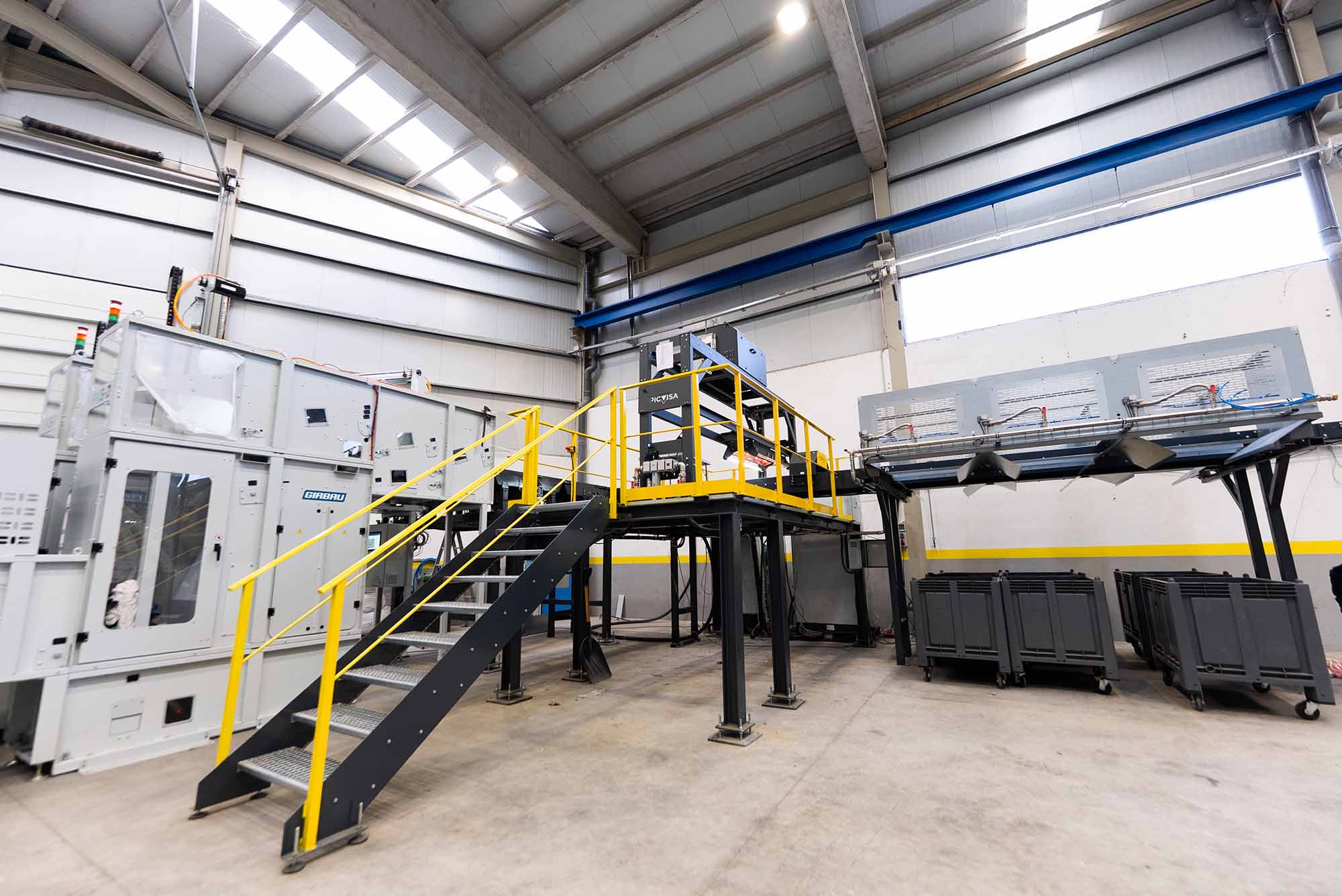
The collaboration combines Girbau’s automated feeding technology, Sortech, with PICVISA’s ECOSORT optical sorting solution
How AI can solve these challenges
This plant positions itself as one of the first in Europe to fully integrate automated feeding and advanced optical sorting for post-consumer textile treatment, marking a key step toward the industrialisation of the textile circular economy.
Girbau’s Sortech system is designed to automate the feeding, separation and controlled distribution of garments in high-volume industrial environments — replacing repetitive manual handling and ensuring a consistent material flow to downstream processes.
Meanwhile, Picvisa’s Ecosort Textile system combines near-infrared (NIR) spectroscopy, RGB vision cameras and machine-learning algorithms to identify fibre composition at an industrial scale.
“We integrate various complementary technologies to ensure unparalleled accuracy — including colour separation, defect identification, and contaminant extraction. RGB systems are used for colour classification, while inductive sensors identify metals in garments,” explains Gregorini.
She adds that AI is “critical” in Picvisa’s sorting process. She says by utilising AI algorithms, the team can achieve the classification of materials that may be identical in colour and composition but differ in appearance or shape, guaranteeing precise sorting outcomes.
“In plain terms: a garment passes along a conveyor at speed, our system reads its fibre composition in real time, and an air jet diverts it to the correct output stream.”
Implementing AI into textile recycling systems
“When we started in textile sorting, AI was largely theoretical in this application,” says Gregorini. “What we have seen over the past few years is a rapid maturation – from systems that could only detect broad categories to systems like ours that can distinguish between fibre blends, identify knit versus woven construction and flag contamination.”
The biggest challenge Picvisa has had to overcome is teaching its system to handle “the enormous variability” of post-consumer textiles.
Garments have different constructions, different blends, different states of wear, and different contaminations.
Gregorini adds: “Building training datasets large and diverse enough to make our AI robust took significant time and investment. The feeding challenge — getting tangled, irregular garments to present consistently to the optical sensors — was also something we worked hard on, which is ultimately why the Girbau partnership made such sense.”
However, it is not just the performance of AI that has become a challenge. There are questions about the transparency of AI decision-making. Operators want to understand why a garment has been classified in a particular way, Gregorini adds, especially when they are making decisions about material streams destined for recycles.
There is also unease surrounding data and the cost and complexity of implementation. There is also concern about how it will affect human jobs.
Gregorini says: “What we see in practice is that automation allows facilities to handle far greater volumes than would be possible with manual labour, which means the sector grows and creates different, better-quality roles — in plant management, quality control, data analysis, and maintenance. The objective is not to eliminate people but to make the overall system viable at the scale that regulation and the circular economy require.”
Moving forward
We are still far off the infrastructure needed for textile recycling to solve the textile waste problem. The infrastructure is not where it needs to be to handle the volume of textile waste that regulations and consumer demand are generating.
Picvisa hopes the new plant will be both a commercial facility and a reference site — demonstrating to potential clients across Europe and beyond that the technology works at industrial scale.
“We will be showcasing it at industry events and through direct engagement with collection operators and recyclers who are under pressure to automate,” adds Gregorini.
She is confident “AI will be the enabler of true fibre-to-fibre circularity”. As AI sorting improves purity levels, she says it will unlock the “economics of chemical and mechanical recycling”.
“We also expect AI to play a growing role in traceability — understanding where materials came from, what they contain, and where they will go next. That data layer will be as important as the physical sorting.”
Gregorini adds: “Our vision is to be the backbone of the circular economy for textiles — the technology layer that makes large-scale, accurate, automated sorting a reality everywhere. We are already working on new facilities in Italy, France, and Spain, and we see significant opportunities in the Americas and Asia as those markets face the same regulatory and volume pressures that Europe is navigating today. The Girbau partnership is a template we intend to replicate: finding the best partner in each part of the value chain and building integrated, scalable solutions together.”
Have your say. Join the conversation and follow us on LinkedIn