



Under the UK’s Sustainable Manufacturing and Environmental Pollution (SMEP) Programme the Solidaridad Network Asia led a project assessing modular wastewater treatment and recycling in Bangladesh.
Early this year (2026) a pilot project in Bangladesh was launched to trial a modular wastewater treatment and recycling solution in the textile industry to address one of the country’s major sources of industrial water pollution.
The SMEP Pilot Project was funded by the UK Foreign, Commonwealth Development Office (FCDO) and is led by the Solidaridad Network Asia with consortium partners QStone Capital, Lenntech, and Kingsley.
The project was positioned as a derisking tool for textile wastewater recycling in Bangladesh. Bangladesh is a major global producer of ready-made garments, with exports of over US$42bn annually. Yet, most textile producers utilise linear water treatment systems, which depend on freshwater extraction.
This puts pressure on the sector as freshwater is scarce, there is tightening discharge standards and sustainability expectations from consumers is growing.
Yet, there are few economic incentives for producers to adopt circular principles and treat wastewater for reuse, which discourages investments in more advanced Minimum Liquid Discharge (MLD) water treatment solutions.
The SMEP Pilot Project aimed to recover up to 80% of Effluent Treatment Plant (ETP)- treated water and generate an understand of reject-stream treatment and ZDHC progressive limit compliance.
WTiN spoke with the project team about their research:
Q: How does textile wastewater differ in different countries and regions?
A: Textile wastewater composition varies depending on processes and chemical used. In Bangladesh, wastewater often contains high levels of dyes, chemicals and suspended solids due to intensive wet processing. While some countries have stricter enforcement mechanisms and advanced infrastructure, Bangladesh faces challenges in consistent monitoring and compliance with regulations.
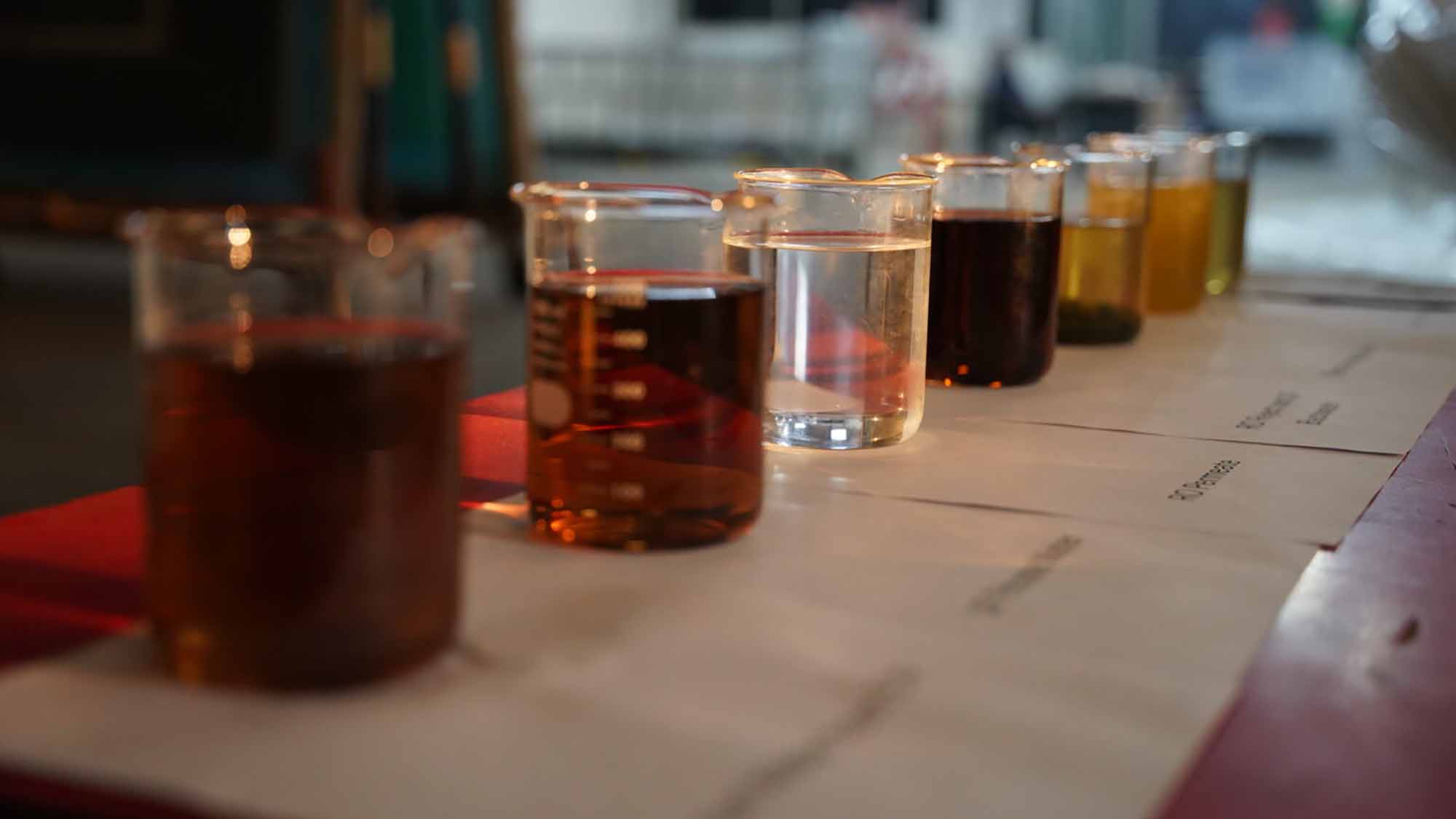
Water samples taken from different stages in the treatment process
Q: What is water bankruptcy and who is at risk?
A: Water bankruptcy refers to a situation where water demand exceeds sustainable supply, leading to severe scarcity. In Bangladesh, industrial zones with high concentrations of textile factories are particularly at risk, as groundwater depletion and water pollution threaten both industrial operations and local communities.
Q: Have you encountered challenges while installing the pilot plants in Bangladesh? And other countries?
A: Yes, key challenges included delays in customs clearance and difficulties in securing tax exemptions for imported equipment in Bangladesh, which affected timelines. Additionally, there has been limited concrete interest from major fashion brands in terms of exploring, discussing and adopting our financial model. We also faced some challenges with people accepting the technology due to their past bad experience with incompetent suppliers. Similar constraints exist in other countries, depending on regulatory conditions.
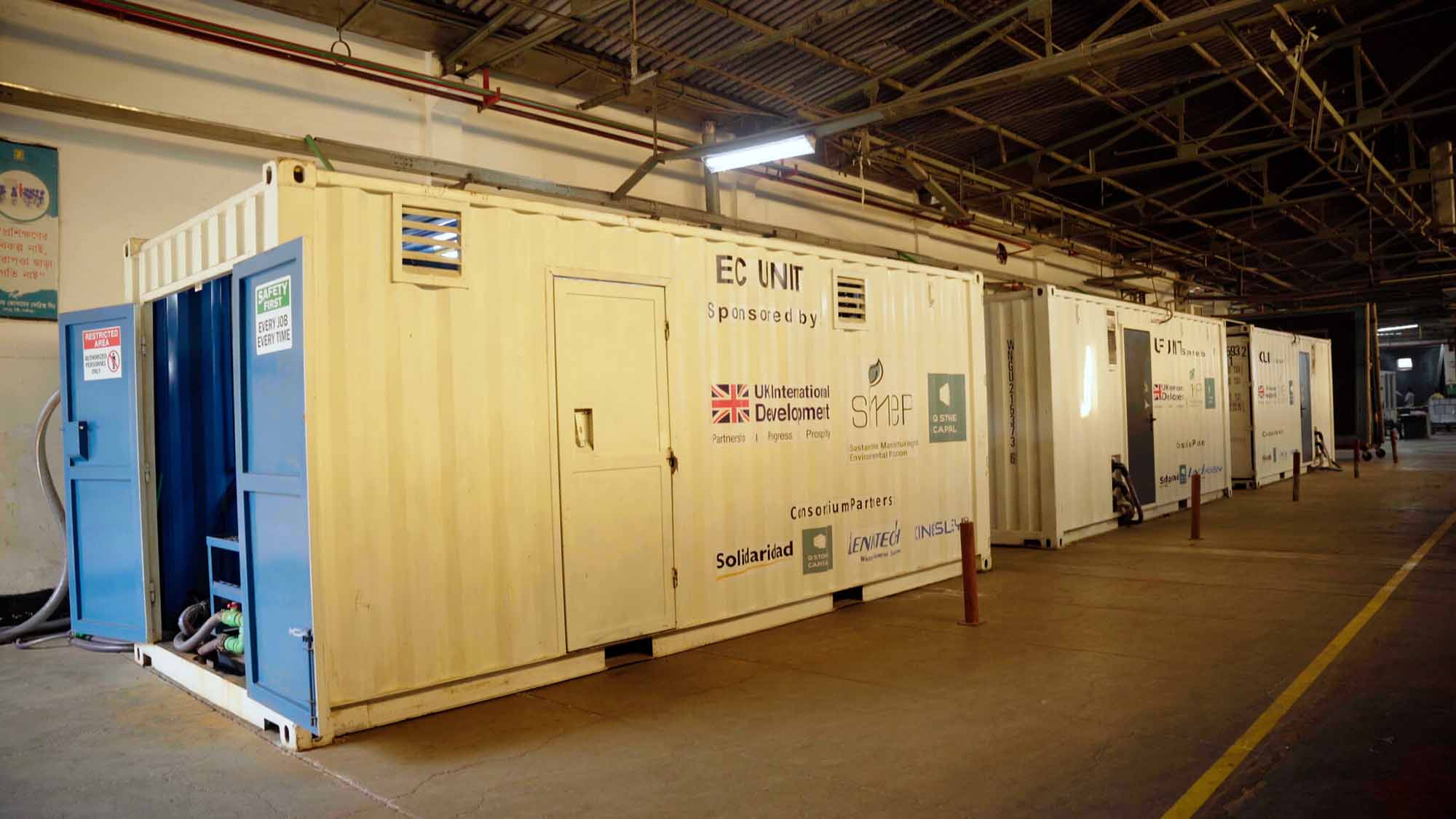
The three pilot containers deployed on site in Bangladesh, sponsored by FCDO SMEP and consortium partners
Q: What are the financial barriers facing textile wastewater treatment?
A: Key barriers include high capital expenditure for installation, recurring operational and maintenance costs, limited access to affordable financing, and lack of direct financial returns from treatment investments. Since wastewater treatment does not generate additional revenue, it is often deprioritised compared to production-related investments.
Q: Why is it important to have a financing model for treating wastewater?
A: Wastewater treatment systems require significant upfront investment and ongoing operational costs. Without a dedicated financing model, many factories struggle to adopt or maintain effective systems. There are no proper incentives from the government or the fashion buyers. A structured financing mechanism ensures that environmental compliance is adequately paid for and becomes accessible, predictable and scalable across the industry.
Q: How expensive are treatment plants to run – who pays the cost?
A: Operational costs vary depending on plant size, technology and wastewater load, but they are significant enough to discourage consistent operation without adequate coverage of costs. At present, factories bear these costs. Our model aims to redistribute this burden through innovative financing mechanisms, reducing pressure on individual producers.
Q: How interested is the fashion and textile industry in championing recycled textile wastewater? Are they keen to get behind your work?
A: There is growing interest, particularly from global brands championing sustainability. However, translating interest into consistent financial or operational support remains a challenge. Treating textile wastewater for re-use instead of discharge bears higher costs that threating wastewater for discharge. This cost gap is one of the reasons we are developing a finance solution that makes sustainability claims unambiguous as it is auditable and result oriented; priced per units of water that have been treated for re-use. It is immediately scalable and fashion brands (and others) can buy these “auditable results” as fungible items to compensate for textile wastewater being generated at production of garments produced at factory they are sourcing from. This provides a basis to offer consumers a solid sustainability claim with its associated commercial value.
Q: What potential has your plant in Bangladesh displayed?
A: The pilot in Bangladesh has demonstrated technical feasibility and provided valuable data on treatment efficiency and operational requirements. Our work here has shown that similar challenges exist across regions, reinforcing the need for adaptable and scalable solutions. Together, these experiences highlight strong regional potential for replication.
Q: Can the plant and the technologies you are using be scaled?
A: The pilot has been designed with scalability in mind. The technologies are modular and adaptable to different factory sizes and wastewater profiles. With the right financing and operational support, the model can be replicated across multiple facilities and regions.
Q: How far does the pilot reach?
A: Currently, the pilot operates at the factory level, treating wastewater generated within the facility. However, the broader vision is to expand this model across clusters of textile factories, increasing collective impact and enabling shared infrastructure where feasible.
Q: What are you working on moving forward?
A: Moving forward, we are focused on maintaining and optimising pilot operations, refining technical performance and piloting and subsequently scaling our financing model, particularly through the development of a digital certification and tokenisation framework. This will enable more transparent, scalable and sustainable funding flows to support wastewater treatment adoption across the textile sector.
RESULTS
- 80%+ denim water recovery
- 60-70% reactive dye recovery
- ~100 mg/L permeate TDS (both)
- $0.30/m3 partial recycle cost
- Vs $2.20 conventional ZLD cost
The team reports: “Partial water recycling is technically proven, economically compelling, and commercially ready. At $0.30/m3 versus $2.20/m3 for thermal ZLD, factories do not need to wait for full zero liquid discharge to act. The time to scale up is now.”
They also set out a list of recommendations saying factories should be conducting water audits; segment-based piloting; and monitor feed quality. Tech providers should offer performance envelopes by wastewater type tied to feed chemistry, energy, cost and reject strategy; while programme sponsors should support second-phase brine management pilots and policy makers should review import duties on recycling equipment and consider targeted incentives for validated recycling systems.
To scale up, the team say they need first strengthen water accounting and reduce avoidable consumption before investing in recycling. They want to prioritise denim and twill for its commercial projects and design reactive dyeing systems with 60-70% recovery and dedicated polishing provisions. Then they will pilot non-evaporative brine management before committing to thermal Zero Liquid Discharge (ZLD) capital expenditure and embedding local Operations and Maintenance (O&M) capability, standard operating procedures and monitoring.
Have your say. Join the conversation and follow us on LinkedIn