




-
Understanding the commercial readiness scale
WTiN’s Commercial Readiness Scale gives an indication of what stage of commercialisation a product is at. It ranges from Emerging: a research stage development; Scaling: the product is being produced on a small but growing scale, and Commercialised: the product is well-established and ready to purchase.


Sponsored by Outlast Technologies
This white paper from Outlast Technologies provides an evidenced summary for brands, R&D departments and decision makers of its Outlast garments as they relate to temperature regulation.
Abstract
Skinos Co., Ltd. is a Japan-based research organisation specialising in quantitative assessment of human thermophysiological responses, including sweat rate, skin temperature and heat flow. The underlying measurement technology originates from academic research at Shinshu University and Nagano National College of Technology, Japan, developed with the involvement of renowned experts in human thermoregulation, including Professor Toshio Ohhashi and Professor Masao Sakaguchi. The studies referenced in this white paper were conducted using validated Skinos measurement systems and established protocols, providing reliable and reproducible data to evaluate the interaction between textiles and the human body under controlled conditions.
Study design and methods
The study was conducted under controlled laboratory conditions with healthy adult subjects wearing Outlast and non-Outlast garments in a crossover design. Participants completed alternating rest and walking phases at defined intensity levels in a climate-controlled environment. Key parameters including heat flow, skin temperature and sweat rate were continuously measured at predefined body sites to assess thermophysiological responses during activity and recovery.

Woman with Outlast Shirt
Test garments and methodology
Two T-shirts made from the same base fabric (90% polyamide / 10% spandex) were evaluated under controlled laboratory conditions: one incorporating Outlast® Temperature Regulation and one reference shirt without Outlast®. Both garments were identical in construction, fit and textile properties to ensure that any differences could be attributed solely to the temper-ature-regulating technology.
The Outlast® garment was based on a standard material from the Outlast® collection featuring Matrix Infusion Coating (MIC) technology - an ultra-thin coating that integrates Outlast® Tem-perature Regulation directly onto the fabric, enabling it to absorb, store and release excess body heat while maintaining the original structure and hand feel.
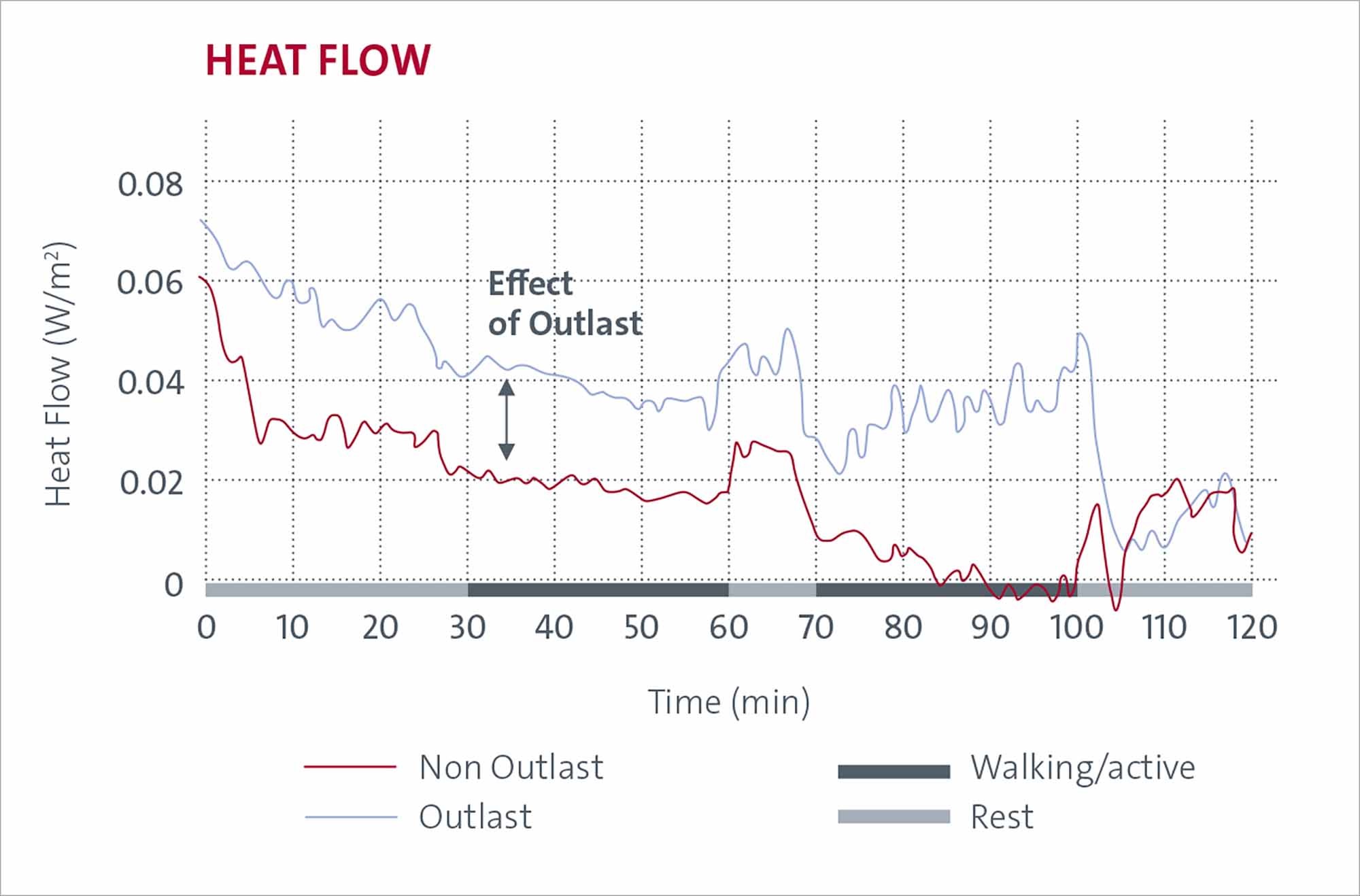
Physiological evidence for Outlast® temperature regulation using advanced sweat & thermoregulation measurement: heat flow
Heat flow results (W/m², back measurement)
Across all test phases, garments incorporating Outlast® showed a higher heat flow at the back compared to non-Outlast reference garments, indicating increased heat absorption from the skin into the textile. This effect was most pronounced during activity phases and contributed to a reduction of peak thermal load at the skin surface. While individual variability was observed, the overall trend confirms that Outlast® actively absorbs excess body heat at the back, supporting a more balanced thermal state during wear.
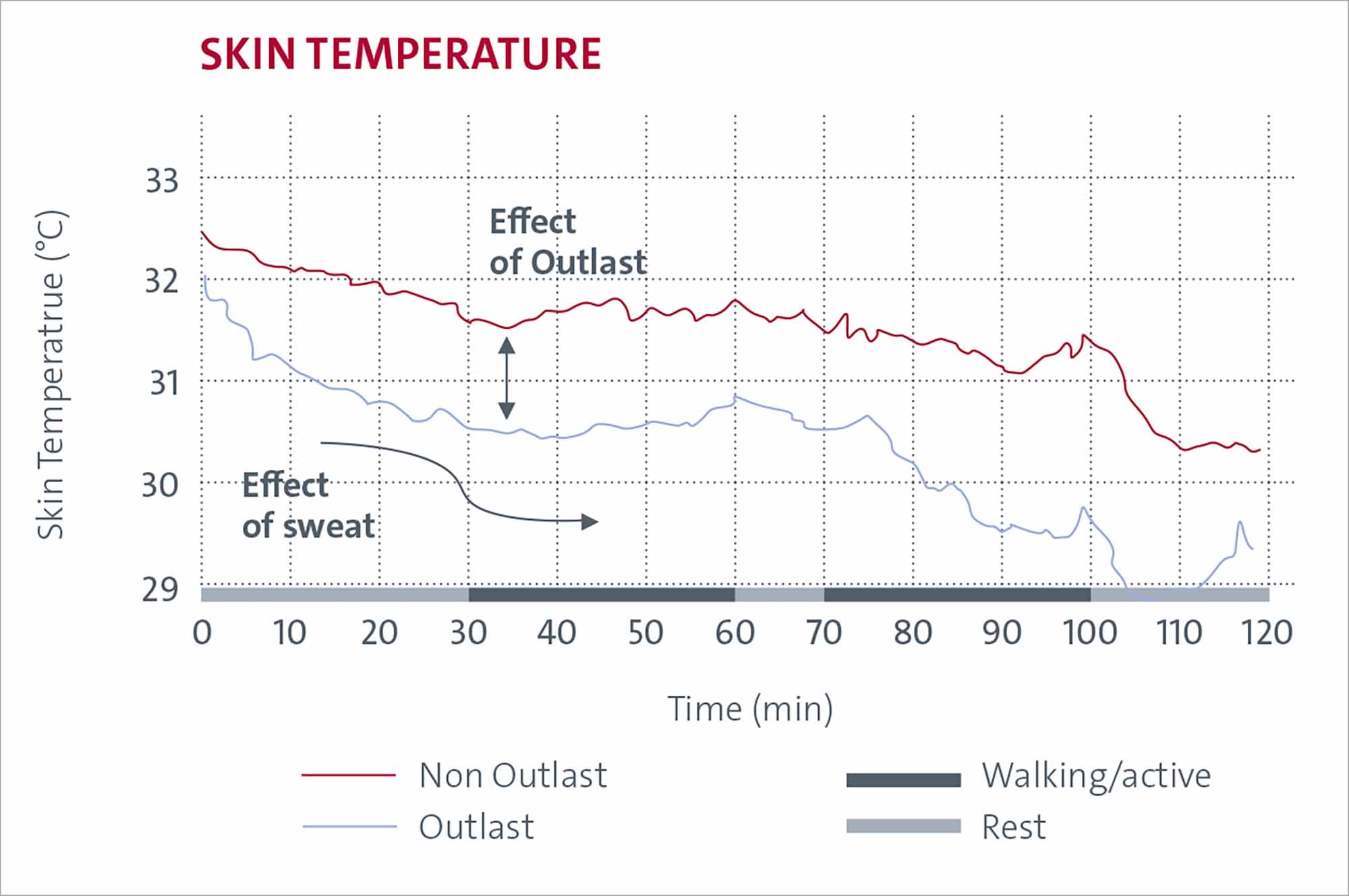
Physiological evidence for Outlast® temperature regulation using advanced sweat & thermoregulation measurement: skin temperature
Skin temperature results (°C, back measurement)
Skin temperature measured at the back was consistently lower when wearing Outlast® garments compared to non-Outlast reference garments. This indicates effective absorption of excess body heat by the textile, resulting in a reduced thermal load at the skin surface. Despite individual variability, the overall results show that Outlast® helps maintain a more stable and controlled skin temperature, particularly during activity phases.
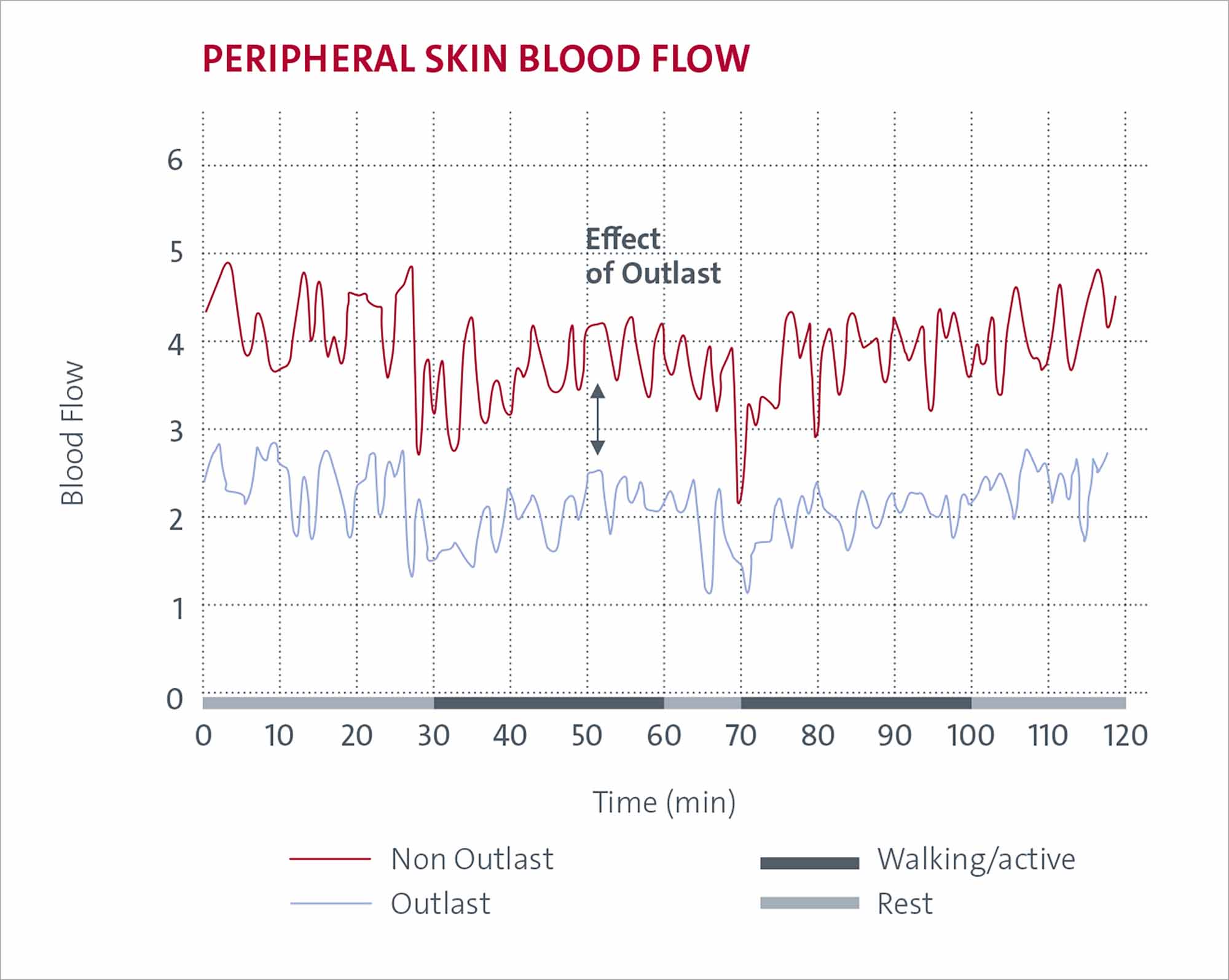
Physiological evidence for Outlast® temperature regulation using advanced sweat & thermoregulation measurement: peripheral skin blood flow
Peripheral skin blood flow and wearer comfort
Human thermoregulation is primarily controlled by changes in peripheral skin blood flow. When excess heat accumulates, vasodilation increases blood flow to the skin, raising skin temperature and triggering sweating. The SKINOS studies show that Outlast® temperature-regulating materials absorb excess body heat early, thereby reducing the need for vasodilation. As a result, peripheral skin blood flow remains significantly lower compared to non-Outlast garments, particularly during prolonged activity. This leads to more stable skin temperatures, delayed and reduced sweating, and lower physiological strain. For the wearer, this translates into a drier microclimate, improved thermal stability, and sustained comfort across activity and rest phases.
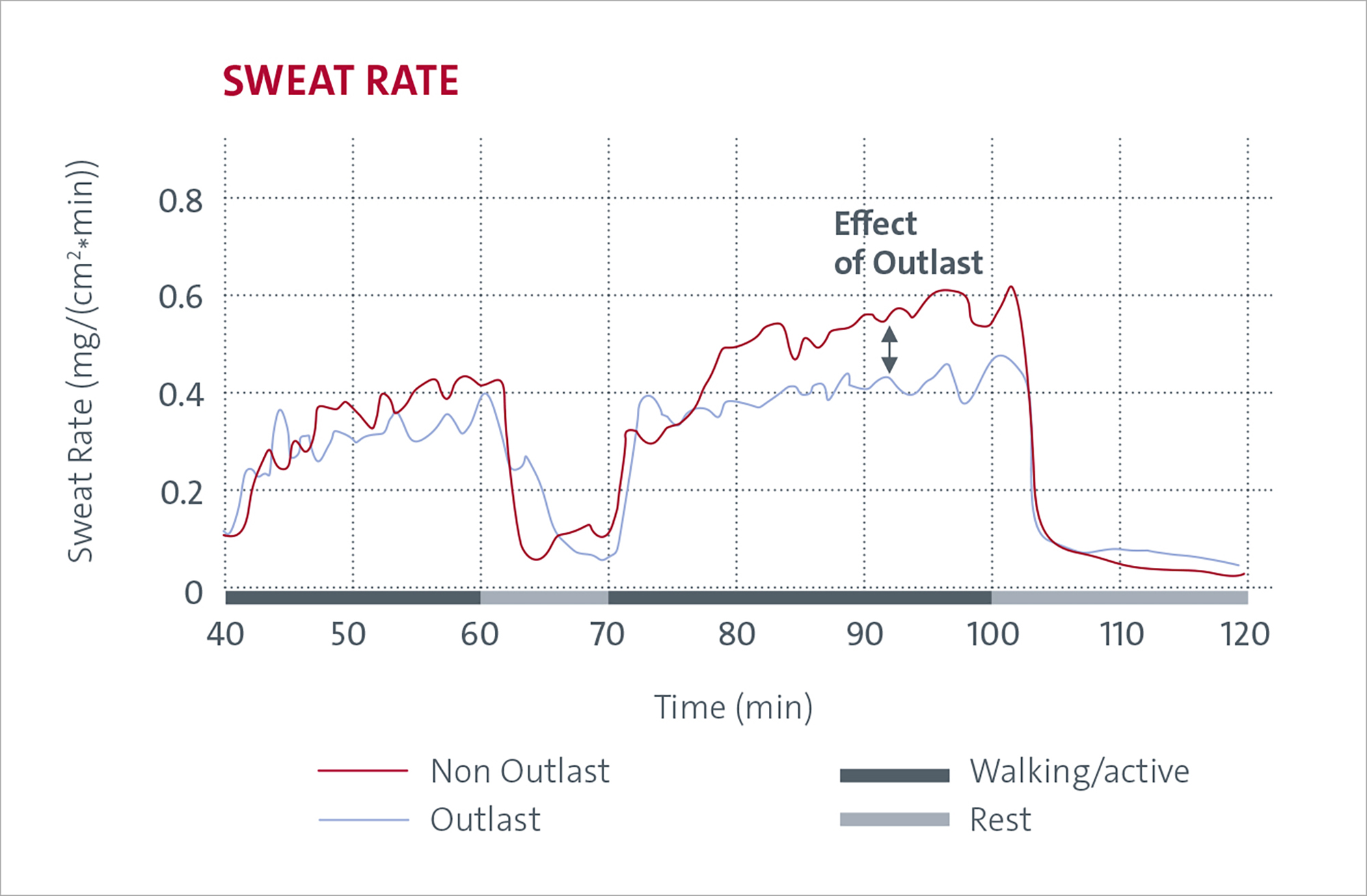
Physiological evidence for Outlast® temperature regulation using advanced sweat & thermoregulation measurement: sweat rate
Sweat rate results (measured at the chest)
Chest sweat rate measurements indicate that Outlast® supports effective thermal regulation while reducing perspiration. By absorbing excess body heat and stabilising skin temperature, Outlast® limits peak sweat responses and delays the onset of sweating, contributing to improved comfort and reduced moisture perception during wear. After activity, the heat stored within the textile is gradually released back to the body, helping to minimise post-exercise cooling and the sensation of chilling.
Thermal image analysis (infrared thermography)
The infrared thermal image compares body surface temperature after 120 minutes of alternating activity and rest in garments with and without Outlast®. The Outlast® condition shows a more uniform and overall lower surface temperature distribution, particularly across the torso and back, indicating reduced heat accumulation at the skin. In contrast, the non-Outlast garment exhibits higher localised temperature peaks, especially in the upper body.
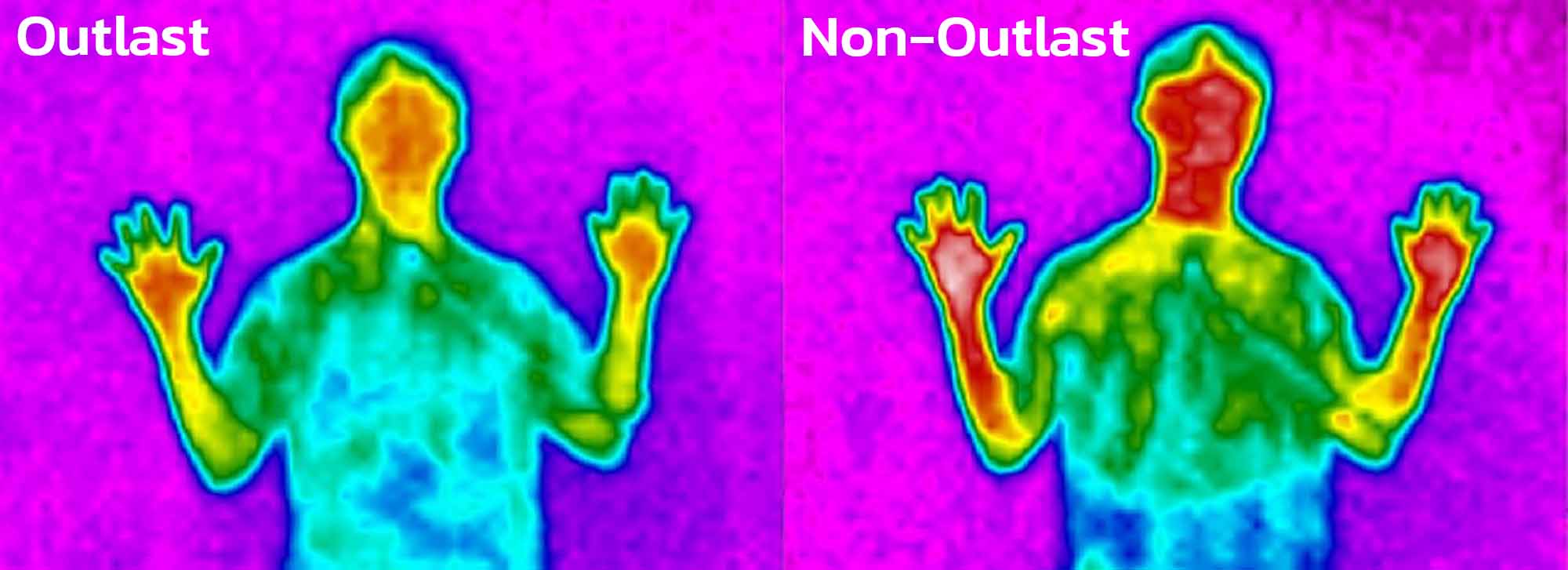
The thermographic results displayed visually support the measured data, confirming that Outlast® effectively absorbs and redistributes excess body heat, leading to a more stable skin temperature profile and improved thermal comfort during prolonged wear.
Conclusion
By integrating Outlast® Temperature Regulation Technology, brands can deliver a measurable and perceptible improvement in wearer comfort across activewear, casual wear, leisure wear, and workwear applications. Unlike conventional solutions that primarily manage moisture after sweating occurs, Outlast® actively regulates the body’s microclimate by absorbing excess heat, reducing thermal peaks and stabilising skin temperature.
For the wearer, this results in less sweating during activity, a more comfortable thermal balance and reduced chilling during rest or recovery phases, as stored heat is gradually released back to the body. This creates a consistent feeling of comfort across changing activity levels and environmental conditions – an advantage that consumers can clearly feel.
For brands, Outlast® provides a clear functional differentiation from competing products. The technology delivers scientifically validated performance benefits that translate directly into added product value, stronger storytelling at point of sale and a compelling reason to buy. As a result, Outlast® Temperature Regulation becomes not only a comfort feature, but a distinct competitive advantage that enhances product performance, brand credibility and consumer preference.
For more information visit: www.outlast.com
Have your say. Join the conversation and follow us on LinkedIn