



Sponsored by MAS Holdings
A materials challenge rarely stays in one place. Solving for durability or performance often requires tracing the issue back through the value chain to the textiles, yarns and polymers used to create a garment.
Often, a challenge facing one group of innovators has already been solved by another; sometimes in an adjacent category or even in an industry far removed from fashion and apparel.
The challenge, then, is not always to invent a solution, but to know where to look for one and how to adapt it for fashion brands at commercial scale. That task has become more complex and consequential as consumers raise their expectations and regulators tighten requirements around circularity, durability and recyclability.
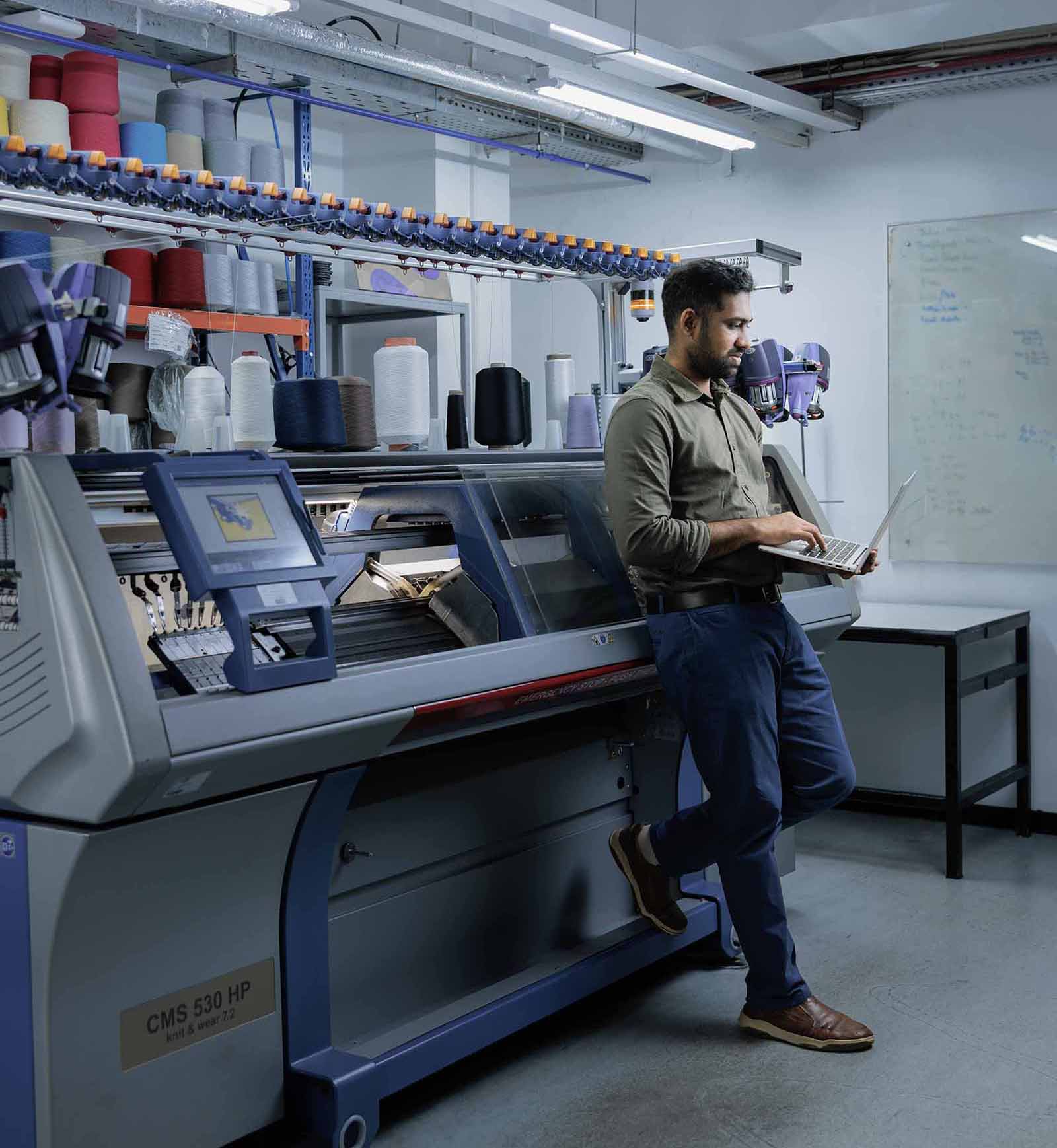
MAS says the future of apparel will be shaped by material innovation
Material decisions once centred on a relatively contained set of questions: how a fabric looked, how it felt and how long it lasted. Today, those decisions must also account for recyclability, cost and speed.
Up to 80% of a brand’s environmental footprint is tied to the materials it chooses (FashionUnited, 2021), while only 1% of the material used in clothing is recycled back into clothing (European Commission, 2022). Choices once made late and in isolation must now be made earlier and alongside a broader set of considerations.
MAS established a dedicated Centre of Excellence for material innovation in direct response to this challenge. Focused on the circularity needs of different product categories, the team brings together cross-category knowledge, upstream partners and proof-of-concept development to create scalable solutions. By combining materials, category and upstream expertise, its mandate is to identify and apply fabric solutions early in product development.
Haritha Ranawaka, who leads the Materials Centre of Excellence for MAS, says: “The future of apparel will be shaped by material innovation. Our aim is to create next-generation material platforms by bringing together science, technology and global partnerships, helping our brands deliver novel products that perform better, last longer and have a more sustainable impact.”

Haritha Ranawaka, Materials Centre of Excellence lead at MAS
While product teams across MAS work closely with customers to understand consumer needs each season, Ranawaka and his team support them by taking on material challenges that require more time, deeper technical input or collaboration further up the supply chain.
A solution developed for one product category may also be relevant elsewhere. This cross-collaboration allows knowledge from one area to inform material development in another while reducing duplication.
Solving earlier in the value chain: from concept to commercial solution
Many material challenges cannot be solved at the fabric level alone. MAS therefore works further upstream, bringing together fibre, yarn, polymer and fabric expertise with research and innovation partners to identify the right material pathway before brands commit to scale. Working at these stages gives the team greater scope to explore opportunities for meaningful differentiation.
Promising proof-of-concept solutions are tested and refined within the wider MAS manufacturing ecosystem and assessed for performance, cost, production compatibility and scalability.
This approach keeps research and commercial delivery connected throughout the development process, helping material solutions move from concept to products that can be manufactured at scale.
Proof in practice: solving real-world material challenges
The result is a range of material solutions addressing challenges in performance, durability, comfort and material composition. One example is colour fading in swimwear, where chlorine, salt water, UV radiation and repeated laundering can affect a garment's appearance and lifespan.
The solution emerged by looking beyond apparel, drawing on approaches used in industries such as automotive interiors and carpeting. The team developed FaDefy, an anti-fade solution that improves colour durability by approximately 2.5 times compared with conventional constructions.
This work also extends to lightweight support and comfort. The patent-pending Comfort Through Lightness platform addresses the challenge of providing support while keeping fabrics lightweight and sheer. Its material architecture combines enhanced holding power with lightweight construction, creating potential applications across intimate apparel, activewear, leggings and other body-contouring products.
A third example is Celluluxe, which focuses on the performance of cellulose-based materials. By re-engineering cellulose-based yarns and fabric constructions, the platform is designed to deliver the look, feel and performance associated with synthetic materials while retaining the natural characteristics of cellulosic fibres.
Ranawaka noted that “every breakthrough begins with a challenge that we want to solve and scale, whether it’s extending the life of swimwear, making lightweight fabrics more supportive or giving renewable materials the performance of synthetics.”
He shared several other examples, including the patented LumiShield solution, which addresses show-through in light-coloured stretch fabrics, particularly in leggings. LumiShield improves opacity through the textile structure while maintaining softness, stretch and breathability.
SmartVent is another solution, addressing sweat and thermal management through a ventilated knit structure that adjusts airflow as activity levels change. Ranawaka also cited UltiSheer, which uses engineered transparency to create lightweight sheer effects while maintaining fabric stability and comfort.
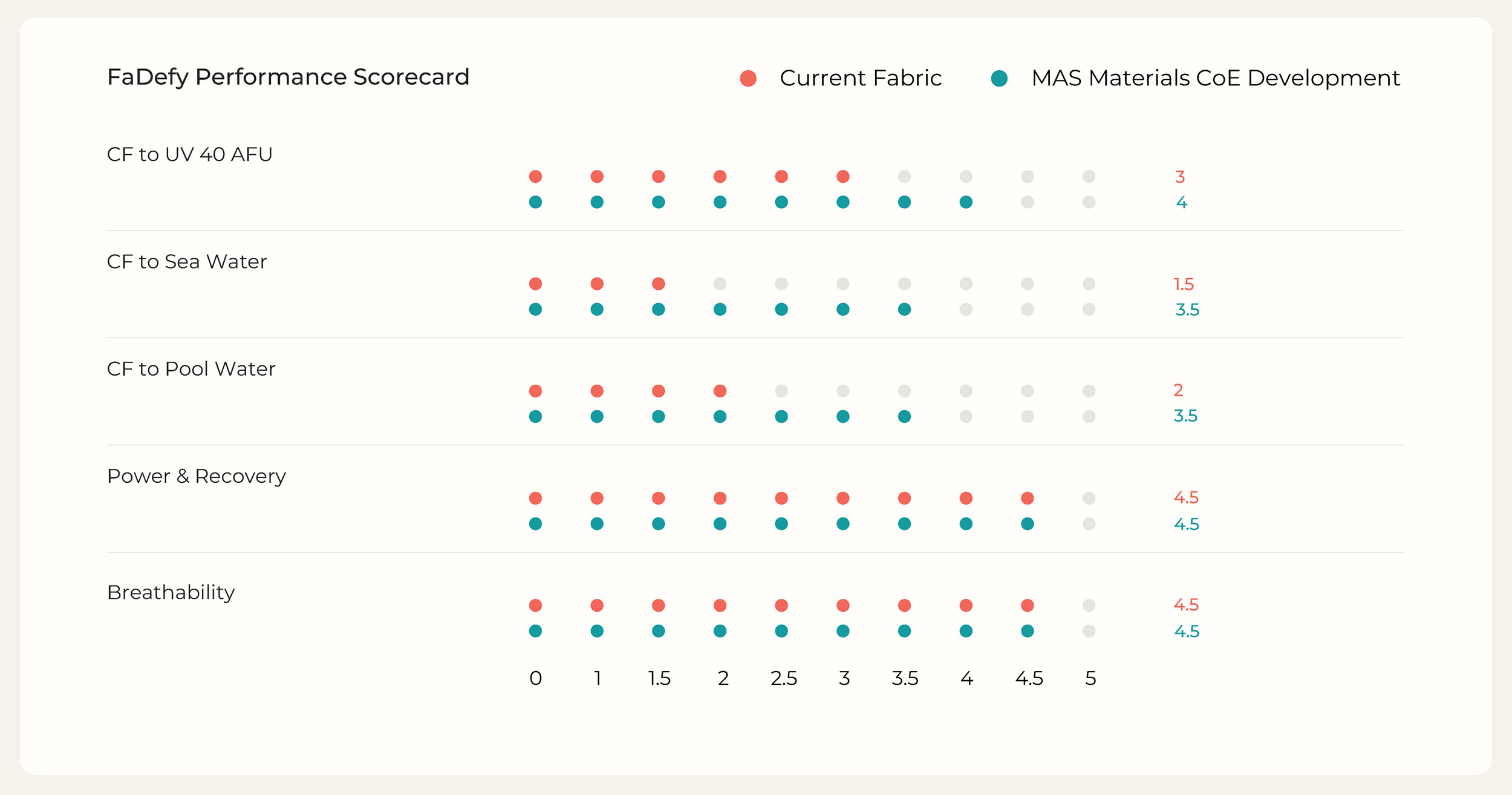
FaDefy performance scorecard
As consumer and regulatory expectations for materials evolve, brands face growing pressure. This shift not only influences how material decisions are made but also highlights the importance of a strong partner ecosystem.
MAS works with research institutes, laboratories, fibre and materials innovators, as well as brands’ innovation and raw-materials teams, helping connect emerging material developments with specific product needs.
For brands, identifying the right material pathway earlier can help address performance, cost, scalability and end-of-life considerations while there is still room to shape the solution. These collaborations expand the range of material technologies available for apparel and can support more than a single product or season. They also have the potential to serve broader category needs over time, enabling ideas to move towards commercial production with greater speed, confidence and technical clarity.
As material innovation becomes increasingly central to how apparel performs and lasts, solving challenges earlier in the value chain will play an important role in shaping what comes next. For innovators working across the material value chain, from polymers and fibres to surface modification, the MAS Materials Centre of Excellence provides a point of connection for exploring how new technologies can be translated into scalable solutions.
For more information about MAS’s work in material innovation, please contact Haritha Ranawaka, Lead for MAS Materials CoE at harithar@masholdings.com
Have your say. Join the conversation and follow us on LinkedIn