

A Juniper Research report, which was published in the first quarter of 2018, forecasts that the smart clothing industry will be worth US$1bn by 2020.
This is a bold claim, but one that the smart textiles market will undoubtedly embrace. For some time, analysts have been hailing smart clothing as a likely saviour of wearables, an industry which has struggled to reach its full potential because of a lack of funding, among other reasons. Consequently, many start-ups have come and gone - one of the most noteworthy was Fitbit rival, Jawbone.
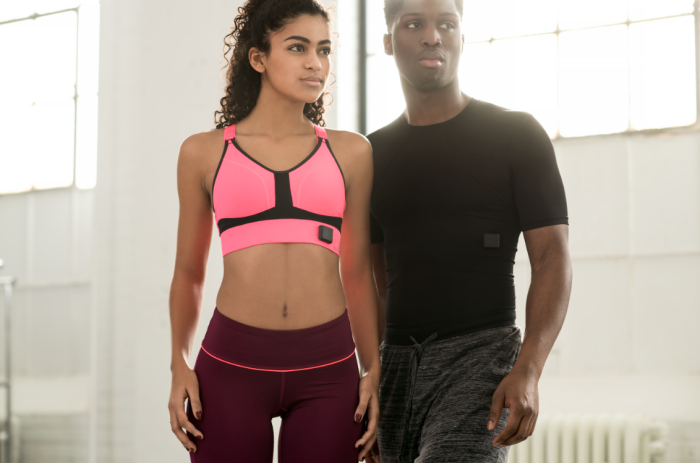 OMsignal manufactures a range of products suitable for men and women
Other issues are associated with reliability and aesthetics. Because of this, wearable products have become a novelty to a large percentage of consumers who discard the item, rather than replacing it, when it breaks.
This signalled a lack of demand for traditional smart wearables, so attention turned to tech-infused clothing. Clothing is an essential component of everyday life, so rather than creating something revolutionary, designers aimed to make small technological improvements to what already existed, without radically changing the appearance of essential garments.
“Aesthetics are a particularly crucial thing to get right in the wearables industry,” says OMsignal’s vice president smart textiles, Aldjia Begriche. “Many preceding products have looked too extreme and have failed to capture people’s imagination – they have also lacked purpose.”
 OMsignal states its products help people live better
Canadian-based biometric smartwear specialist OMsignal manufactures a range of smart garments for men and women that monitor the user’s ECG and respiratory system. The company’s success, since it was established in 2011, typifies the transition from smart wearables to e-textiles.
“At OMsignal, we develop technology that helps people manage their conditions and live better,” says Begriche. “Our products have a purpose, which is key, but what is equally important is that our products blend in with everyday garments.
The medical textiles market was one which benefited substantially from the focus on smart clothing. Scientists and designers realised quickly, through clothing’s proximity to the body, that health monitoring applications could be transformed, according to Begriche. She adds: “The company’s goal is to improve the quality of life for millions of people, so the healthcare industry is obviously an important market for us.”
Additionally, medically-focused wearables have a clear purpose unlike some of the high-profile headline-grabbing products unveiled by some of the world’s wealthiest tech companies and fashion retailers, which appear to do nothing more than make every day mundane jobs even simpler. Alternatively, some of the unsuccessful wearables copy what other devices can do – usually the mobile phone – and therefore fall into the category of a passing craze for many consumers.
“We believe textiles are the future of the smart wearable industry. It is far easier to monitor a person’s ECG and breathing rate in sensors close to the body – which is the case in our products – rather than from a watch on the wrist. For this alone, I believe that the wearables industry will continue to move towards textiles and away from some of the traditional wearable products on the market.”
 Currently, OMsignal's biggest markets are North America and Asia
Nevertheless, devising the perfect smart garment doesn’t come without its own series of challenges. For example, unlike smart watches clothing needs to be machine washable, which can be tricky when you consider that smart sensors have been embedded into the textile that forms the garment. Another issue, also closely associated with practicality, is comfort – a factor that can strongly influence a purchasing decision.
“Making our products comfortable is a top priority for us,” says Begriche. “As a company we aim to make our smart clothing range as comfortable than everyday garments, which has been one of our biggest challenges. If they’re not comfortable to wear people will simply not use them. But, integrating sensors and recording modules onto a garment, while not compromising comfort, is not easy. We work very closely with the manufacturing partners to achieve this and we will continue to do so moving forward to ensure that our smart clothing range is as comfortable and practical as it can possibly be.”
Begriche continues: “I think a lot of wearables have been doomed from the offset because the manufacturers have failed to prioritise the quality of the textile. A textile-based smart wearable is, first and foremost, a garment and therefore needs to fully function like one. Too many products are infused with lots of tech but fall short of their primary purpose.”
OMsignal has become a pioneer in the medical textiles sphere having become one of the first companies to manufacture health-focussed smart clothing. Furthermore, the company takes great pride in being among one of a select few companies to have mass-produced smart textiles.
“It was a challenge to make our products scalable,” says Begriche. “Originally it was a huge task to get just one product off the ground. The industry has been experimenting with smart textiles for two decades, but pioneers struggled because everything had to be manufactured for the first time. Every ingredient in a product was brand new and made specifically, therefore a lot of time and expense was added onto the entire manufacturing process. Subsequent high prices then prevented the majority of consumers from purchasing the early smart wearables. Thankfully, now that there has been a steady stream of smart wearables – particularly textile-based – coming to market, there is a specific supply chain in place to make the whole process a lot smoother for current and future creators.”
However, why has it taken so long for the textiles to take a front seat in the development of the smart wearables industry? Begriche says: “Technology was not capable of allowing for the creation of many e-textiles. For instance, the modified yarns were not compatible with the needles in a knitting machine. Now there are industry specific knitting machines on the market. But, during my time in the industry I have witnessed big improvements in yarn capabilities, in terms of both durability and practicality. This is why OMsignal has been able to leverage that early progress.”
A range of man-made fibres are used in the production of OMsignal’s smart wearables, which are no longer sold direct to the consumer since the company, founded in Montreal, adopted a go-to-market set up. Additionally, the data which is gathered by the embedded sensors in the garments are accessible on the OMsignal real-time app, which can be downloaded to the user’s smart phone device.
“Another key to our growth is that we have not just created one product: we have created a full range from sportswear, to nightwear,” states Begriche. “This means a user has the option to gather valuable medical data for longer, during the day and through the night. This enables far more use cases.”
OMsignal’s work has been praised by medical institutions around the world, particularly in North America and Asia, the company’s biggest markets geographically. The company’s products currently include two sensors that are embedded into the garment: one to monitor ECG; and the other breathing. The sensors, which are highly flexible, are embedded into the clothes early in the production process and are therefore barely visible in the final product, according to Begriche.
She adds: “Our products are also customisable depending on the user’s needs. The sensors send information to the attached biometric recording module, before transferring that information to the cloud. This data is collated and, after two days of wearing the garment, can provide a doctor with enough accurate information to make a more suitable diagnosis.”
For some time, scientists have agreed that wearable technology has bags of potential. Now, integrated with textiles – a traditional industry – wearables have finally found a purposeful place to thrive, according to the latest market growth figures.
Have your say. Tweet and follow us @WTiNcomment
RELATED ARTICLES
-
AI on-demand sportswear production tool launched
- Otis Robinson
- WTiN
-
Ecomondo 2026 expands to textiles
- Madelaine Thomas
- WTiN
-
Integrating bicomponent yarns in the US
- Abigail Turner
- WTiN
-
Intelligence
Inline pretreatment ink for reactive dyes
TRENDING




Keywords
Keywords relating to the article being analysed. Hover over the keyword to see the relevance (0 low relevance, 1 high relevance) and click a keyword to open a search for more related content.