The first sale of 2019-20 Australian wool season held this week was much better than last year’s closing sale and was topped off by a firm finish. There was a bit more business around this week, perhaps helped by getting the G20 behind. Nearly all types and descriptions on offer gained value. Whether this trend continues is yet to be seen, but sentiment clearly moved from gloomy to buoyant in the space of just the one week. Confidence was key to the wool market’s outlook and that is present at the moment. However, conversion to fresh forward business in volume was missing and is needed to achieve complete stabilisation down the supply chain.
Business activity this week saw strong competition between top makers from China and local Australian-based traders. Indent buying by the two big operators from China is yet to return to normal and both these companies were outside the top positions of buying lists, where they usually stay. Nevertheless, it was unclear if the stronger buying intent from almost all traders was to cover off of old sales or was indeed a pre-cursor to renewed buying interest from overseas manufacturers.
The Australian Wool Exchange Eastern Market Indicator finished the week up 0.5% or 81 cents at 1,723 cents a clean kg. In US Dollar terms, the EMI gained 1.1% or 13 US cents at 1,212 US cents clean a kg. On Wednesday, the EMI dropped 5 cents to 1,710 a kg clean and down 3 cents at 1,196 US cents a kg. On Thursday, it firmed up 13 cents to 1,723 cents a kg and by 16 cents in US dollar terms to 1,212 a kg.
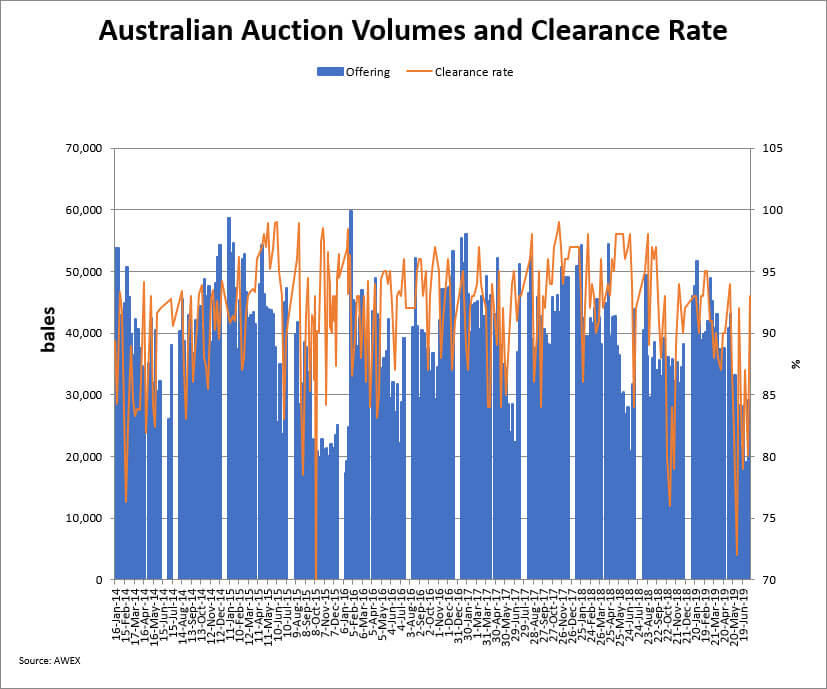
The national offering was 30,991 bales, compared with 29,167 bales in the previous week. The clearance rate improved to 93% from 80% in the previous week. The AWEX reported the value of the wool sold was AUD$53.9 million (AUD$1,858 per bale), taking the season total to AUD$53.9 billion. The previous season’s average was AUD$2,140 per bale.
Sydney sales saw another week of falling prices across the microns. Good, average and inferior style lots again dominated the selection with discounts compounding for lots with low staple strength (<30 N/ktex). Merino skirtings eased during the week with oddment lots also losing ground. The Northern Regional Indicator closed at 1,731 a kg clean, losing 58 cents with clearance rate of 83% as against 88% in the previous week. On the second day, increased offering of 19-20 micron wools were keenly sought across all types and descriptions, ending the day dearer. The finer microns attracted solid buyer competition for all types and descriptions, pushing the micron price guides higher. Merino skirtings strengthened across all categories while crossbreds ended generally unchanged across all microns. Thus, the first week ended on a positive note, with price increases across all microns and a clearance rate of 98%.
In Melbourne, new season began on a more positive note than the closing of the old season. High clearance rates and widespread competition was seen only small reductions across all microns. At the close of the first day, selling all microns were indicating small reductions. Fewer style offerings and less well measured wools were most affected with some well measured wools recording increases. On day two, strong widespread competition and high clearance rates stimulated the market to climb a solidly across the entire micron spectrum. Merino skirting wool was driven upward in line with fleece wools with most microns adding many cents to all descriptions. Crossbreds increased early driven by a good selection of well-prepared wool. The Southern Regional Indicator gained 8 cents to 1,713 cents a kg clean with clearance rate of 93% as against 83% last week.
In Fremantle, auction started 2019-20 season strongly. 22% of the offering was withdrawn prior to sale, but what was left attracted strong widespread competition as buyers fought hard to secure their share of the reduced quantity. The result was price increases across the board. The second day saw further price increases over the first day sale. Gains were seen across all microns, with a passed in rate again relatively low. Merino skirtings of less than 3.0% vm were dearer while those more than 5.0% vm were generally dearer. Crossbreds were insufficient to quote while oddments lost further ground. The Western Regional Indicator ended at 1,867 cents a kg clean with clearance rate of 88%.
In the upcoming season, forecasts from AWPFC sees production levels falling a further 4.4% but this will be re-evaluated in early to mid-August when the committee next meets. Many wool selling brokers were already on record stating that figure is likely to be well short of the decline in the current clip, with early shearing and drought continuing to cloud the real drop-off in supply they are seeing in wool producing regions.
Next week, the second sale of the 2019-20 season will see all three centres operate and 34,831 bales rostered for sale. This will be 14% less than in the same week last year.