
3D printing of textiles is becoming increasingly popular in the couture, high-fashion market. But Frances Murphy is developing 3D printed textiles that can look, feel and hang like normal textile fabrics, while ensuring the garments themselves are biodegradable and that the manufacturing process is more sustainable.
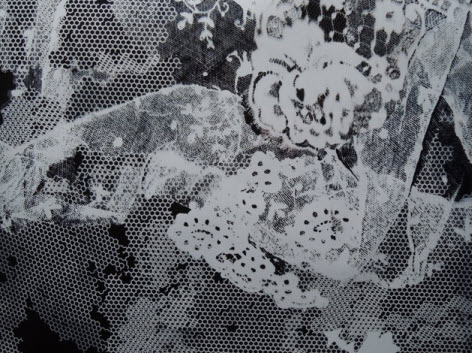
Frances Murphy's 3D printed lace
An entrepreneur in the textile industry, having worked in several areas in the market, Murphy is now a student at the Royal College of Art. Throughout her career she has continually been exploring what sits at the forefront of technology in a bid to keep up with the demanding fashion market. For example, she was at the forefront of digital textile printing when it was first introduced and is now, also looking into whole garment knitwear. As an ambassador for CREATE Education, ‘a collaborative platform that provides free resources and support, helping educators to introduce and embed 3D Printing technology in the classroom’, Murphy’s work looks at traditional textile structures, and how these could be interpreted through 3D print technology.
To create 3D printed textile structures that are biodegradable Murphy is using bioplastics and cellulose. She explains: “I’m using bioplastic filament from a company called Biome 3D. I’m looking to develop what I’m doing in terms of 3D printing lace in the company’s biofilament.” However, Murphy does not want to create something as part of a couture project, but wants the structures she creates, and the way she creates them, to be used on an industrial level. She adds: “With developing bioplastics, it has to be done on an industrial level in order for it to be of any use to me, because of my background in fashion I want to make sure that it is applicable to a real industry.”
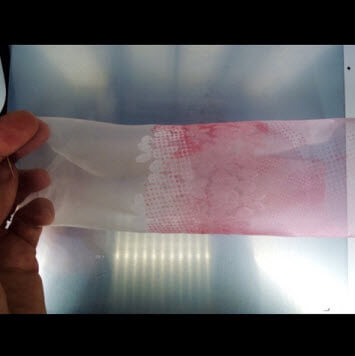
3D printed lace over textiles created by Frances Murphy
Murphy has also been working with plastic filaments that are already available on the market, such as PLA (polylactic acid) and TPU (thermoplastic polyurethane), which are not biodegradable. As a result, Murphy is now attempting to work with Biome. She says: “A recently developed filament, Biome, could be really important in assisting what I am working on at the moment. I’m at the early stages of development and what’s important to me is progressing a fabric through 3D printing, which I have currently based on lace, to enter the real, manufacturing world.”
And this approach seems to be paying off for Murphy, who has had large manufacturers of lace and various sports fabrics and performance fabrics, contact her to express their interest in the way that she has started to print lace onto existing fabrics, which could lend itself to them using it as prototypes in the future. Murphy says: “To set up a loom, it can be expensive and very time consuming to produce samples for customers to look at. It could be the beginning of 3D printing coming into the textile industry in terms of manufacturing. Once you get one manufacturer to take on that, and it works, then they’re more willing to look at it on a bigger scale because it’s beneficial to them.” She continues: “I still want to create a beautiful product, but at the same time I want to be able to make sure that it can eventually be sustainable and also be real in terms of its production. Because if you haven’t got that then you’re not touching on the real industry. To me, that is really important.”
3D-printed textiles
One of the main issues with 3D-printed garments has always been the lack of material/filament to print the textile structure, so finding the right filament has been difficult for Murphy. However, in order to get the project started, rather than 3D printing the entire textile, Murphy has been using fabric to 3D print lace-like structures and add value to a textile.
She says: “To make it look aesthetically lace-like, I have had to use existing fabrics to print on, which is not a new thing. It’s something that lace has always done, since the machines were introduced. There were machines that were producing net, which would then have the applications put on top or embroidery would be put on the top of the net and that was what made it accessible to the masses. I used the same concept in terms of filament. I thought ‘if we are using the filaments that are available at the moment, we can, if we use the right base fabric, print it to actually look like lace’.”
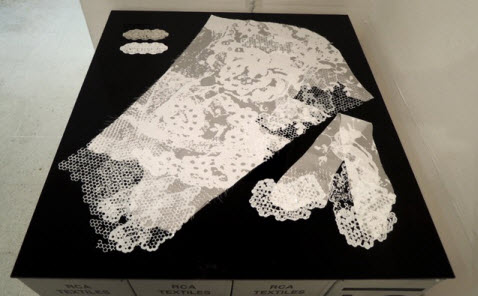
3D printed lace from Frances Murphy
The fabric, complete with 3D-printed lace, can be washed and treated in exactly the same way as normal lace. “Your only restrictions are that the machine is very small – we don’t have larger 3D printers that print lengths in this way,” adds Murphy. “However, if you’re just using it for prototype purposes, it’s really good and saves a lot of resources. With samples, as long as people can touch it and feel it in the same way and it resembles the design of the lace, that’s all they want.”
At the moment, to appeal to the mass market, Murphy comments that additive manufacturing has to be used in conjunction with traditionally produced textiles, because the material simply does not exist for the full textile to be 3D printed and keep its soft touch and flow. Creating that material is what Murphy’s phD is all about. “I am trying to develop material to go through a 3D printer that has a cloth feel,” says Murphy. “That’s something that I am going to have to collaborate with someone on, such as a materials expert. That would have such an impact on the industry itself and the resources that manufacturing uses. In terms of design, the technology is there and a there are lots of people in technology that have that capability, but they have to get involved with designers and manufacturers to make that real and to put it in to action.”
To try and make the finished product feel like a textile and to make it move with the body like a textile, rather than a solid-printed object, Murphy has used TPU, which is a very soft filament. However, this product isn’t biodegradable, therefore Murphy is seeking to address this hurdle. The new Biome filament is, according to Murphy, very flexible so she hopes that this will be a good replacement. She comments: “I’m using an Italian filament, the Italians are very good at making materials and always have been. They have the best fabric and seem to be ahead of the game when it comes to applications for the feel of filament for possible textiles.” Murphy is currently using the filament on nylon and polyester. She adds: “I can use it in any colour and I can also dye in terms of sublimation. I’m not putting it through a massive dye process I’m just doing it digitally. Again, the resources are very limited.”
This limitation of resources is partly because the area is so new to the textile industry. However, with the growth of the ‘batch-size one’ market due to the rising demand for customised products and the pressure for localised manufacturing and greater transparency, this is changing. Murphy says that 3D printing is: “Doing made-to-order on a massive scale. To produce just the one garment, if that could be a possibility, imagine what that could do. Imagine how landfill would be reduced, how we could still demand what we demand from the fashion industry but not with a detrimental effect. That’s what we all have to work towards. It does start with design and manufacturing and the government, they cannot put responsibility on the consumer.”
She advises: “We have to get fabric engineers together to develop the fabric technology and they need sponsorship from government to develop these, such as nylons that are able to be created using 3D printing. It is important because it could be developed into such a process where, in the future, all sorts of things could be embedded in it. For example, it could be the future of smart fabrics, it has endless possibilities. But at the moment, we just have couture pieces that don’t convince people that it is a possibility [on a wider scale]. I want the average person to be able to look at it and think ‘I could wear that/see that in my store on the high street’. That to me makes it possible and makes people think it is possible.”
The cost of 3D printing in this way also makes it more possible. Additive manufacturing is often thought of as an expensive process, but in fact it can work out much cheaper when it comes to the sampling phases of manufacturing. Murphy says: “It is easily more cost-effective than printing a few metres of lace just for sampling.” For example, there is no transport or storage and inventory costs. “All you’re paying for is a pretty low-grade net, approx. GB£4-5/m. You can produce several swatched from this. And, the 3D printing material doesn’t cost very much – around 90/100m on a reel costs about GB£35. So, it is cheap and it is useful,” she continues. “It can definitely be a bonus to a manufacturing process.”
Therefore, additive manufacturing for textile fabrics can be beneficial to an existing production line, rather than replacing parts of a production line and can eliminate a lot of costs and save time for manufacturers and designers. Murphy argues: “I know people say that 3D printing is very slow, but if you compare it to printing lengths of fabric or printing lace, I can do a finished print that isn’t very big – about 24cm x 24cm – and that would take 30 minutes to create. That’s not bad in terms of manufacturing as it can take hours to do a print but because I’m not using much height, it is quicker.”
Machinery
Murphy uses a desktop 3D printer from OEM Ultimaker. She chose this machine because it is readily available on a mass scale and easy to use. She says: “If someone contacted me and said, ‘we’re interested in doing that’, I could say ‘well this material is in production and is available to you.’ That’s what I wanted.”
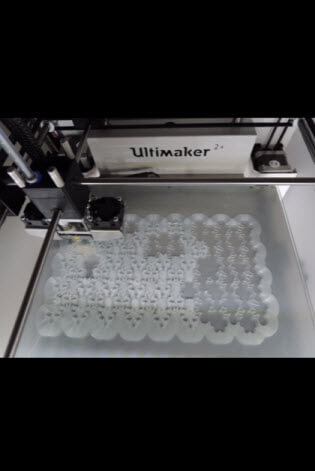
The Ultimaker 3D printer 3D printing lace
However, she says that 3D printers in general are initially built to print 3D objects, not fabric. Murphy says that the next step is to develop a 3D printer for garments that is custom-built for purpose. “An engineer needs to get together with a fashion designer and material engineers to understand how we can change the material that goes into the machine and actually build a new machine to be able to develop garments.”
This development would also mean that some software would have to be developed, specifically for the development of garments, to work in the machine. Murphy comments: “We need the software, a piece of data with all of the wearer’s measurements in. There are people that are working towards that and there are scientists and manufacturers that have got the beginnings of it. There is a company in Japan that produces made-to-measure suits. It sends out, to its customer, a free suit that looks like you would swim in it, lycra-looking, very tight and all embedded components to measure your size. All the measurements, once you put it on, get translated to the manufacturer of the suits and they make suits for you. It’s an interesting idea, the technology is there and is starting to be manipulated.”
Next steps
To make sustainable 3D-printed garments that can be available at an affordable price, with the right material, to the mass market, there are a number of things that need to happen. Murphy says: “Collaboration is key with the technology moving on. Designers, engineers and scientists need to get together and collaborate to develop these materials, technologies in the right way. Everyone together can definitely think about all these issues in terms of the circular economy. We also need to involve the retail sector. I work closely with someone who is heavily into sales on the luxury level, at the forefront of selling to luxury customers. I regularly speak to them to help me understand the latest trends and hot topics within the market. That’s really important. If we don’t have every aspect on the table, it’s not going to go anywhere.” If only engineers and material scientists are involved, Murphy notes that there is no reality to selling the product and it infiltrating the wider market and wider economy. She adds: “The retailer understands the customer, what makes them click, their attention span. Obviously, luxury is very different to high street. Usually luxury is very far ahead of the game and it filters down to high street. When it gets to high street it is important that it doesn’t lose its quality, purpose and aesthetic.”
With the fast-fashion market, it is easy to become consumed by the on-demand society and lose our individuality, according to Murphy. She says: “With high street retailers and larger corporations, we are beginning to lose our culture in fashion and I think that 3D printing could bring that back – it could possibly give the independent person, the consumer, rights to producing. Not everyone wants to be a designer, but it does allow for do-it-yourself designers to engage in designing without the cost (hopefully) and therefore make design, more democratic.”
In the end, it is the consumer that is doing the talking. Murphy concludes: “The consumer demand outweighs our possibility to produce in an ethical way, with good pay, to our labour force and the skill that evolves. The only way forward is technology. The designers, scientists, manufacturers and engineers all need to come together to work towards a circular economy – that is where the younger generation are very well in-tuned. It is up to legislation to embrace this and get everyone working together.”


