Sponsored by International Wool Textile Organisation
As the drive to remove chemicals from across the textile supply chain intensifies, insights from a new study highlight the many advantages wool has in helping clean up the sector. Dalena White of the International Wool Textile Organisation explains more.
In the drive to build and embed sustainability and responsibility throughout the textile value chain, chemical use is an issue at every stage of the product lifecycle. In numerous ways, ‘chemicals’ is a dirty word, and the textile industry – like so many others – is striving to clean up its act.
Wool offers a great natural solution, both in terms of the current state of play, and the direction of travel. Backing up that assertion, insights from a new study identify the relatively low level of chemical residue currently found in raw wool, and show that even these low levels are declining.
Sponsored by Australian Wool Innovation (AWI) in response to EU regulations and increasing consumer interest in improved safety and environmental standards, the study focused on agricultural chemical residues in ‘greasy wool’ (raw wool shorn from sheep) in Australia and New Zealand.
This accounts for almost a third of the global wool supply. From a regulations perspective, the results reveal an abundance of clean wool in both countries, comfortably below the European Union’s residue limits. For trade and consumer audiences, the new data is a timely reminder of just one aspect of wool’s compelling sustainability credentials.
As a natural material, wool offers many advantages at every stage of the product lifecycle. As well as exhibiting a long list of positive characteristics for a huge range of applications, wool is renewable, recyclable and biodegradable.
CHEMICAL RESIDUES
So, how are chemicals associated with the raw material at all? The answer to that is linked to the rearing of sheep. Most wool growers use various medicines to control parasites like lice, ticks and mites. While proper use of these is important to meet animal health and welfare standards, the medicines can contain chemicals that, if not used according to the label, could later be found as residues when the greasy wool is washed.
Residues such as those are presently in the spotlight of European policy makers, as well as a growing number of apparel rating agencies that are adding toxicity to their fibre rating systems, which in turn inform brands as they decide which materials to use in their products.
Some of these agencies play a significant role in lobbying for policy change, which leads back to the very EU regulations that industry has to follow. As is the case for every other material, this scenario has the potential to impact the wool sector, and key to an effective response is the availability of robust data. As it happens, this turns out to be very good news for wool.
DOWNWARD TREND
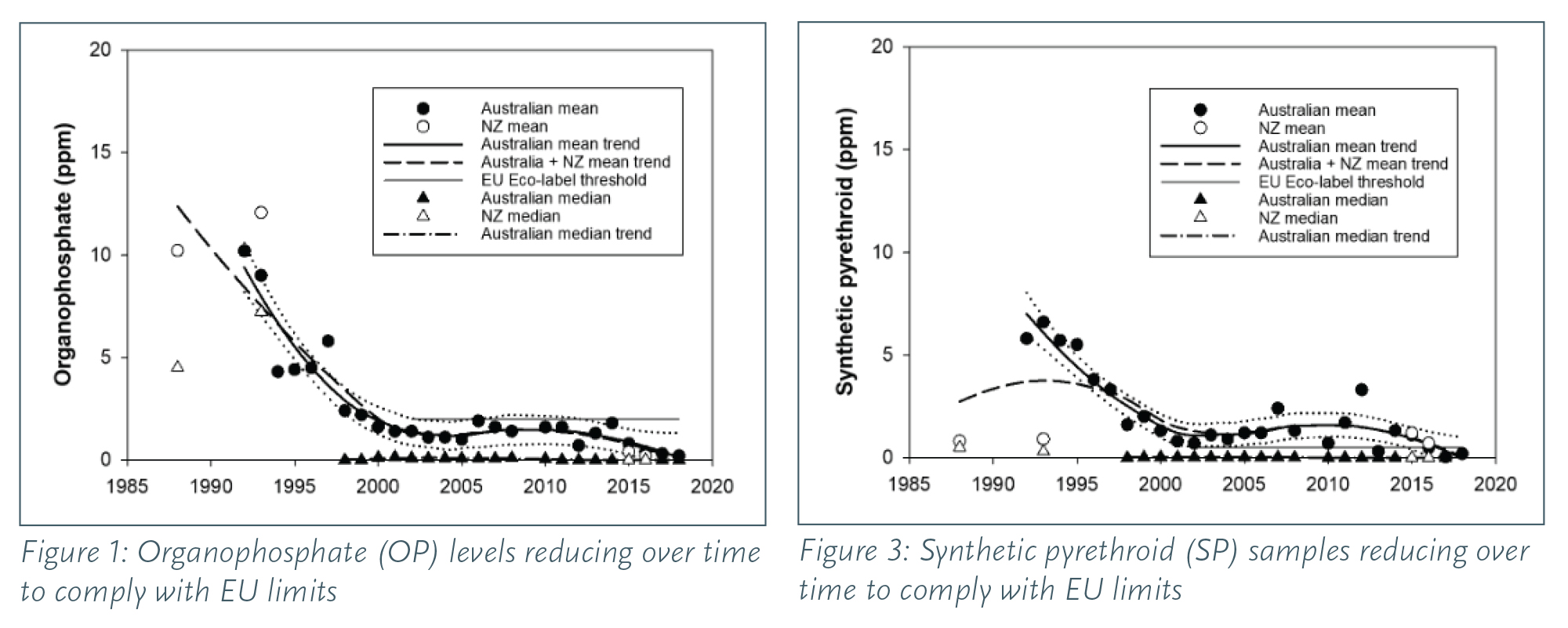
AWI has been sponsoring the annual study since 2001, so not only do the latest results provide evidence of the very low levels of chemical residue in greasy wool today, but they also represent the latest marker in a sustained downward trend.
As usual, AWI has carried out tests for a range of chemicals, including organophosphates (OPs), organochlorines (OCs), synthetic pyrethroids (SPs), and specific insect growth regulators (Diflubenzuron, Triflumuron and Dicyclanil).
The sampling and testing procedures used were consistent with methodology that was developed by a technical working group of our own here at the International Wool Textile Organisation (IWTO). Crucially, for the sake of transparency and credibility, we maintain a published method for the determination of wool residues, used by licensed and accredited testing laboratories participating in wool industry chemical residue surveys.
In this context, residues of the older chemical groups (OP and SP) have declined towards a mean of near zero. In fact, by 2020, the vast majority of sale lots analysed did measure actual zero or virtually zero for residual pesticides. This trend has continued through to 2022 – it is sustained, consistent and, crucially when promoting wool, it is supported by a wealth of peer-reviewed evidence.
POWERFUL NARRATIVE
Underpinned for over two decades by the AWI-sponsored study, we have access to analysis of a database that has been developed during more than 30 years of monitoring ectoparasiticides in greasy wool.
Put simply, this provides a chronology of evidence of ever cleaner wool production, and while some of this has been prompted by regulatory change, it’s also part of a deeper and even more powerful narrative that’s at the heart of wool.
From every angle of sustainability and responsibility, wool has a claim to be the material of choice. We can demonstrate durable product performance, we can showcase genuine circularity, and we can present the long-term data that proves how clean wool is as a raw material.
At IWTO, we’ll be doing all of this with passion and purpose, and we will also be helping colleagues around the world at every stage in the value chain to join us as champions of wool.
Dalena White is secretary general of the International Wool Textile Organisation (IWTO).
For more information go to: iwto.org