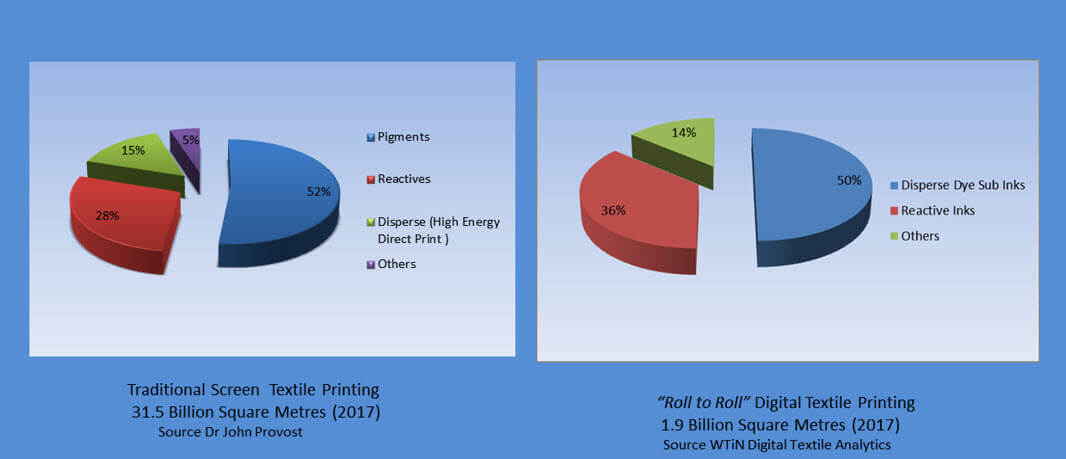
If we look at the market breakdown for inks in the digital textile printing sector, two ranges of inks are dominant: disperse dye-sublimation inks; and reactive dye inks. Between them, these inks account for over 85% of the roll-to-roll digital textile printing market. Based on the latest market analysis by WTiN Intelligence: Digital Textiles, these two ranges are still growing in line with the overall high digital textile market growth rate of ~20%, through the period 2017-2021.
This market breakdown contrasts starkly with the traditional textile market, where textile pigment inks dominate, used extensively in the home textiles market. There are three main reasons for the dominance of pigment inks: the obvious lower cost of textile pigment prints; the high light fastness performance; and the compact processing route, which utilises only a heat fixation stage and therefore eliminates the requirement for post-fixation wash-off treatments.
An update on market segmentation of the traditional screen-printing industry and the digital textile printing sector by ink type is shown in Figure 1. It shows the dominance of the disperse dye sub ink sector in the digital area and the high consumption of reactive dye inks. The application of digital textile pigments in the roll-to-roll digital textile market is still under 5% in digital printing, and digital print market penetration in the home textiles market is still relatively small. However, one of the reasons for the increase in digital printing with reactive dye inks, shown in Figure 1, is the uptake in single-pass digital textile printers, printing with reactive inks for the home textile sector, despite the significantly lower light-fastness performance of reactive inks compared to pigment inks.
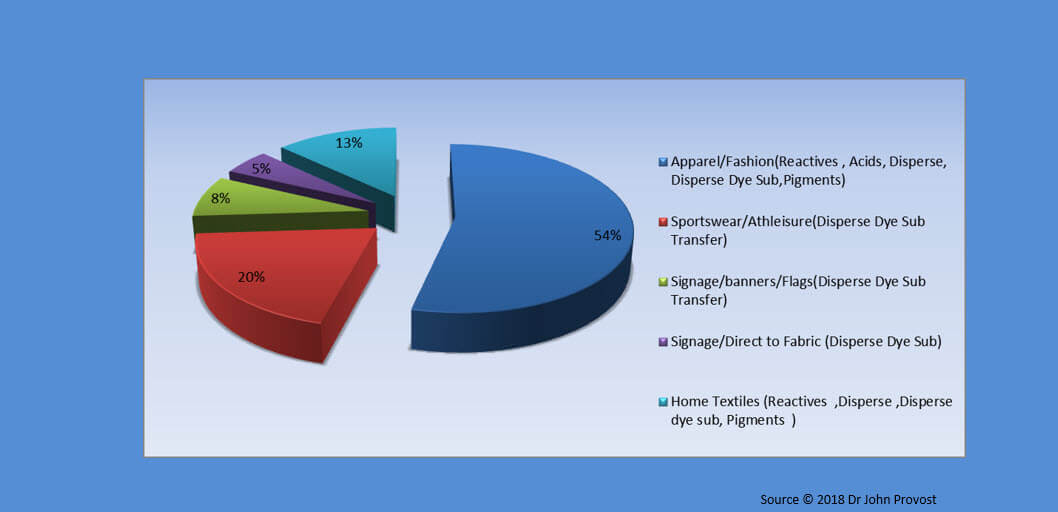
If we look at current digital textile printing market by industry segment, the relatively small market penetration in home textiles is evident (Figure 2). It must be emphasised that this first attempt at a market breakdown by industry segment is only approximate, although it has been cross-referenced with several sources. However, it does show the relative size of the different digital textile print market segments. Apparel fashion is a dominant area, which mainly uses reactive inks. This is followed by the fast-developing sportswear and athleisure segment, which uses disperse dye-sublimation inks. The home textile sector, as we have said, is relatively small at 13%, compared to the very large traditional screen home textile print market (~40% of the traditional screen print market). The digital home textiles market currently uses a wide range of ink types, reactive dye inks in single pass machines, disperse dye sub inks in niche markets and textile pigments in scanning digital textile print machines.
Developments for home textiles
The development of the digital home textile printing market has been a focus from both the digital textile print machine manufacturers and major ink chemistry providers. The primary targets are to develop inks with high light fastness, print heads with high-speed operability and, at the same time, combined technologies that bring the overall cost per square metre down to a level comparable with home textile screen prints.
An often-heard comment from new players in the digital textile printing market, coming from a non- textile background, is ‘why do the currently available digital inks not achieve acceptable light fastness levels for home textile prints’, as this is an essential product specification for many of the high street retailers, brand owners and mass market merchants.
At the recent 5th International Digital Textile Congress, held in Ghent, September 2018, Tony Nashberger, CEO of Zimmer Machinenbau GmbH, gave an excellent summary of the requirements and comparison of fastness performance for the complete range of textile inks (Figure 3), on a 1-5 scale (1).
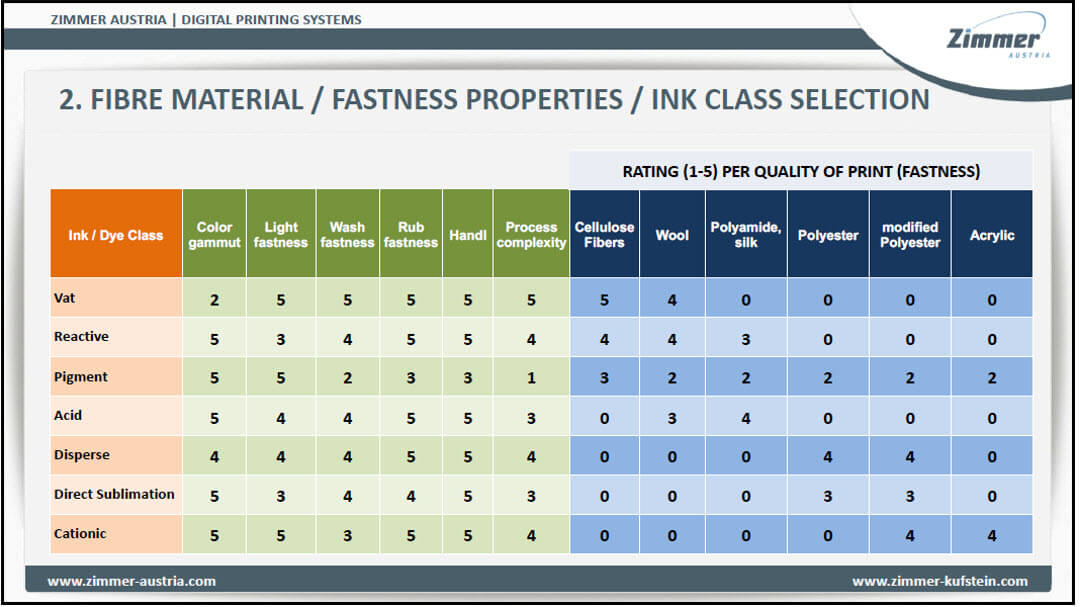
The two major digital textile inks used in the industry at present, reactive and disperse dye sub inks, are rated only 3 (medium performance) in the light fastness area. However, the major high light fastness inks, vat dyes and pigments – currently used in the home textile area – together with selected high light fastness disperse dyes used in the technical textiles segment (for example automotive textile coverings) currently occupy a low market share.
To increase the overall digital textile market growth, the home textile digital print market needs to be developed, and with that the vat dye inks and pigment inks for this sector. The current digital textile pigment ink systems in the market have improved considerably in the last few years and are used in scanning digital textile printing applications. However, improved systems are still required, with acceptable print head performance, to give confidence to textile printers that they will operate at high production speeds in single pass digital textile print machines.
There are also other textile printing segments that require high light fastness system solutions, for example, industrial work wear, technical textiles and military camouflage applications, which require both disperse and vat dye-based inks with high light fastness and weather fastness.
Light fastness testing and standards
Light fastness is the fastness of materials and colorants to the effects of visible and ultra violet radiation, under many different conditions, including radiation intensity, geographical location, season, humidity, heat, exposure time, etc. It is an extremely complex subject and has been studied over many years, in order to establish methods to obtain quantitative measures of performance.
The textile industry was one of the first to study this area in detail, and the methods and standards in use today by many other colorant-using industries are all based on textile research from the first half of the 20th century. Now, there are a number of internationally recognised light fastness test procedures in the textile industry, for example the ISO (International Standard organisation), AATCC (America Association of Textile Chemists), and the ASTM (American Society for Testing and Materials), all with very specific protocols for light testing methods. There are also many modifications of these test methods used by major retailers and brand owners and specific industries, for example the automotive industry, where all major car manufacturers have specific light fastness tests (adapted from the ISO I05/B02 2014 test, with the addition of specific temperature and humidity protocols).
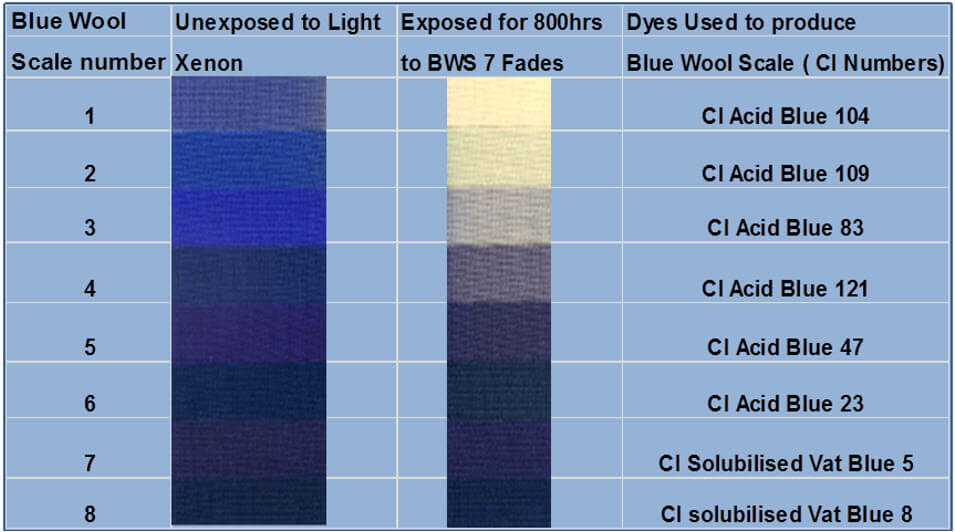
A detailed review of the development of light-fastness testing and light fastness standards has been published, which gives an excellent review of the area (2). The most recognised test used on a global basis is the ISO (International Standard Organisation) I05/B02 test method (3), which uses eight blue dyes on wool fabric, with eight specific dyes at specified depths, representing eight different levels of fastness on a scale of 1-8. The Blue Wool Scale (BWS), used in the ISO test was developed by the UK Society of Dyers and Colourists between 1928 and 1934 (4), after multiple dyeing and light fading tests under controlled conditions in many global locations. The final selection was made so that each grade of the 1-8 scale, was designed to fade in a controlled, geometric scale when exposed to light. Each grade would take twice as long to fade to a certain level as the grade below it.
Table 1 shows the BWS exposed to grade 7, together with details of the dyes used. It has been estimated that a BWS Seven or Eight results would equate to take over 100 years of display under normal internal light conditions without noticeable fading (5). It must be noted that the AATCC (USA) blue wool scale dyeings are different from the ISO Blue wool dyeing and their test method (AATCC method 16- Option 3) results are not reported in the same manner (2).
In the case of reactive dye inks, the light fastness performance varies depending on the specific chemistry. For example, for bright orange or red region, the light fastness is generally in the region of a four on the blue wool scale, which is well below the light fastness standard accepted by the industry for home textile prints. Also, the majority of deep black reactive digital textile inks are based on mixtures of CI Reactive Blue 176, shaded with golden yellows and reds, and in many cases the light fastness is below the home textile standard. Specific details of the light fastness performance for full shades and pale reduced shades (which have a lower BWS fastness rating) can be found in the digital textile dye ink manufacturer’s literature.
It is a similar situation with disperse dye sublimation digital textile inks, which are as small range of disperse dyes, having small molecular weights and importantly having the property to sublime in the region of 190-210oC. The main dyes used as the basis of disperse dye inks (CI Disperse Yellow 54, Red 60, Blue 359, Blue 360, with black mixtures based on CI Disperse Blue 360) have higher light fastness performance compared to reactive dye inks, although, again, in certain shade areas and with pale shades (1:9 reductions), the light fastness of prints does not meet the home textile performance standard.
Available high light fastness ink ranges
Vat dye inks
Vat dyes are textile dyes with the highest light fastness levels on cotton of any colourant class, with a light fastness greater than six on the BWS in both full and reduced shades. Vat dyes have been used for the highest quality of furnishing fabrics, technical textiles work wear and military camouflage printing, were the highest stand of light/weather fastness is required. The only range of vat dye inks available were introduced at the 2015 Milan ITMA by Dystar, in a development programme with Zimmer and have subsequently expanded to eight available inks, under the Dystar trademark of Jettex vat inks.
The processing of vat dyes is complex and requires a number of processing stages. The vat ink is first printed in a pigment form, before a padding stage using a combination of alkali and a reducing agent, which reduces the pigment to a soluble form. It is then immediately passed through a vertical steamer (flash ager) for fixation, followed by a wash-off stage, including an oxidation stage which returns the vat dye to a pigment form, resulting in prints with the highest fastness levels. The complex processing route and the high cost of the vat dye ink, together with the extended processing steps, restricts vat dye ink to use by experienced textile printers with the necessary textile processing machinery.
Disperse dyes for polyester
There are established disperse dyes in the textile industry which have known excellent performance against light and weather conditions. These have been used by traditional screen printers for very demanding applications in the automotive industry, and for technical textiles and military applications.
This category of disperse dyes is capable of passing demanding fastness specifications from the major global automotive manufacturers, each of which have their own specifications, similar to the established ISO test, but with the addition of increased temperatures, humidity and time in the test procedures (6). Typical disperse dyes used in high fastness automotive printing are: CI Disperse Yellow 86; CI Disperse Red 86; and CI Disperse Blue 77.
The complex processing route involves a pre-treatment stage, printing, fixation stage using high temperature steaming at 170-180°C, followed by a wash-off step, which must include a reduction clear stage, to ensure high-fastness performance. Huntsman International LLC released a specific range for this market segment in October 2017, the TeraTop XKS HL inks, which have been tested in alignment with major automotive manufacturers’ test protocols.
Pigment inks for home textiles
There are currently many ranges of digital textile pigment systems for all major print head types. For example, just counting the major ink chemistry suppliers, there are over 10 ranges available, all claiming to have the ‘perfect’ solution for roll-to-roll digital textile pigment prints. However, the latest WTiN Intelligence still shows only 3% of roll-to-roll digital textile print production in 2017 used pigments. This low production level is likely due to a combination of current pigment ink technology still needing more development for higher production speed machines and the higher cost of the inks. The current prices of digital pigment inks, due to inevitable small ink production batches, cannot approach the price levels of the home textile prints, in terms of cost per square metre, particularly in the major far east markets printing home textiles for European and US retail markets.
With the considerable research effort currently underway by the major manufacturers and introductions of more re-circulating print heads (8), we will undoubtedly see more technical developments, and digital textile print machinery launches, together with pigment ink chemistry solutions, as we run up to ITMA Barcelona in June 2019.
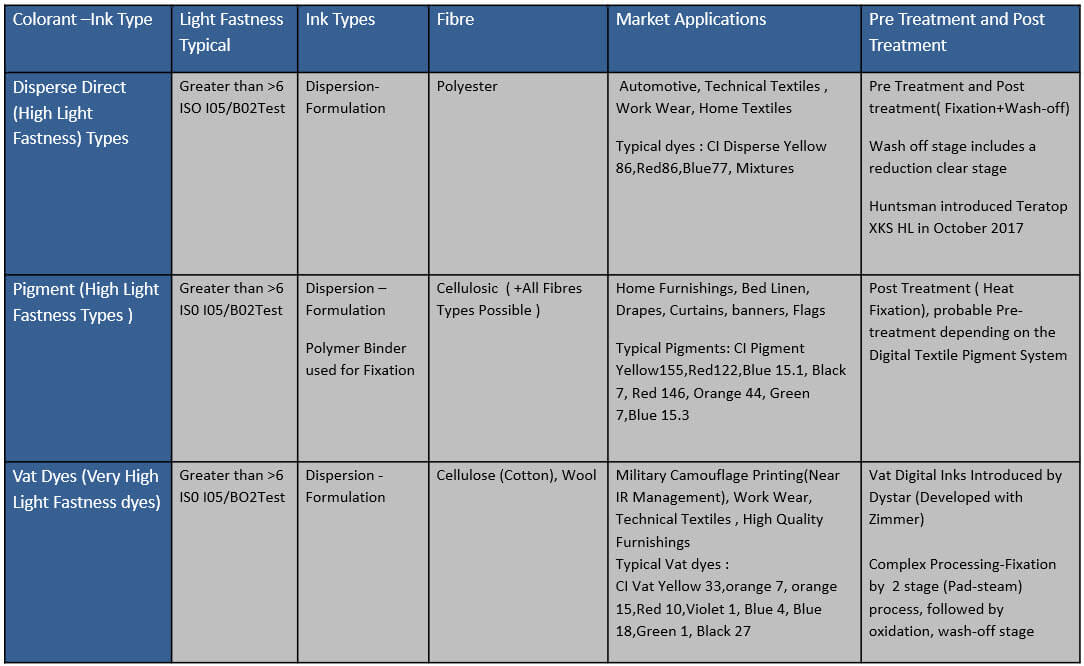
In summary, Figure 4 gives an overview of the current high light fastness digital textile inks available, and their applications and processing routes.
The textile pigment ink area is, by far, the major focus of the major digital textile machinery manufacturers and ink chemistry suppliers, as the rewards will be significant; the traditional screen-printing market for home textiles is in the range of twelve billion square metres.
If an increase in digital printing in the home textile market could be achieved, we could be well be looking at further significant increases in digital textile print production levels.
References
1. A Nashberger, “Ink jet Printing – How to Choose the Right Ink jet Printing System”, 5th Digital Textile Congress (ESMA and Unitex), Ghent, September 2018
2. S Pugh, J T Guthrie “The Development of Light fastness Testing and Light fastness Standards”, Review Progress Coloration, 31 (2001), p42-56
3. ISO test Method ISO B05/B02, 2014, Preview available at: https://www.sis.se/api/document/preview/917759/
4. The Society Dyers and Colourists UK, “Report on Early Work on Fixing Standards for Light Fastness”, Journal Soc. Dyers Col. 72(1956) p431-433
5. https://en.wikipedia.org/wiki/Lightfastness, and http://www.handprint.com/HP/WCL/pigmt6.html#lightfast
6. A Athalye, “Automotive Textiles”, International Journal of Textile Engineering and Processes,1(2015)p42-52 available from : http://engineering-shirpur.nmims.edu/docs/automotive-textiles-ijtep-july-2015.pdf
7. http://www.huntsman.com/textile_effects/Applications/itemrenderer?p_rendertitle=Latest%20News&p_renderdate=yes&p_renderteaser=no&p_item_id=999128559&p_item_caid=1263
8. J Provost, “Pigment Ink Development for High Production Digital Textiles”, Digital Textile Magazine Issue 2, 2016, p10-20