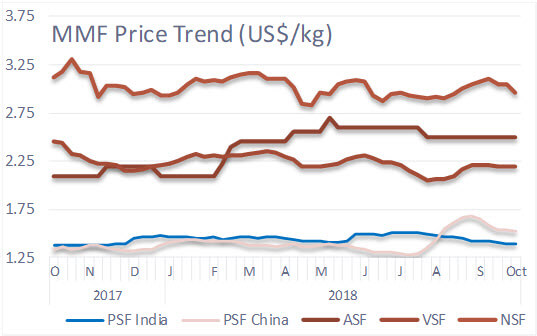
Polyester staple fibre markets in China moved sideways and downstream converters started stocking up after the week-long national holiday. Mainstream discussions for 1.4D direct-melt-spun PSF in Jiangsu and Zhejiang were held stable while markets in Shandong and Hebei were also stable. Liquidity was moderate, with each deal discussed separately. In Fujian, PSF offers kept stable as downstream buyers adopted cautious attitude. Offers rolled over with 1.4D direct-melt PSF at 10.55-10.80 Yuan a kg (US$1.53-1.56 a kg) in Jiangsu and Zhejiang while the same in Fujian and Shandong at US$1.53-1.56 a kg. Export offers were at US$1.30-1.35 a kg FOB China.
In Pakistan, producers’ offers were raised, citing the high cost of raw materials, but a sharp fall in the currency pegged offers down in US$ terms. 1.4D PSF producers’ offers were hiked PakRs5 to PakRs.203-205 a kg (US$1.55-1.56 a kg, down US cents 6 due to sharper fall in the currency).
In India, with weak PTA and MEG values, PSF suppliers held stable offers but trading sentiment failed to pick up. 1.2D at INR103.25 a kg (US$1.40 a kg) and 1.4-2D at INR102.50 a kg or US$1.39 a kg.
Nylon
In China, nylon staple fibre 1.5D prices were down at 20.50-21.50 Yuan a kg (US$2.97-3.11 a kg).
Acrylic
Acrylic staple fibre prices rolled over in China and India, while they were reduced in Pakistan this week. In China, prices were supported by lower supply as acrylic fibre plants average run rate fell to 34%, due to turnarounds at some facilities. In the previous week, domestic the run rate had averaged 41%. In September, the average run rate was around 53%. Shanghai Petrochemical brought forward its maintenance plans due to sluggish downstream demand. The 150 kilo ton a year plant was shut on 10 October instead of 18 October, and is expected to restart around 18 November. In India, prices remained unchanged after they were raised for October last week. In Pakistan, offers were cut by over 4% as demand remained muted. Overall, Asian market fundamentals were weak, and prices are expected to march south in coming weeks.
Taiwan origin 3D bright ASF tow offers rolled over at US$2.50-2.60 a kg, while offers in China for medium-length and cotton-type acrylic fibre remained unchanged at 20.50-21.90 Yuan a kg (US$2.97-3.02 a kg). In Pakistan, 1.2D ASF prices were cut PakRs15 in Karachi market to PakRs.345 a kg (US$2.632 a kg, down US cents 28, also due to weak currency). In India, producers’ offers were stable for October at INR197-208.50 a kg (US$2.67-2.83 a kg), after they were raised last week.
Viscose
Viscose staple fibre markets remained firm after the week-long national holidays in China and prices were seen climbing slightly. Mainstream high-end producers raised prices slightly on brisk sales and rejected deals at below their lower end level. Deals remained hard to conclude at high levels and met with some resistance. On the other hand, next week will welcome the Yarn Expo in Shanghai, so some negotiations may gradually begin. It is reported that some major producers still tend to raise the prices, and thus attention was paid to downstream follow-ups. In Pakistan, viscose fibre prices were cut on spur the waning demand. Demand has shifted to cotton for a while when cotton prices were falling. In India, viscose prices remained unchanged on the week implying steady demand.
In China, offers for medium-end viscose goods climbed to 15.30-15.50 Yuan a kg (US$2.21-2.24 a kg) and those for high-end goods at 15.50-15.60 Yuan a kg (2.24-2.26 a kg), both up US cents 2-4 from previous trading week. In spot, 1.5D VSF offers inched up to 15.17 Yuan a kg (US$2.19 a kg) and 1.2D at 15.35 Yuan a kg (US$2.22 a kg). In India, 1.2-2.0D VSF prices were stable at INR150-200 a kg (US$2.03-2.71 a kg). In Pakistan, offers for 1.5D VSF fell PakRs5 to PakRs265-268 a kg (US$2.02-2.05 a kg, down US cents 17, also due to weak currency) in Karachi.