Polyester input: MEG
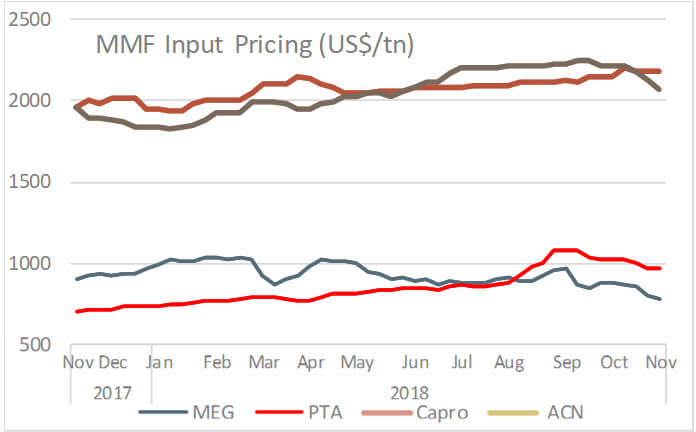
Mono ethylene glycol prices tumbled in Asian market to an 18-month low midweek amid bearish market sentiment due to lack of support from either upstream or downstream. Supply was ample with the startup of two new coal-based MEG plants in October. However, markets rebounded at the weekend amid healthy transaction and improved buying interest, which helped post a small weekly gain. Inventories along east China decreased 4.5% to 661 kilo ton. Earlier in the week, MEGlobal announced its December Asian contract price down from November nomination, citing lukewarm downstream and bearish sentiment on China’s economy. MEG spot prices inched up US$4 week-on-week with CFR China at US$722-727 a ton and CFR South East Asia at US$734-755 a ton. In China, major offers for nearby-month cargoes were above US$720 a ton and bids around US$715 a ton, with discussions below US$720 a ton.
In Europe, the October MEG contract confirmation continued to be severely delayed, while spot prices remained on downward trajectory. Settlements have been delayed since June, which has created administrative difficulties for the wider market. Buyers and sellers were at odds with pricing expectations for November. While a decrease for November is expected, given the weakness in Asia and slipping spot prices. Bulk prices were assessed at Euro25 down on the low end and Euro10 lower at the upper end, bringing prices in the range of Euro745-760 a ton CIF NWE. Truck prices were assessed down Euro10 at both ends, to Euro820-840 ton FCA NWE.
Polyester input: PTA
Purified terephthalic acid markets continued to remain in correction in Asia and prices easily fell as difficulty to rise in recent time was strong amid bearish trend in paraxylene markets. In China, the futures market was under slightly fluctuation retreating after rushing higher earlier after upstream market improved slightly. Offers for bonded goods were adjusted and discussions for nearby-month cargoes rebounded slightly. PTA markers the CFR China edged down US$10 on the week to US$910-912 a ton, while offers from Taiwan/Korea fell to US$920-950 a ton. In China, offers for bonded goods were adjusted to US$910-945 a ton and discussions for nearby-month cargoes were at US$890-900 a ton.
In Europe, November contract decreased month-on-month as the settlement moved alongside upstream paraxylene contract for November. The domestic PTA market shifted from tight, to balanced, to long in matter of weeks, as downstream polyethylene terephthalate entered the low season and buyers held back, expecting cheaper PET imports. PTA production problems at Poland’s PKN Orlen led to difficulty sourcing prompt product in the region, and there were signs that the market was tightening again. November PTA contract price was down Euro52 on either end of the range to reach Euro837-871 ton FD NWE. In the US, October prices were assessed at US cents 60.10 per pound DEL USG.
Nylon input: Caprolactam
Caprolactam markets in Asia were quiet and prices remained range-bound as the feedstock benzene market dipped early in the week, only to rebound somewhat later. In China, mainstream prices for liquid and flake goods rolled over on the week. Demand remained flat as run rates at polymerization units averaged 75% with inventory worth 5 days. Nylon yarn makers were running at 80%, but inventory was high at 19 days’ worth. With benzene weakening and caprolactam supply likely to decrease in coming weeks, the markets will be cautious, and prices will remain range bound. Asian caprolactam prices were flat on the week with SE and FE Asia markers at US$2,080-2,100 a ton. In China, spot prices for liquid goods were at 16,000-16,500 Yuan a ton (US$2,305-2,380 a ton) while flake goods were at 16,500 Yuan a ton (US$2,380 a ton).
In Europe, no discussions were reported in caprolactam market as the low water levels of river Rhine disrupted proceedings. Meanwhile, pre-cursor cyclohexane supply was lengthy, with demand increasing for second half of November due to continued issues with Rhine water levels delaying deliveries. These constraints were also disrupting in entire polyamide chain. If conditions do not improve by year-end, the river is likely to contribute to negotiations for Q1 contract price.
Acrylic input: Acrylonitrile
Acrylonitrile prices in Asian markets plunged to a low level during the week, though the downward momentum moderated in the closing weekend. Sellers mostly rolled over offers, while a few kept liquidating at low price level. Market was dominated by wait‐and‐see sentiment. End users had poor appetite for acrylonitrile as acrylamide maker ran at less than 60% capacity while ABS market was on a weak note. Acrylic yarn makers operated at just 33% run rate, with poor need for raw material. Acrylonitrile marker the Far East CFR marker plunged US$250 to US$1,749-1,751 a ton while CFR China was down sharper by US$350 at US$1,650-1,750 a ton. In China, self-lifting values at Lianyungang port, however, regained US$55 to US$1,700-1,730 a ton.
In Europe, acrylonitrile spot prices declined sharply, pressured by bearish Asian market. Contract talks were expected to take longer, as the gap between selling and buying targets was wider in some cases. Spot prices pummeled US$150 to US$1,648-1,652 a ton CIF Mediterranean.
In the US, spot export acrylonitrile offers decreased steeply following declines in Asia and Europe. Spot prices were holding against the global downtrend due to limited availability and expectations that demand will snap back. However, prices are still at their lowest levels since May. Export prices were nosedived US$330 to US$1,670-1,680 a ton FOB USG.