Polyester input: MEG
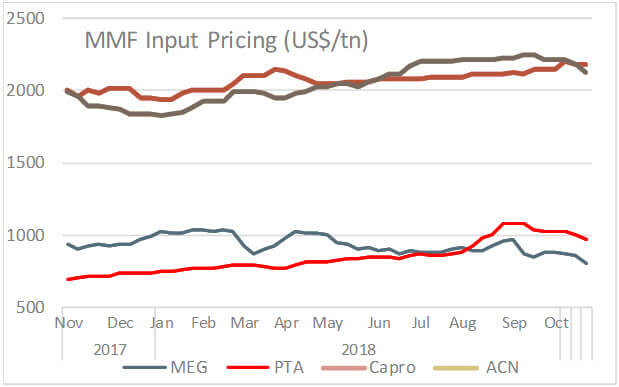
Mono ethylene glycol prices fluctuated in weakness amid moderate trading sentiment this week in Asian markets. In China, November H2 and December deliveries were higher than spot numbers, while the spot market saw moderate buying interest for low-priced goods. Meanwhile, inventories along East China increased 15% 692 kilo ton. The control measures over ship movement on Huangpujiang River weighed on offtake, thereby piling inventories. MEG spot prices declined sharply by US$50-67 week-on-week with CFR China at US$718-723 a ton and CFR South East Asia at US$730-750 a ton. In China, major offers for nearby-month cargoes were around US$730 a ton, with counter offers closer to US$720 a ton, and discussions were at US$725 a ton.
In Europe, contracts for October and November were still not concluded, and the delay was weighing on the market. An initial October number was agreed, but was unconfirmed, while spot prices remained unchanged. Bulk range was assessed in the range of Euro 800-806 a ton CIF NEW while truck spot prices were at Euro 850-870 a ton FCA NWE.
In the US, MEG markets were experiencing downward pressure as supply was long and demand soft during the off-peak season. Reports noted that a good volume of material was available, including a large bulk material. October contracts prices settled at US cents 40.5-46.5 per pound FOB. Domestic spot MEG was quoted in the mid-US cents 30s per pound (US$661 a ton).
Polyester input: PTA
Purified terephthalic acid prices did not move in Asian markets as downstream demand remained stagnant and upstream paraxylene cost continued to retreat. In China, the PTA Futures contract retreated further while some deals were done at a high level and some deals were flat. Markets are expected to continue to soften, but there is possibility for a slight technical recovery. PTA markers CFR China rolled over on the week at US$920-922 a ton while offers from Taiwan/Korea were at US$970-990 a ton. In China, offers for bonded goods fell to US$950-970 a ton, and discussions for nearby-month cargoes were at US$880-900 a ton.
In Europe, availability of spot goods declined, just as the Asian market became more bearish and the regional market shifted from tight to long in a matter of weeks. Downstream PET entered the low season and buyers held back, expecting deliveries of cheaper imports. Some participants started to feel the effects of PTA production problems, but other units were running well, as the impact of a problem in PNK plant in Poland may not reach the broader market. Contracts were stable at Euro 889-923 a ton FD NWE.
In the US, demand for PTA continued to soften amid seasonal downturn in the polyester chain. October prices were assessed at US cents 60.10 per pound DEL USG.
Nylon input: Caprolactam
Caprolactam markets in Asia were quiet in the week, amid uncertainty and volatile prices in domestic China. With a major Asian producer expected to release its offers soon, spot markets were range bound and given the lower feedstock benzene cost and thin demand. Market sentiment was still bearish. Spot prices declined, with SE and FE Asia markers down US$100 at US$2,080-2,120 a ton. In China, spot prices for liquid goods were at 16,000-16,500 Yuan a ton (US$2,310-2,380 a ton, down US$25) while flake goods were at 16,500 Yuan a ton (US$2,380 a ton).
European October contract discussions were concluded down last week on lower October benzene costs. Discussions were reportedly extensive with suppliers aiming for stability, despite lower feedstock costs. Worries about weaker automotive demand including the nylon 6 market, along with concern of outlook due to macroeconomic and political uncertainty. Precursor, cyclohexane contract price for November have softened double-digits, implying limited room for caprolactam to go up. In the US, the cyclohexane November contract settled at a decrease on the back of a reduction in benzene costs. October contract prices were in the range of Euro2,264-2,417 a ton FD NWE while cyclohexane November contract settled at Euro858 a ton ex-works.
Acrylic input: Acrylonitrile
Acrylonitrile spot prices witnessed sharp decline across regions during the week. In China, though the downward momentum moderated at the closing weekend, prices still collapsed more than 20% at Lianyungang port self-lifting. Traders were looking to unload material at low prices in order to reduce inventories before the year-end, but liquidity remained thin. Acrylonitrile markers, Far East CFR marker, plunged US$70 to US$1,999-2,001 a ton, while CFR China was steady at US$2,000-2,050 a ton. In China, self-lifting values at Lianyungang port tanked US$450 to US$1,645-1,660 a ton.
In Europe, spot prices fell on the week, pressured by downstream production cuts and steep drops in the Asian market. Usually European spot prices are a discount and tend to follow movement of Asian ranges. Regional downstream acrylic fibre sector run rates were down to an average of 70-80%. Meanwhile, Ineos' acrylonitrile plant in Seal Sands will go offline for maintenance starting mid-November for about 2-3 weeks. Spot prices declined US$40 to US$1,798-1,802 a ton CIF Mediterranean.
In the US, acrylonitrile export spot prices fell to their lowest levels since May as Asian prices plunged. US prices are slower to fall than Asia since spot selling is less of concern as players were building inventories for Q1 2019. Spot export prices were down US$45 at US$2,000-2,010 a ton FOB USG.