Textile materials with a high specific tensile strength and modulus are the common choice for the manufacture of protective body armour. With gun control legislation becoming increasingly strict, sharp objects have become accessible weapons, and injuries arising from stabbings are now much more common. Conventional body armour has traditionally been bulky, stiff, uncomfortable and challenging to disguise under clothing. Therefore, there is a greater requirement for flexible and wearable stab-resistant materials.
Aramid materials are well known for providing high ballistic protection, however, these materials commonly have low puncture resistance. Recently advanced strategies have been incorporated into the development of stab-resistant materials to improve performance. This includes techniques such as treating the materials with resin or coating the material with hard and refractory particles to improve the flexibility of the material as well as its resistance to sharp objects.
In this innovation profile WTiN reports on a research outcome from Shandong Non-Metallic Materials Institute, China, detailing the development of a novel stab-resistant material that incorporates vinyl ester resin–aramid composites coated with silica (SiC) particles for the development of a cost-effective, high-performance and flexible stab-resistant material.
Purpose
To fabricate a cost-effective textile material for use in body armour to provide increased performance by coating SiC particles onto thermoset–aramid composites.
Approach
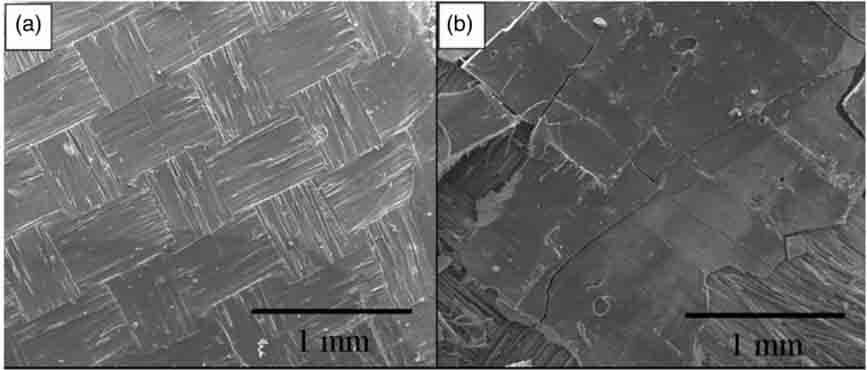
For the manufacture of this novel flexible body armour, the researchers saturated aramid fabrics with thermoset vinyl ester resin. The thermoset–aramid composites were subsequently coated with hard and resilient SiC particles. The researchers used Kevlar with a weight of 410 g/sqm and a thickness of 0.4 mm, with a plain weave structure as the base material, demonstrated in Figure 1a. Thereafter, the Kevlar material was coated with a controlled amount of SiC particles via the solution spray application on a single side of the Kevlar material, seen in Figure 1b. After the water from the SiC spray suspension evaporated from the fabric, vinyl ester resin was applied to the SiC-coated Kevlar via hand lay-up technology. After curing the fabricated material at room temperature, the samples were cut and prepared into multi-layered samples.
Results
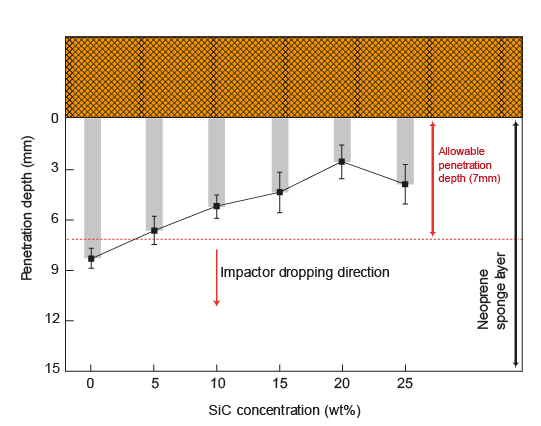
The researchers experimentally demonstrated that when SiC particles are incorporated into thermoset resin and Kevlar composites, resistance against knife penetration to the material is greatly increased. Incorporation of SiC particles was found to improve the fibre-to-fibre friction and blunt the sharp metal blades via abrasion, therefore improving stab resistance of the fabricated material. Additionally, it was discovered that 20 wt.% was the optimum concentration for the leading stab resistance against knife penetration, illustrated in Figure 2. Results found that with an increase in the concentration of SiC from 5 wt.% to 20 wt.%, the stab resistance was dramatically improved. However, when the SiC concentration was raised above 20 wt.%, results demonstrated that stab resistance was reduced; researchers attributed this to a lower resin rate brought about by the increased SiC concentration, therefore reducing adhesion between the material interfaces. Moreover, the dispersant PVP was found to provide the leading dispersion stability for the SiC particle suspension, in comparison to alternative dispersants chosen for testing such as PEG and TMAH. Additionally, the researchers characterised the stab resistance of a variety of samples, each with a different number of material layers. The experiment found that a higher areal density (nine layers of fabric with an areal density of 6.75 kg/sqm) gave increased stab-resistant performance. Additionally, the researchers demonstrated that when coating the Kevlar surface with the SiC particles, energy efficiency of the fabricated stab-resistant material was improved by 11.25%, while the weight of the anti-stab material was reduced by 10 wt.%.
The researchers measured the tear force of the material because this strongly correlates to the tensile breaking strength and is therefore important to understanding the puncture failure of the fibres. It was experimentally shown that the tear force of the material was found to be marginally lower when coated with SiC particles. The researchers concluded that the lower tear performance was likely to be attributed to the decrease in resin rate, which was reduced accordingly with an increase in SiC particles. Moreover, the irregular shapes of the SiC particles may have been destructive to the fibres when the material was stretched, reducing the tear properties of the material.
Impact
The researchers verified that incorporation of SiC particles into thermoset resin/aramid composites greatly enhances the stab resistance of the material when compared with conventional woven Kevlar material, indicating that SiC particles are favourable for the development of high-performance stab-resistant textile composites.
Alternative approach
A key issue with coated or laminated stab-resistant materials, as with the developed stab-resistant fabric from the Shandong Non-Metallic Materials Institute, is that they can often be extremely stiff, making the fabrics less comfortable for everyday wearable use and for wear over lengthy time periods.
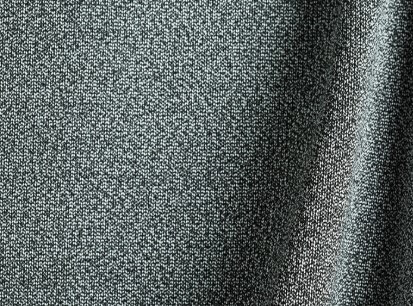
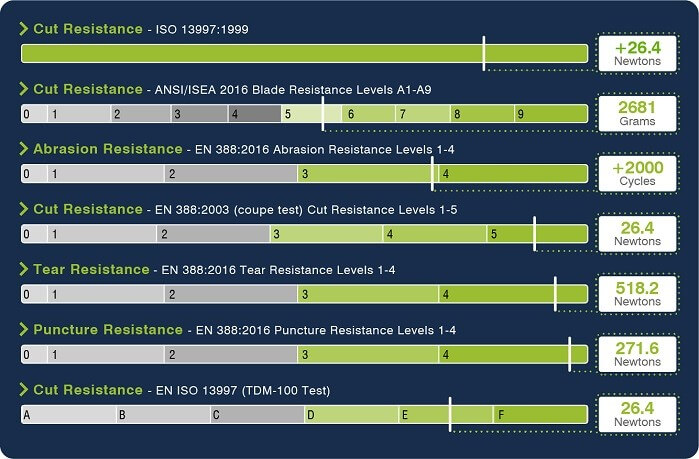
The company PPSS Group has developed an alternative high-performance fabric named Cut-Tex PRO, made from a combination of ultra-high molecular weight polyethylene, along with some other technical fibres, and then woven into a textile using high-density knitting machines. The Cut-Tex PRO fabric has high performance for cut, tear, puncture and abrasion resistance, while additionally feeling like a soft fabric, making the material much more versatile for wearable applications. This high-performing material was found to be at least five times more cut resistant than conventional Kevlar products, outlined in the performance results detailed in Figure 4.