Concept designs often pave the way for future garment solutions, bringing ambitious ideas to life. California-based designer Aarish Netarwala speaks to Andy Rhodes about his Adidas Grit concept shoe
A US-based designer has developed an Adidas concept trainer that replicates the experience of running on sand, a proven method of increasing fitness.
The Grit concept shoe was designed by Aarish Netarwala and features a lattice sole that makes the wearer’s foot unstable on solid ground, simulating the feeling of the foot sinking into loose sand. This slight sinking effect creates a form of resistance training, offering a more intense workout.

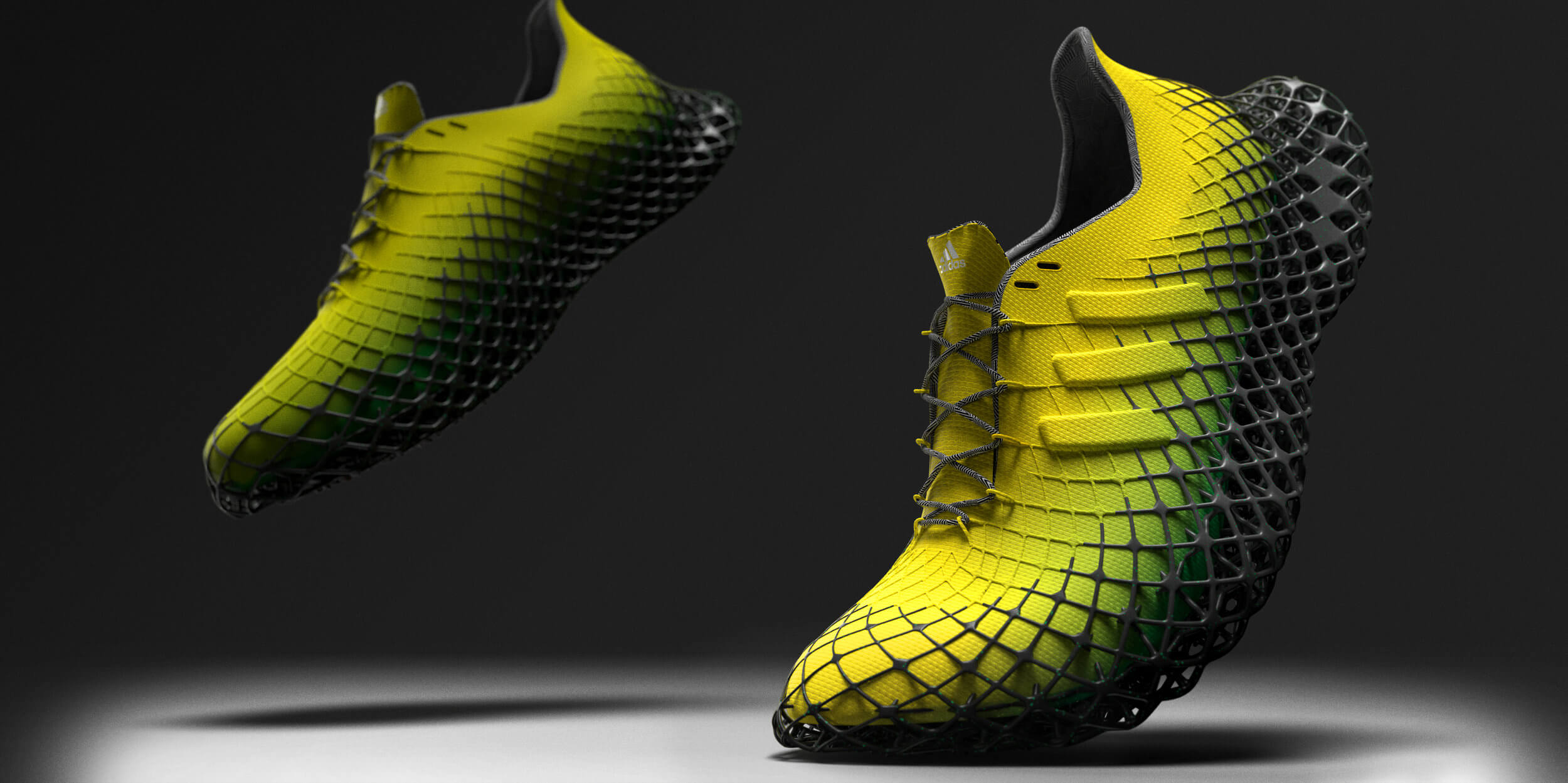 The Grit shoes feature a lattice sole which collapses when the foot hits the ground
The shoes were developed as part of a collaboration between Adidas and the Pasadena, California-based ArtCenter College of Design with the aim of bringing together a number of innovative design concepts and technologies to maximise material potential. “The Adidas Future Group came to ArtCenter College of Design in Pasadena to partner with students and ideate around concepts for the future of sports over a semester,” he says.
“I started to research sports by visiting Manhattan Beach in California. MB has a high density of athletes attracted by the coastal lifestyle and proximity to LA,” Netarwala adds, explaining his research process. “I would observe athletes’ activities and I started to interview people by just walking up to them at the beach and asking them questions.
“By chance, I happened to walk up to someone without the knowledge of who they were. It turned out the interviewee was a famous beach volleyball Olympian and hall of famer, Mike Dodd,” he continues. “Mike told me about the benefits of playing sports on sand and training kids in volleyball early to build their muscles. He had mentioned several benefits of playing on sand like longevity in the sport and I was curious about sand as a material after that.”
Armed with this new knowledge, Netarwala visited Manhattan Beach’s Sand Dune Park, a special training facility which, due to the benefits of the high intensity training on offer, attracts athletes from across Los Angeles. “Kobe Bryant and Kevin Durant, Russell Westbrook and NFL athletes training here among others had sealed its status as the place to train for high intensity exercise,” he says. “But behind the pop significance, speaking to athletes who trained there, it seemed what drew them in was a short workout that made you work really hard and achieve effective results over time.”
He adds: “This probably seems obvious in any exercise, but the fact that you could be dead tired in 20 minutes made sense to me. I wanted to make this phenomenon and method of training to everyone who wouldn’t be able to make it to Manhattan beach. That is where the inspiration came from.”
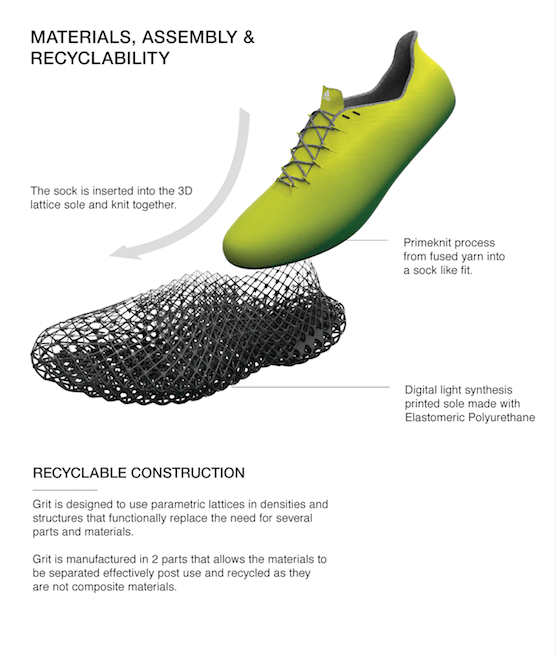
A diagram showing the construction of the shoe. Courtesy: Aarish Netarwala
Following extensive ethnographic and secondary research undertaken with athletes at Sand Dune Park, Netarwala discovered that athletes find it difficult to maintain grip and balance when training on sand dunes as they are constantly shifting. From this research, Adidas spotted an opportunity.
“Sand dune training attracts high performing athletes that seek intense, strenuous exercise, bringing out their best performance and effective results,” says the company. “There is an opportunity to cater to like-minded athletes globally, providing them with gear to challenge themselves in training.”
Innovative design
Netarwala states that the Grit shoe’s lattice structure collapses on impact with the ground before relapsing once the foot is off the ground. This allows the shoe to absorb energy without returning it the user, thus increasing the amount of energy required to train, giving the wearing a more intense training session in a shorter space of time.
The lattice is weaved to the upper fabric of the shoe and a sinking toe-off also provides less energy return. Meanwhile, the midsole wraps around the foot, providing more continuous lateral movement, ultimately mimicking the effect of running on sand.
Due to the collapsing effect that Netarwala wanted to achieve, he states that countless hours of research and development went into the design, as well as which materials and processes should be used. Asked how much R&D he conducted in total, Netarwala says: “I can’t say. A crazy amount went in.
“The project was one of two projects I was working on for four months. I put in crazy hours trying to make it work and spent a few rounds of creating prototypes and to get a proof-of-concept model to work. Being a physical item, it would require some more funding to be further prototyped repeatedly and tested,” he adds.
He states that creating the desired sinking effect from the lattice was a key hurdle. “The sinking effect required printing small prototypes of different lattice structures. Once I found a lattice that had a directional property and structure that would collapse at the right impact level, that helped in the sinking aspect of the sole.”
He continues: “There are two lattice structures on the sole; a dense and stronger pattern takes the impact and weight of the heel striking the ground while the front of the shoe provides a sinking lattice to absorb the forward motion of the foot.”
Primeknit process
The shoe’s upper is made using Adidas’ Primeknit, a process which digitally knits the entire upper in just one piece. On its website, Adidas states that knitting infused yarns allows its designers to “fine-tune the exact amount of flexibility and support needed in every part of the shoe. This means lightweight comfort that wraps seamlessly around your foot, while fewer materials produce less waste.”
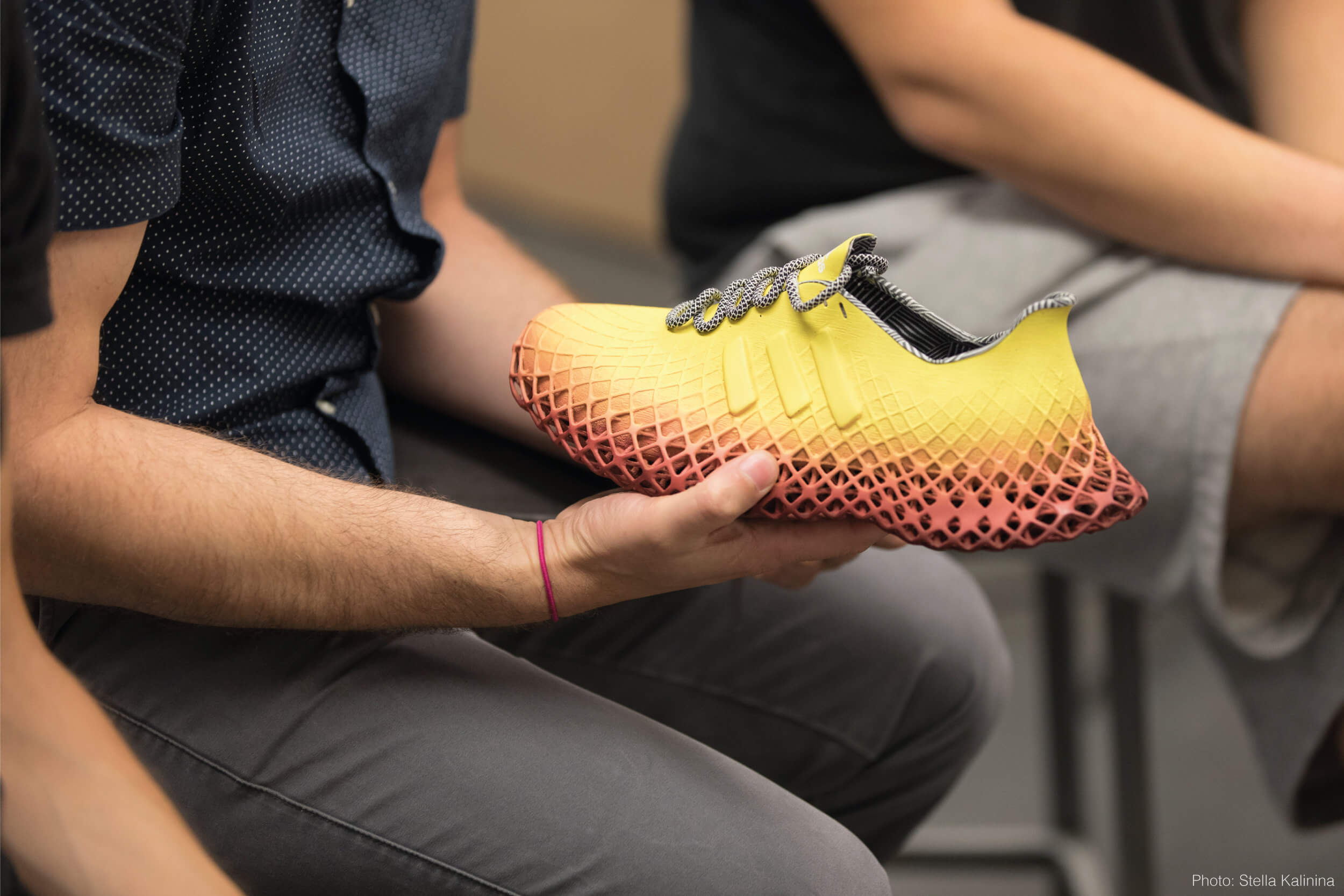 The shoe upper is made using the adidas Primeknit method
Discussing how he used the Primeknit method, Netarwala says: “The shoe construction moves away from the traditional upper and sole model. The materials for the shoe are made from an Adidas Primeknit for a sock-like structure which is slipped into a lattice structure for the sole. The sock is made out of fused yarn. The lattice would require a digital light synthesis 3D printing process and the material is an elastomeric polyurethane.”
Although the Grit shoe was just developed as a concept, Netarwala states that if the right opportunity were to come along he would like to explore the possibility of future commercialisation. “I’d love to work on developing with the right partner who might have capabilities in manufacturing,” he says.
As people look for more ways to exercise in cities across the world, innovative solutions like this may be the key to making the most of each workout.
Have your say. Tweet and follow us @ARhodes_WTiN and @WTiNcomment