abstract
The implantable medical textiles category is a new horizon in the landscape of medical textiles. However, the manufacture of these products demands a complex and innovative technological approach combining conventional textile manufacturing technologies such as weaving, knitting and braiding with technologies originating from the electronic sphere, such as coating, lithography and inkjet printing. Thus, the functionalisation of textiles may be processed at different levels, ie from fibres to fabric, or even readymade clothing. Understanding the drivers, state-of-the-art elements and tendencies of implantable medical textiles ensures further efficient development technology and its interaction with manufacturers and consumers. This paper explores and systematically describes the applications of implantable medical textiles for healthcare with sensing and actuating functions and introduces the main principles of technology for implantable medical textiles.
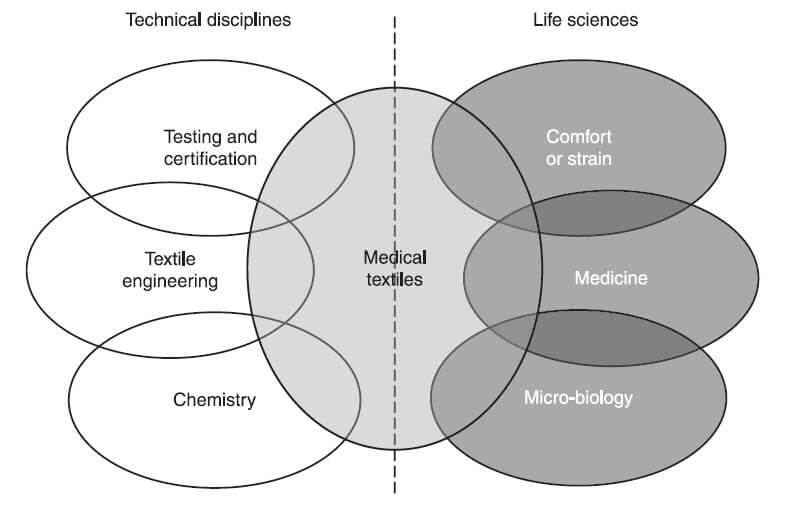
Implantable medical textiles
The natural way to replace a defective body part is via transplantation, but this is not always possible. Therefore, physicians use artificial biomedical materials such as biotextiles, foreign or synthetic materials to replace body parts; artificial body parts are referred to as prosthesis.
Due to a steadily growing number of patients and considerable diagnostic and therapeutic advances, vascular diseases are becoming more and more important in general and clinical practices. Nowadays, large diameter arteries are easily replaced, but that is not always the case with small diameter arteries. The design and fabrication of synthetic vascular prostheses have been challenging to the area of surgical research over the last four decades. Surgeons have been working closely with the medical products and textile industries to develop a successful prosthesis for the replacement of traditional bypass methods of arteries in patients suffering from vascular disease.
Soft tissue implant technology examines the market for this revolutionary technology. The soft tissue market has two major segments – tissue engineered products and traditional implants.
The requirements of implantable medical textiles are: biocompatible materials; material combinations; 2D and 3D structures; mechanical characteristics; adjustable macroscopic structures; and specific surface designs etc. [1]
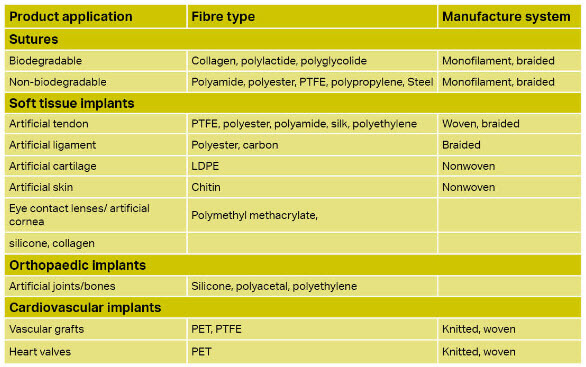
Manufacturing implantable medical textiles
Implantable textile devices can be created using resorbable or non-resorbable polymers, or a combination of different materials, and custom shaped to meet specific anatomical and biological requirements.
Although textile structures have been used in certain surgical procedures for decades, increasing complexity driven by technology innovations is allowing textile devices to serve greater purposes and to target a broader range of applications. Having a clear understanding of the anatomical purpose of the device early on helps to drive more informed decisions in the materials selection process, which will significantly impact design and development.
Types of implantable medical textiles include: sutures; soft tissue implants; hard tissue implants; vascular veins; vascular grafts; nerve guidance channels; biomaterials in ophthalmology; dental biomaterials; and textile sensors.
Benefits of implantable medical textiles
Implantable medical textiles are life savers with various benefits, including the following:
Customised edge treatments
Most textiles are produced in a bulk form that gives manufacturers a desired material that is not necessarily in the desired unit-of-use configuration. These forms can be rolls, sheets or reels of all sorts of multi-filament woven, knitted or braided textiles. Traditional cutting processes are capable of providing a unit/part with the proper length or outline, but in a manner that could cause the ends of textiles to fray, making the edges of the implant rough and potentially generating particulate or degrading the textile’s structural integrity. Cutting methods are available that will create semi-sealed edges on cut parts that drastically reduce the amount of particulate and enhance the ‘surgical hand’ of the implant by creating smoother, more flexible, cleaner and more structurally stable implants with improved tissue passage characteristics that benefit both the patient and the surgical team.
Optimised edge treatment processes during manufacture can offer broader benefits that may include:
- Enhanced edge quality of implantable medical textiles, which may minimise tissue inflammation and scar tissue formation;
- A reinforced edge feature that can enhance stability and suture pull-out;
- An integrated deployment feature that can enable device delivery through a cannula;
- A smoother edge to enhance tissue passage;
- Advance manufacturability of the finished device, which reduces component preparation time within the overall device assembly process
Resorbable implants
Generic textile implants that merely provide the infrastructure for the healing process have the potential to be replaced by active textile implants that can actually play a critical role in the wound healing process. Implants using resorbable textiles break down naturally in the body after a procedure, which can help support improved clinical outcomes and reduce costs by eliminating foreign materials in the body or the need for additional implant removal procedures. These implants can be customised to unique anatomical shapes and incorporate various coatings that can help direct the healing process and reduce potential complications. Additionally, resorbable textile implants don’t interfere with imaging and radiotherapy like other permanent implants may [3].
Critical aspects of implantable medical textiles in terms of structure
Medical-grade textiles are an ideal component for implantable medical devices, largely due to the product design versatility they offer. Textiles can be developed in 2D and 3D implantable forms in any number of configurations. Taking a raw textile material and transforming it into an optimal medical implant is a complex process requiring a special combination of capabilities and materials expertise.
The applications in which implantable textiles play a part is extensive, and their presence is growing in conjunction with the infusion of new polymers, constructions, and the potential for more ‘active’ device forms like drug/device combination products. Such products are typical in the sports medicine, trauma, orthopaedics, wound management, tissue replacement, plastic surgery, neural, and endoscopy market segments [3].
Recent advancements in implantable medical textiles
Recent innovations include bacterial cellulose fibre for artificial blood vessels, bacterial polyester fibre for repairing bone fracture, and deodorant fibre for diapers etc. In tissue engineering, textiles are used as scaffolds, providing optimal spatial and nutritional conditions for cell maintenance. Tissue engineering textiles (nonwoven, woven and knitted fabrics) have been introduced for the development of different tissues in-vitro, such as liver, skin, bone, cartilage and muscle.
Bandages have themselves evolved into advanced dressings which enable antibiotic and other drugs to be delivered directly to the parts of the body where they are needed. Some incorporate agents for stopping blood loss quickly.
Sutures have evolved from natural materials obtained from animal intestines to advanced biodegradable or bio-absorbable materials which eliminate the need for further medical attention once stitching has taken place. In casts, moisture curing resins and glass fibres offer a lightweight and more comfortable alternative to plaster of Paris.
Advances in cell growth technology include the use of cell scaffolds made from microfibre membranes. Advances in textile fibres and conduits have been developed to guide nerve reconnection. Other areas of development include antimicrobial fabrics for medical uses and medical garments [4].
Trends in world trade of implantable medical textiles
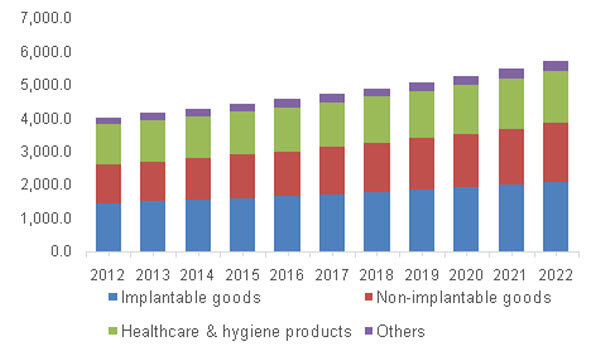
The market for medical textiles is being driven by a number of factors:
- Population growth rates, particularly in newly developing global regions;
- Changes in demographics, including the ageing population in the Western European market;
- Changes in living standards;
- Attitudes to health risks – increased awareness of the risks to health workers from health threats from bloodborne diseases and airborne pathogens;
- The continuing dominance of leading suppliers and brands (especially in the consumer market);
- Ongoing enhancement in product performance;
- The growing dominance of purchasing, which demands increasing value for money;
- The increasing share of nonwovens in the medical world market in relation to traditional textile materials. [5].
Regional insights
European countries, including Germany, the UK and Sweden, are anticipated to witness a robust recovery in healthcare spending by 2022, along with revised policies to encourage industry growth and upsurge competition among providers. In Europe, economies under transition including Russia are expected to witness a decline in healthcare spending, on account of political tensions with Ukraine and their unfavourable effect on the Russian currency and economy. The medical textile companies based in US are endeavoured to improve their existing products and produce new ones with innovative designs and materials. These products are intended to serve the cause of less invasive surgical procedures, accelerated healing and infection control [6]. The Indian market is said to be growing steadily at an annual rate of 15%.
Competitive market share insights
The global medical textiles market is dominated by a limited number of multinational companies. Major participants including Freudenberg & Co Kommanditgesellschaft, ATEX Technologies, Bally Ribbon Mills and Vestagen Technical Textiles are engaged in significant R&D for new product development. These companies are entering into collaborations with small high-tech companies to attain unique selling points which these big giants can leverage in their global marketplaces. This consequently allows small businesses to gain access to the global market as long as they are inclined to partner with one or more of these global market players [6].
Limitations of implantable medical textiles
- A clear understanding is critically needed of the structure-property relationship of novel textile products, so that precise simulation of mechanical parameters for specific clinical applications can be achieved.
- Tissue engineering research:
(i) Development of efficient manufacturing processes for preparing novel polymeric biomaterials, fibrous scaffolds;
(ii) Detailed insight about targeted modulation of behaviour of human cells with respect to architectural and chemical signals offered by textile and/or polymer-based materials.
- Scalable, cost-effective production under GMP (Good Manufacturing Practice) conditions.
- Multidisciplinary cooperation is urgently needed to encourage the formation of consortia that work on challenging topics, to improve interdisciplinary networking. An ideal strategy should be to bring different groups into one specific area, rather than making one group that masters all fields.
- Translation into the clinical arena through controlled trial for applied biomedical applications [7].
Future prospects of implantable medical textiles
Medical textiles, or Medtech, is one of the most important, continuously expanding and growing fields in technical textiles. The number of applications is diverse, ranging from a single thread suture to the complex composite structures for bone replacement and from the simple cleaning wipe to advanced barrier fabrics used in operating rooms. Textile materials and products that have been engineered to meet particular needs, are suitable for any medical and surgical application where a combination of strength, flexibility and sometimes moisture and air permeability are required. The medical textile industry has diversified with new materials and innovative designs. Recently, the application of textiles has started to go beyond wound care, incontinence pads and plasters etc. The latest innovations, ie a wide variety of woven, nonwoven and knitted forms of textile are increasingly finding their way into surgical procedures.
Conclusion
Textile materials are very important in all aspects of medicine and surgery, and the range and extent of applications to which these materials are used is a reflection of their enormous versatility. Products used for medical or surgical applications may at first sight seem to be extremely simple items. In reality, however, in-depth research is required to engineer a textile for even the simplest cleaning wipes in order to meet the stringent performance specifications. New developments continue to exploit the range of fibres and fabric-forming techniques which are available. Advances in fibre science have resulted in a new breed of wound dressing which contributes to the healing process. Advanced composite materials containing combinations of fibres and fabrics have been developed for applications where biocompatibility and strength are required. It is predicted that composite materials will continue to have a greater impact in this sector owing to the large number of characteristics and performance criteria required from these materials.
References
- Annapoorani S, Recent Developments in Medical Textiles. Volume 2. Issue 12. Page Nos. 255 to 258. December 2013.
- Horrocks A & Anand S. Handbook of Technical Textiles. Woodhead Publishing Limited. Page Nos. 407 to 420.
- http://ieeexplore.ieee.org/document/6887634/ [accessed 16 March 2018].
- https://www.researchgate.net/publication/209636622_Recent_Developments_in_Medical_Textiles [accessed 22 March 2018].
- https://textileapex.blogspot.in/2015/03/woven-fabric-defects-causes remedies.html [accessed 22 March 2018].
- http://www.medical-directions.com/10-most-common-medical-implants-and-info/ [accessed 24 March 2018].
- https://www.grandviewresearch.com/industry-analysis/medical-textiles-market. [accessed 24 March 2018].