It has been an incredibly hectic week for the Australian wool market, as all worked very hard to get this week’s sales up. The offering was the first over 60,000 bales since January 2009. The almost two weeks’ worth of volume was just too much to cope with in a single week. Growers were disadvantaged by falling prices across almost the entire selection. This was disappointing for the affected growers as many influential experts were publicly expectant of a dearer market before the cancellation last week.
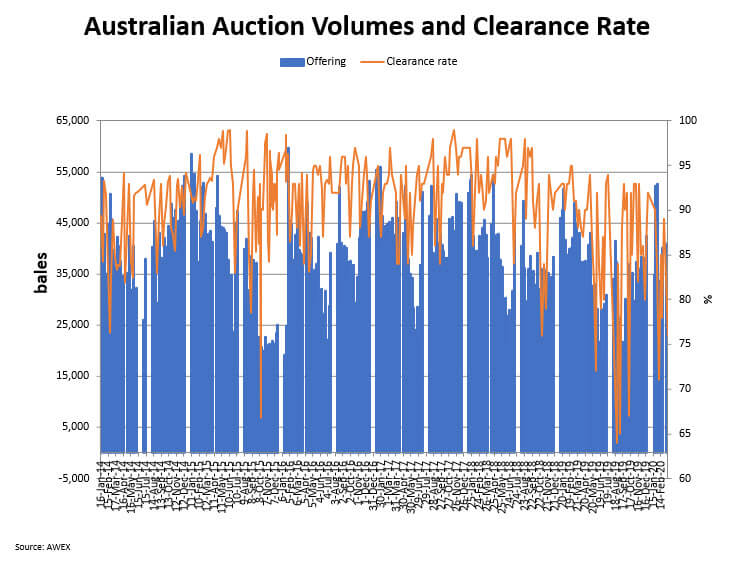
The national offering was up 52% at 62,166 bales, of which, the clearance rate was 76% compared to 89% in the previous trading week of 20 February.
On Wednesday, with all three centres operating, the EMI gained three cents and went down seven US cents, with an overall clearance rate of 84%. On Thursday, the EMI plunged 22 cents or down 11 US cents to close the week at 1,562 a kg clean or at 1,034 US cents per kg, down 19 cents or down 18 US cents from the previous trading week.
The AWEX reported turnover of wool sold at AUD$81.07m, taking the season’s total to AUD$1,492.09m.
In Sydney, a large offering on day one was met with strong buyer demand for best and good style wool with favourable additional measurements. All microns gained ground except the 18 which maintained ground. Day two saw the fleece selection soften, with prices easing across all microns as buyers discounted low yielding lots with unfavourable additional measurements. Merino skirtings were firm on day one with finer (<17.5 µm), well measured, best style lots gaining before softening on day two as high VM (>3%) lots were discounted. The crossbred market lost ground this week while lots gained on day one only to ease on day two. Other oddment categories remained unchanged. The Northern Regional Indicator lost 13 cents to 1,605 cents a kg clean. The Northern Regional Indicator lost 13 cents to 1,605 a kg clean with a clearance rate of 82%.
In Melbourne, price increases were maintained for most of day one with some small price falls occurring at the finer range (<19.0 µm) towards the end of the day. Broader microns gained while large offering of lower style lots with unfavourable additional measurements dampened demand on day two. Prices fell across all microns and produced low clearance rates. Merino skirtings followed the fleece trend on both sale days. Crossbred was strong on day one but weakened on day two. The oddment market rolled over on day one but fell on day two. The Southern Regional Indicator was down 22 cents at 1,536 a kg clean
In Fremantle, a strong opening on day one was unsustainable, with prices falling as the sale progressed. All microns lost ground, except the 21 µm which rose marginally, with finer selections most affected. Further falls occurred on day two. Finer merino skirtings were keenly sought on day one, with prices rising although broader lots lacked support and prices eased. Further price falls occurred on day two. The oddment market was mixed on day one and tended to ease on day two. The Western Regional Indicator closed the week at 1,662 a kg clean, losing 48 cents from the previous trading week with a clearance rate of 67%.
Next week, the national offering is pegged at 46,680 bales, with all three centres operating on 11 and 12 March.