
For SMEs conforming to Industry 4.0 trends and digitalising manufacturing processes can be difficult, particularly as no two factories or their infrastructures are the same. As a result, it can often be a lonely process trying to figure out how best to streamline and digitise personalised but traditional processes that, in some cases, have been done in a particular way for generations.
The August-Wilhelm Scheer Institute for Digitised Products and Processes (AWSi) recognises the challenges that SMEs face when it comes to digital transformation and aims to support them through it. Founded in 2014 by professor Dr. Dr. h.c. mult. August-Wilhelm Scheer to foster research and innovation, the Institute focuses on digitisation of economy and society. Digitised consulting, blended learning, Industry 4.0 and digitised business models and processes are the AWSi’s main topics. It is an independent research institute that committed itself to develop new technologies and ‘think ahead business models’, according to the institute. “That’s why we place great value on combining research with innovation and entrepreneurship,” says the AWSi. “We are located at the campus of Saarland University, which is one of the most renowned German universities in computer science.”
Dr Christian Linn, research professional at the AWSi, says: “The AWSi’s general aim is to support the digital transformation of SMEs, especially to bring new digital technology and digital concepts, like business models and digital business processes, from a research perspective into actual use cases in a business or economic environment. We have some research streams that go from technology motivated areas like digital reality – so everything connected, VR, AR, AI, recommended systems, all these new digital technologies which are expected or have already shown that they can change the way business processes behave.”
The institute is also trying to bring transformation into the core processes of how businesses and industries work. “For example, by doing research for digital business models research on how to digitise some services but also on how to transform internal business processes, be it in production or office processes so that they can be more efficient and can be optimised by digital technologies,” says Linn.
The AWSi researches together with partners from industry in national or EU-wide funded research projects and also does research directly with its industry partners.
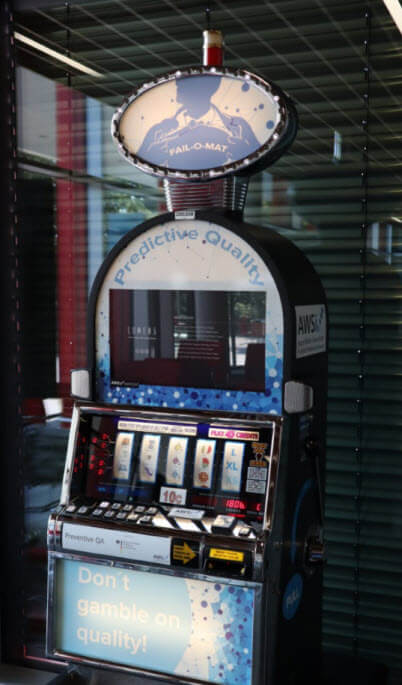
The AWSi's predictive quality slot machine
Predictive quality
Looking at digitalisation of business processes, which the AWSi calls Business Processes 4.0, predictive quality is a concept that comes up time and time again. Displayed in the form of a slot machine at Hannover Messe in April of this year, the predictive quality concept is to foresee issues with the quality of products, such as garments, before they are produced. Before the garment is manufactured any issues are therefore prevented from occurring.
Linn says: “The main idea behind predictive quality is that we somehow try to predict quality problems, performance problems, before they actually occur. The reason why we think this is important and not yet really addressed is, in the research and industrial environment, the typical way of how quality assurance works nowadays is that there are some quality tests during production, maybe even at a later stage when the product is being delivered to customers. With the quality tests, some quality problems can be discovered and then learned from based on the results.”
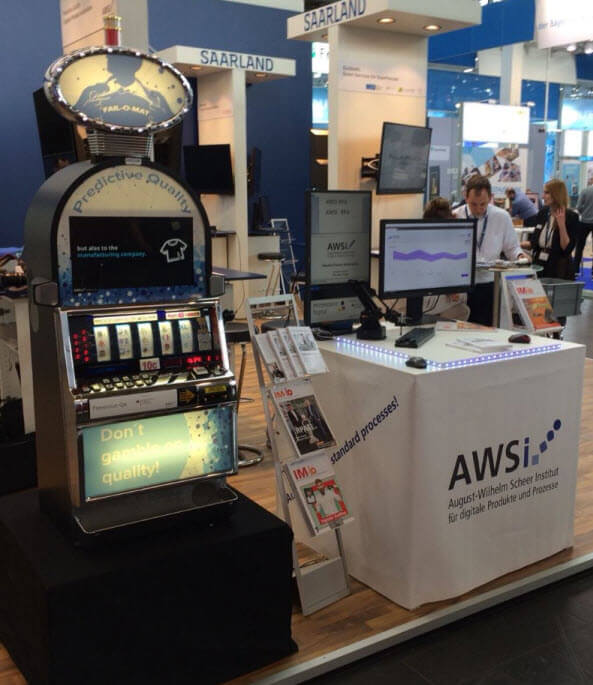
The AWSi stand at Hannover Messe in April this year
However, the AWSi tries to change the process, turning it the other way around and do the testing using data. Linn continues: “We use the data from quality controls from the customer returns of products and try to find correlations between products’ characteristics and the probability to have a quality problem and do this by means of artificial intelligence (AI) and machine learning. Through this we get insight into how the quality of the product characteristics influences the quality and we feed this back to the early stage of the product development in order to make predictions for future products.” Using this method, the AWSi is able to prevent quality defects before they actually happen.
Predictive quality is a new concept in the textile industry, not to be confused with predictive maintenance. Predictive maintenance is typically focused on specific production machines that need to be maintained. Linn says: “The key concept for predictive maintenance is that you measure or get data from machines and use this to predict when a machine is likely to get a defect or to get a problem. You basically make a prediction and then you can avoid stops in the production [unplanned downtime] or avoid losses by addressing these problems before they become imminent.
“Predictive quality is more product focused while predictive maintenance is machine focused. With predictive quality you explicitly address the product that is being produced and you make the prediction about quality problems at the stage when the product is developed.”
The data required for predictive maintenance and predictive quality is collected during the manufacturing process, but with predictive quality it is not the data produced by machinery but the data of the products. “If there are many different products, a lot of different data, then we use this data to predict the quality expectations for future products,” adds Linn.
With predictive quality, even a new design can be quality checked before it is created using the consolidated data. The impact that predictive quality could have on the textile manufacturing market is huge, with less wasted energy, raw materials and man power needed to correct quality errors.
Linn says: “The motivation behind this concept is that we think there is a great benefit and potential for the fashion or more generally the textile production industry. Researchers have found that 75% of all product defects have their source, or their reasons for defect, already in the production in the product design or development phase. So, for 70% of defects, the wrong decision was taken in the initial design and development. Other defects break out at later stages in the production or when the consumer has it.”
As a result, when a quality problem is realised, it is already too late. Linn continues: “At this point, you have spent a lot of money and time in developing and designing your product and producing it, you may have even sent it to the customer and then you get a problem with the customers because you sent them faulty products. So, the earlier you know you will have the quality problems the better. With predictive quality, we provide companies with the possibility to get a prediction of how the quality of the specific products will be in the design or development phase: at the beginning, before anything goes wrong.”
With this approach, manufacturers can simply adjust their design or development strategy, in accordance with the predictive quality dataset.


