The Australian wool market recorded losses for a second consecutive week, with falls across the Merino types, although prices for the crossbred wools continued to increase.
The Australian Wool Exchange (AWEX) Eastern Market Indicator (EMI) was down by 8 cents (0.4%) for the week to close on 2,008 cents per kilo clean on Thursday 7 March. In US dollar terms, the EMI declined by 26 cents (1.8%) to finish on 1,415 US cents.
The Australian dollar against the US dollar finished 0.97 cents (1.4%) lower to close at 70.49 US cents on Thursday.
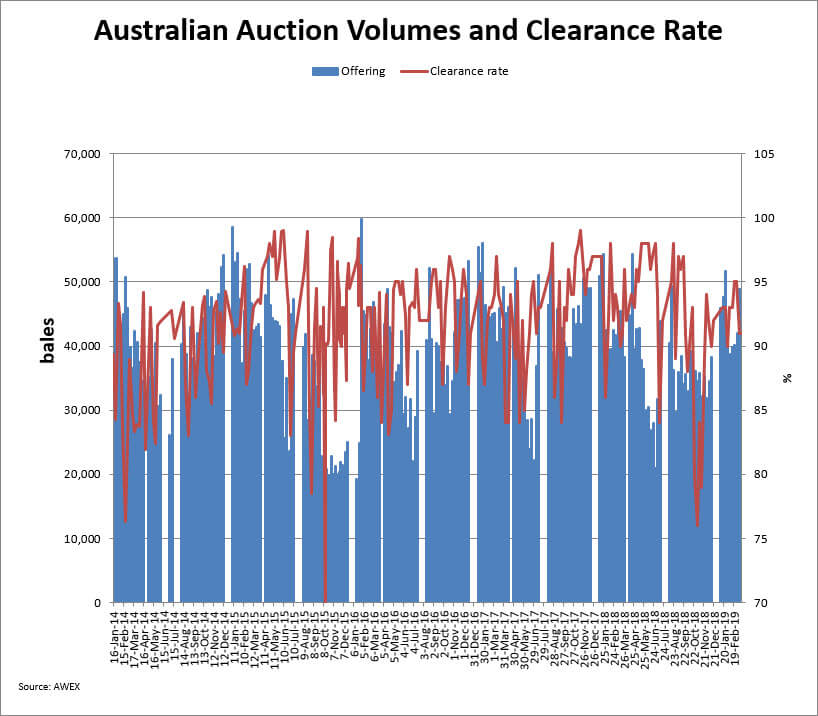
This week’s total national offering was 45,130 bales, compared with 48,948 bales last week. The clearance rate this week was 90.7%.
Sales were held in Melbourne on Tuesday 5 March and at all three selling centres on Wednesday 6 March and Thursday 7 March. On Tuesday the EMI rose by 2 cents to 2,018 n cents but in US dollar terms fell by 13 cents to 1,428 US cents. On Wednesday the EMI was unchanged in local currency terms but in US dollar terms decreased by a further 8 cents to 1,420 US cents. On Thursday the EMI fell by 10 cents to 2,008 cents and in US dollar terms declined by an additional 5 cents to 1,415 US cents.
AWEX reported that a limited selection of good style wools with favourable additional measurement results and low vegetable matter (vm) came under intense pressure, as buyers fought hard to secure their share of these types. This strong competition meant that these better wools recorded very little change for the week.
However, AWEX noted that the bulk of the selection was lesser style wools, and wools with poor additional measurement results. The large amount of these types meant that buyers struggled to average them into their purchases. The result was a continuing reduction in prices for these lots. By the end of the series these inferior types were selling at levels generally 30 to 60 cents below those achieved at the previous sale. These reductions played a large role in the overall fall in the individual average AWEX Micron Price Guides (MPGs) for the Merino types, which fell by 10 to 40 cents.
The drop in the merino MPGs was the reason behind the EMI falling. It was only the strength of
the other sectors that prevented it from declining further.
There were falls right across the Merino MPGs.
16.5 microns fell by 19 cents (0.7%); 17 microns was down by 11 cents (0.4%); 17.5 microns declined by 14 cents (0.6%); 18 microns decreased by 23 cents (0.9%); 18.5 microns was down by 22 cents (0.9%); 19 microns fell by 20 cents (0.8%); 19.5 microns lost 21 cents (0.9%); 20 microns fell by 23 cents (1%); 21 microns decreased by 32 cents (1.4%); and 22 microns declined by 21 cents (0.9%).
The crossbreds continued to track upward, with prices generally rising by 15 to 30 cents. The better prepared lines received the most attention and as a result enjoyed the largest increases. The only exception was 30 microns, which fell by around 20 to 30
cents.
Among the average AWEX MPGs for the crossbred types, 26 microns climbed by 11 cents (0.8%); 28 microns rose by 25 cents (2.2%); 30 microns decreased by 26 cents (2.7%); and 32 microns was up by 10 cents (1.7%).
The strongest performing sector was the oddments, with most types and descriptions rising by 20 to 50 cents, pushing the average AWEX Merino Carding Indicator up by 30 cents.
AWEX reported that the total value of the wool sold this week was AU$88m (AU$2,138 per bale), taking the season total to AU$2.315bn (AU$2,196 per bale). Buyers for China were dominant, with support from buyers for India and Europe.
The national offering is forecast to drop further next week (Week 37) to 41,722 bales, while the projection for Week 38 is 37,630 bales and Week 39 37,560 bales.
Offerings for the next three weeks are expected to be 7% less than in the same period last year. The forecast progressive difference for the season as a whole up to Week 39 is 12.7% lower than the same period last season.