The Australian wool market recorded substantial gains this week, with much of the increase attributed to the postponement of this week’s sale in South Africa.
The Australian Wool Exchange (AWEX) Eastern Market Indicator (EMI) was up by 59 cents (3%) for the week to close on 2,027 cents per kilo clean on Thursday 21 February. In US dollar terms, the EMI climbed by 50 cents (3.6%) to finish on 1,451 US cents.
This week’s increase took the EMI back over 2,000 cents for the first time since the second week in October. The EMI has now risen for eight consecutive sales, adding a total of 178 cents in local currency terms during this period.
The Australian dollar against the US dollar finished 0.43 cents (0.6%) higher to close at 71.62 US cents on Thursday.
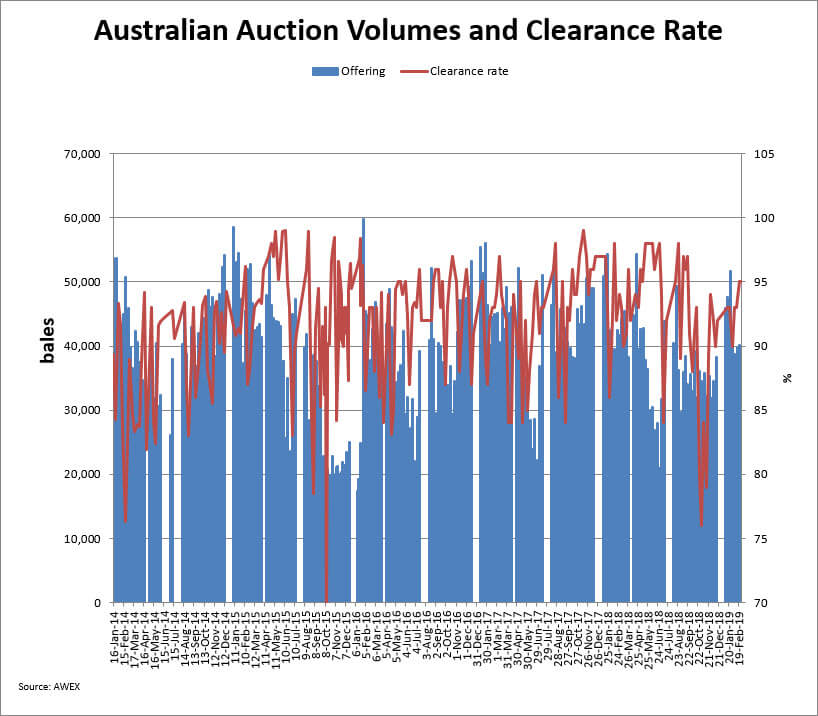
The total national offering this week was 42,029 bales, compared with 40,165 bales last week. The clearance rate this week was 94.6%.
This week’s offering included 2,061 bales from the New Zealand Merino Company on Thursday, which had a clearance rate of 97.6%.
Sales were held in Melbourne on Tuesday 19 February, and at all three selling centres on Wednesday 20 February and Thursday 21 February. On Tuesday the EMI lifted by 42 cents to 2,010 n cents, and in US dollar terms rose by 28 cents to 1,429 US cents. On Wednesday the EMI climbed by a further 26 cents to 2,036 cents and in US dollar terms lifted by an additional 29 cents to 1,458 US cents. However, on Thursday the EMI declined by 9 cents to 2,027 cents and in US dollar terms fell back by 7 cents to 1,451 US cents.
AWEX reported that extra Chinese demand drove the significant rises in the market this week.
Chinese Customs have suspended all greasy imports from South Africa, due to an outbreak of Foot and Mouth disease earlier in the year. As a result, the South African wool industry postponed the wool auction scheduled for 20 February, leading to an overall reduction of global auction wool supply this week.
AWEX noted that the limited offering in Melbourne on Tuesday came under intense buyer pressure from the outset. Mainly pushed by Chinese interests, prices quickly increased by 80 to 90 cents. When sales resumed on the second day in Sydney and Fremantle, similar price increases were experienced. The price rises pushed the average AWEX Micron Price Guides (MPGs) for 21 microns at all three centres to all-time highs. The North and South MPGs also posted new records for 20 microns.
However, although the market recorded strong positive movement for the week, there was a distinct softening experienced on the final day of selling. The falling market was more
evident in the Western region. Selling last, the Western indicator fell by 41 cents.
Among the national average AWEX Micron Price Guides (MPGs) for the Merino wools this week, 16.5 microns rose by 29 cents (1.1%); 17 microns was up by 31 cents (1.2%); 17.5 microns gained 20 cents (0.8%); 18 microns increased by 35 cents (1.4%); 18.5 microns was up by 47 cents (2%); 19 microns increased by 56 cents (2.4%); 19.5 microns gained 57 cents (2.5%); 20 microns lifted by 61 cents (2.7%); 21 microns increased by 60 cents (2.6%); and 22 microns rose by 61 cents (2.7%).
The crossbred sector continues to track sharply upwards. Prices generally improved by 20 to 50 cents this week. These increases have pushed the MPGs for 28 and 30 microns further into record territory.
Among the average AWEX MPGs for the crossbred types, 26 microns climbed by 56 cents (4.1%); 28 microns rose by 57 cents (5.2%); 30 microns increased by 55 cents (6%); and 32 microns was up by 52 cents (9.9%).
AWEX reported that the total value of the wool sold this week was AU$78.5m (AU$2,097 per bale), taking the season total to AU$2.128bn (AU$2,199 per bale). Buyers for China were dominant, with support from buyers for India and Europe.
Due to the spike in prices, many sellers holding wool in brokers store have decided to offer next week, pushing the national offering well beyond original estimates. There are now 49,738 bales on offer, over 8,500 bales more than expected, for next week (Week 35), which is a designated Australian superfine sale. The projection for Week 36 is 38,813 bales, and Week 37 36,460 bales.
However, offerings for the next three weeks are still expected to be 5.5% less than in the same period last year. The forecast progressive difference for the season as a whole up to Week 37 is 13.7% lower than the same period last season.