The last sale of the 2018-19 season was marred by a poor show once again, and prices continued the downward trend that began at the beginning of June. Wool now, it appears, badly needs better global economic factors than the market is engulfed with. Could there be some hope at the G20 Summit? But nevertheless, it is hard to be optimistic. The positive signs that had emerged at the end of the previous weeks’ sales swiftly faded by the time this week’s sale commenced. The three-week sales recess also failed to buoy demand and reverse the recent trend of low buyer confidence.
Buying this week was again dominated by top makers, traders and downstream processors from China. Indent buying was sparse. The reduction in supply in recent weeks and months has been outweighed significantly by slowing demand from the northern hemisphere, which has had a strong effect throughout the supply chain.
The Australian Wool Exchange Eastern Market Indicator finished the week lower by 2.9%, or 51 cents, at 1,715 Aus cents a kg clean. In US dollar terms, the EMI fall shrank 1.5%, or 18 US cents, to 1,199 US cents a kg clean. On Wednesday, the EMI dropped 26 cents to 1,740 Aus cents a kg clean and was down 6 cents at 1,211 US cents a kg. On Thursday, the EMI fell 25 cents to 1,715 Aus cents a kg and accelerated to 12 cents in US dollar terms to 1,199 cents a kg.
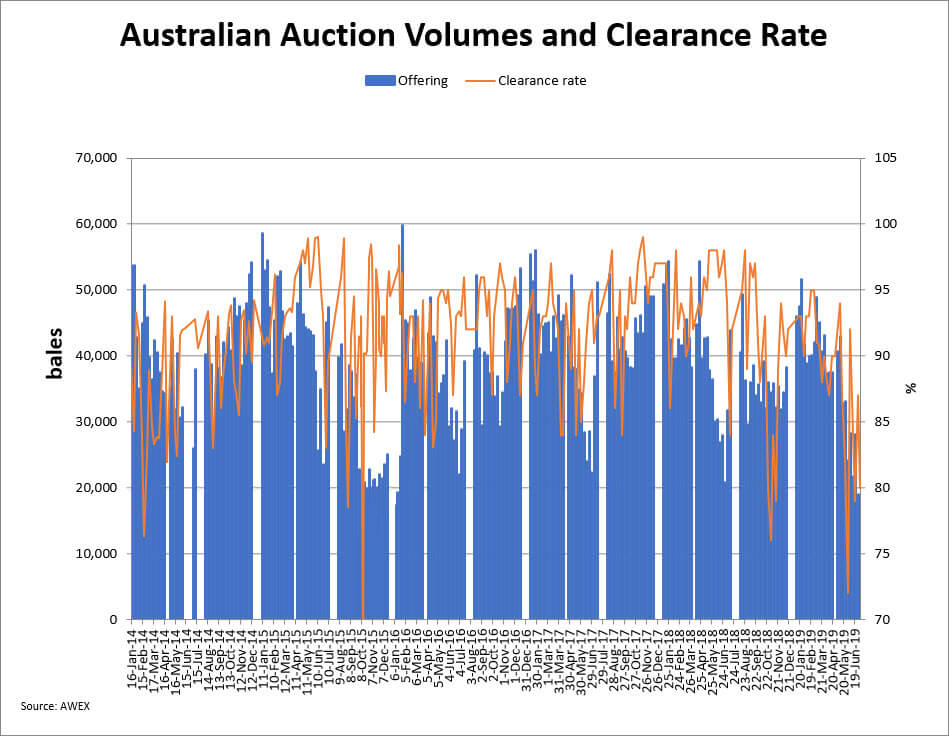
The national offering was 29,167 bales, compared with 19,072 bales in the previous week. The clearance rate weakened to 80% from 87% in the previous week. AWEX reported the value of the wool sold was Aus$41.9m ($1,802 per bale), taking the season total to Aus$3.175bn ($2,145 per bale).
Sydney’s sales saw another week of falling prices across the microns. Good, average and inferior style lots again dominated the selection with discounts compounding for lots with low staple strength (<30 N/ktex). Merino skirtings eased during the week, with oddment lots also losing ground. The Northern Regional Indicator closed at 1,731 Aus cents a kg clean, losing 58 cents with a clearance rate of 83%, as against 88% in the previous week.
In Melbourne, low clearance rates on both sale days implied signified grower reluctance to sell in the continuously falling market. Drought affecting wools continued to dominate the selection, comprising the bulk of those passed in or non-cleared. While buyers were actively seeking out and competing for lots with favourable additional measurements and best style, limited supply of these wools could not alleviate the price falls. Merino skirtings and oddments also trended downwards, particularly those with higher VM levels. The Southern Regional Indicator lost 46 cents to 1,705 Aus cents a kg clean with a clearance rate of 83%, as against 82% last week.
After a week’s recess, sales at Fremantle saw significant price reductions across all microns. Poor clearance rates, together with a proportion of lots withdrawn prior to sale, resulted in nearly 46% of the merino fleece lots offered failing to sell on Thursday. High VM merino skirting lots fell in value with all categories of oddments easing. The Western Regional Indicator lost 105 cents to 1,832 Aus cents a kg clean with a clearance rate of 68%.
Overall, supply concerns throughout the season were well established, with the amount of wool sold through auction dropping by 16.6% or 296,326 bales year on year. Approximately 1.48 million bales were transacted through the auction system. Another roughly 177,000 bales were sold by private treaty and direct sales, based on the AWPFC figure of 298 million kg of production.
Next week, the first sale of the 2019-20 season will see all three centres selling, with 34,504 bales rostered for sale.