The Australian wool market continued to track upwards this week with steady rises across all wool types.
The Australian Wool Exchange (AWEX) Eastern Market Indicator (EMI) was up by 24 cents (1.2%) for the week to close on 1,968 cents per kilo clean on Thursday 14 February. In US dollar terms, the EMI climbed by 21 cents (1.5%) to finish on 1,401 US cents.
The Australian dollar against the US dollar finished 0.20 cents (0.3%) higher to close at 71.19 US cents on Thursday.
The EMI has now increased for seven consecutive sales, adding 119 cents since Week 24 in local currency terms.
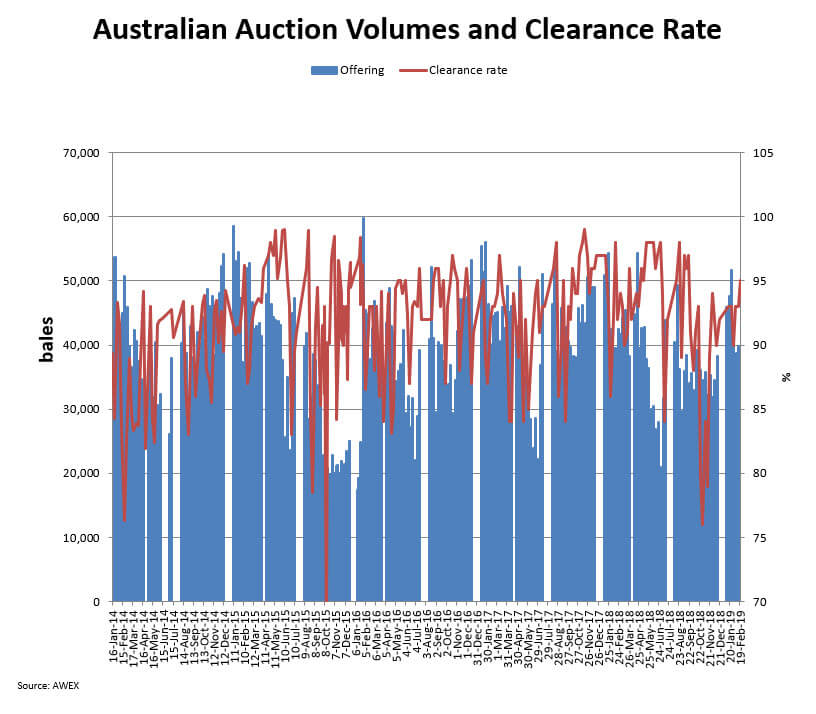
The total national offering this week was 40,165 bales, compared with 39,894 bales last week. The clearance rate this week was 94.7%.
AWEX noted that quantities were higher than first rostered, resulting in a slightly increased offering on the previous sale. However, in the Northern region, Thursday’s sale was the smallest Merino
fleece offering in 12 months. The weekly total in the North was the smallest in almost five years.
Sales were held at all three selling centres on Wednesday 13 February and Thursday 14 February. On Wednesday, the EMI lifted by 9 cents to 1,953 cents and in US dollar terms rose by 13 cents to 1,393 US cents. On Thursday, the EMI increased by a further 15 cents to 1,968 cents and in US dollar terms climbed by an additional 8 cents to 1,401 US cents.
AWEX reported that as in recent weeks the rise of the market was gradual but sustained. Prices continually increased as the series progressed. By the end of the sale, the prices being achieved were generally 10 to 20 cents above those seen last week. The only exception to this was a larger than normal superfine offering in the Southern region, due in
part to the sales in Melbourne on Wednesday including a Tasmanian Origin feature sale, comprising 36.1% of the bales on offer in Melbourne that day. This resulted in wools of 18 microns and finer falling by 15 to 25 cents for the week in the Southern region.
AWEX reported that the Tasmanian selection of predominantly 16 to 19 microns was of a high standard for style and measurement with 44% of the offering testing 40 N/kt and above.
Overall, the greatest gains nationally among the Merinos were at the medium and broader end of the micron ranges. Among the average AWEX Micron Price Guides (MPGs) 16.5 microns rose by 25 cents (1%); 17 microns was up by 21 cents (0.8%); 17.5 microns gained 22 cents (0.9%); 18 microns increased by 20 cents (0.8%); 18.5 microns was up by 24 cents (1%); 19 microns increased by 24 cents (1%); 19.5 microns gained 28 cents (1.2%); 20 microns lifted by 35 cents (1.5%); 21 microns increased by 26 cents (1.2%); and 22 microns rose by 30 cents (1.4%).
The crossbreds attracted extremely strong support, helping to push some prices to record levels and contributing to the healthy rise of the EMI. The average AWEX MPGs for the crossbred types in Sydney and Melbourne posted their highest recorded levels of
1,083 and 1,103 cents respectively. In the Southern region, the MPG for 30 microns is also now at a record. It is the first time since the AWC/AWEX series commenced in 1979 that it
has been over 900 cents. The previous high was in 2015, just shy of 900 cents.
Among the average AWEX MPGs for the crossbred types, 26 microns climbed by 19 cents (1.4%); 28 microns rose by 43 cents (4.1%); 30 microns increased by 40 cents (4.5%); and 32 microns was up by 8 cents (1.6%). The 28 and 30 micron crossbred wools have risen by 200 cents and 208 cents, respectively, since sales resumed in January.
It was also a good week for oddments, with the average AWEX Merino Cardings Price Guide up by 25 cents after two weeks of falls, closing at 1,158 cents.
AWEX reported that the total value of the wool sold this week was AU$83.3m (AU$2,190 per bale), taking the season total to AU$2.049bn (AU$2,200 per bale). Buyers for China were dominant, with support from buyers for Europe and India.
The offering for next week (Week 34) is forecast to be 42,469 bales, with the projection for Week 35 – a designated Australian superfine sale – 35,780 bales, and Week 36 36,785 bales.
Offerings for the next three weeks are expected to be 12.4% less than in the same period last year. The forecast progressive difference for the season as a whole up to Week 36 is 14.7% lower than the same period last season.