The Australian wool market had a relatively steady performance this week but was unable to halt its
continued downward slide.
The Australian Wool Exchange (AWEX) Eastern Market Indicator (EMI) fell by 4 cents (0.2%) for the week to close on 1,943 cents per kilo clean on Thursday 4 April. In US dollar terms, the EMI was up by 1 cent to finish on 1,383 US cents.

The Australian dollar against the US dollar moved back above 70 cents this week to finish 0.14 cents (0.2%) higher and close at 71.11 US cents on Thursday.
The EMI in local currency terms has now fallen for six consecutive weeks, the longest downward run
since September 2012 when it lost 150 cents (19.3%). The losses accrued over the last six weeks of this season have not been as severe, with the EMI declining by 84 cents (4.5%).
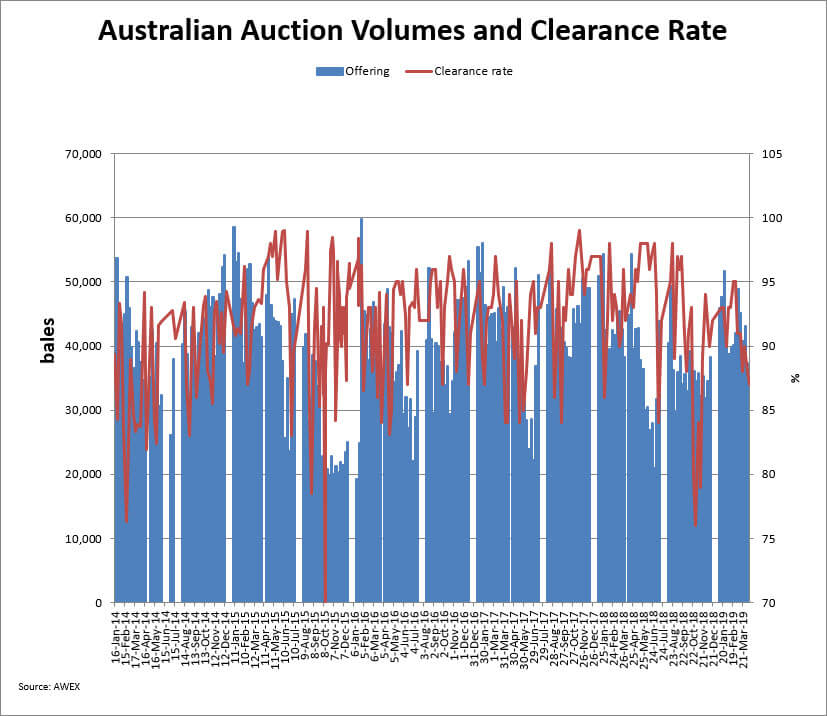
This week’s total national offering was 37,454 bales, compared with 37,405 bales last week. The national clearance rate this week was 87.2%, with rates of 80.9% in the West, 91.2% in the South and 87.6% in the North.
Sales were held at all three selling centres on Wednesday 3 April and Thursday 4 April. On Wednesday the EMI fell by 1 cent to 1,946 cents and in US dollar terms stayed firm on 1,382 US cents. On Thursday the EMI declined by a further 3 cents to 1,943 cents and in US dollar terms rose by 1 cent to 1,383 US cents.
In a positive sign, the Western region sold very strongly to finish the week and managed overall increases.
The overall market followed the pattern seen in recent weeks with the better Merino fleece and skirting types generally in good demand and crossbred types out-performing the Merino types.
AWEX noted again that among the Merino fleece types the amount of lower yielding wools continues to rise. It said that the increase in these lesser style wools is pushing down the average national yield, and in a continuing trend, the prevalence of these types is contributing to the downward pressure on the market. Higher yielding / good style wools continue to be highly sought after. However, AWEX said that there is not enough of these wools to prevent overall reductions in the individual Micron Price Guides (MPGs).
Among the average AWEX MPGs for the Merino wools, 16.5 microns fell by 11 cents (0.4%); 17 microns was down by 16 cents (0.6%); 17.5 microns declined by 2 cents (0.1%); 18 microns decreased by 4 cents (0.2%); 18.5 microns was down by 1 cent; 19 microns fell by 5 cents (0.2%); 19.5 microns lost 12 cents (0.5%); 20 microns fell by 13 cents (0.6%); 21 microns decreased by 7 cents (0.3%); and 22 microns declined by 2 cents (0.1%).
The crossbred sector continued to defy the trend of the Merinos, recording increases for the third
week in a row. Strong demand helped to push prices higher, generally between 10 and 25 cents. AWEX noted that it was the increases in the crossbreds which prevented the EMI from suffering a larger fall than it did.
Among the average AWEX MPGs for the crossbred types, 25 microns gained 28 cents (1.8%); 26 microns rose by 23 cents (1.6%); 28 microns was up by 23 cents (1.9%); 30 microns increased by 18 cents (1.9%); and 32 microns was up by 8 cents (1.3%).
Oddments had a better performance this week with the average AWEX Merino Carding Indicator falling by 10 cents. Although the price movement was downwards, it was much more favourable than the 89 cents fall experienced in the two previous weeks.
AWEX reported that the total value of the wool sold this week was AU$66.1m (AU$2,023 per bale), taking the season total to AU$2.605bn (AU$2,179 per bale). Buyers for China were dominant, with support from buyers for Europe and India.
The national offering for next week (Week 41) is forecast to increase slightly again to 38,712 bales, while the projection for Week 42 is 42,465 bales. In Week 43 there will be a recess for the Easter break.
Offerings for the next two weeks are expected to be 13.7% less than in the same period last year. The forecast progressive difference for the season as a whole up to Week 42 is 12.5% lower than the same period last season.