After rising for eight consecutive sales, the Australian wool market recorded losses this week.
The Australian Wool Exchange (AWEX) Eastern Market Indicator (EMI) was down by 11 cents (0.5%) for the week to close on 2,016 cents per kilo clean on Thursday 28 February. In US dollar terms, the EMI declined by 10 cents (0.7%) to finish on 1,441 US cents.
The Australian dollar against the US dollar finished 0.16 cents (0.2%) lower for the week to close at 71.46 US cents on Thursday, as the Aussie dollar largely recovered from its fall on Friday 22 February.
The decrease in the EMI this week was the first week-on-week loss in the 2019 calendar year, bringing to an end a run of eight consecutive weekly increases. The market had enjoyed the best start to a calendar year since 2006, rising for seven consecutive sales since the first sale of the year.
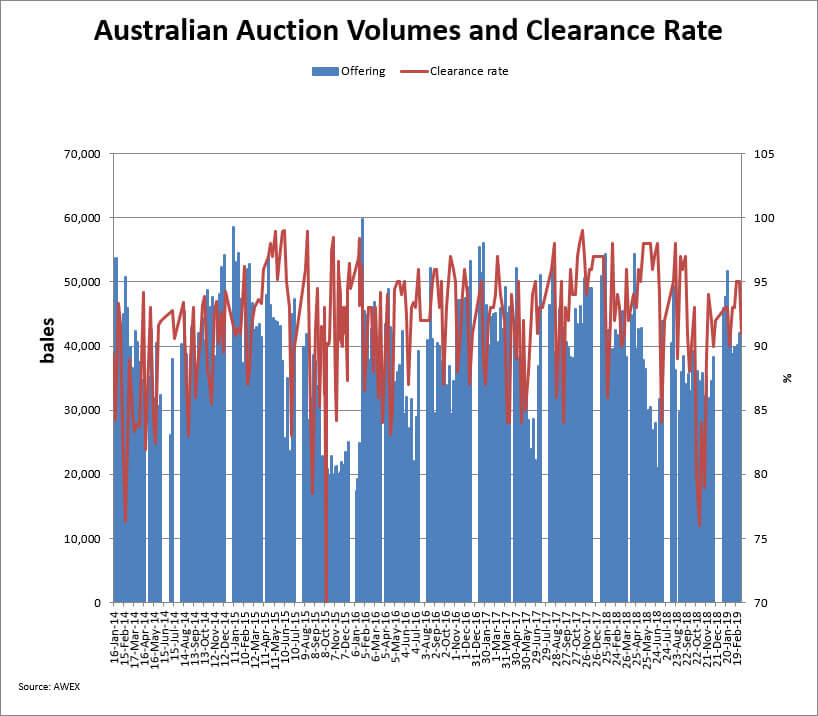
AWEX reported that last week’s price increases encouraged more sellers to the market, resulting in
the third largest sale of the season. The total national offering was 48,948 bales, compared with 42,029 bales last week. The clearance rate this week was 91.1%.
Sales were held in Melbourne on Tuesday 26 February and at all three selling centres on Wednesday 27 February and Thursday 28 February. On Tuesday the EMI fell by 11 cents to 2,016 n cents and in US dollar terms decreased by 7 cents to 1,444 US cents. On Wednesday the EMI fell by a further 4 cents to 2,012 cents but in US dollar terms rose by 1 cent to 1,445 US cents. On Thursday the EMI rose by 4 cents to 2,016 cents but in US dollar terms declined by 4 cents to 1,441 US cents.
AWEX noted that in Melbourne on Tuesday the market quickly realised the losses that were experienced in the Western region on the final selling day of the previous week. Prices generally fell by 25 to 35 cents. When sales resumed on the second day, it was Sydney’s turn to record losses, generally of 15 to 35 cents. Melbourne and Fremantle steadied, however, and both centres
recorded modest increases for the day. In contrast to the previous week, there were positive signs to finish the series, with the three regional indicators all recording increases on the final day. Fremantle, selling last, recorded the largest increase, with the Western Indicator rising by 12 cents. The Western region recorded healthy increases when compared to the previous week.
For the Merino types nationally, most average AWEX Micron Price Guides (MPGs) were down by around 0.5%, apart from at 22 microns, which rose by 10 cents (0.4%). The 28 and 30 micron MPGs eased by 7 and 12 cents respectively from their record levels of last week, to finish on 1,142 cents and 967 cents respectively.
16.5 microns fell by 13 cents (0.5%); 17 microns was down by 17 cents (0.7%); 17.5 microns declined by 25 cents (1%); 18 microns decreased by 14 cents (0.6%); 18.5 microns was down by 6 cents (0.2%); 19 microns was unchanged; 19.5 microns lost 6 cents (0.3%); 20 microns fell by 11 cents (0.5%); 21 microns decreased by 3 cents (0.1%); and 22 microns rose by 10 cents (0.4%).
The crossbreds had mixed results, with 28 and 30 microns dipping slightly below the records
achieved last week, while 26 and 32 microns managed 20 cent increases. Among the average AWEX MPGs for the crossbred types, 26 microns climbed by 22 cents (1.6%); 28 microns fell by 7 cents (0.6%); 30 microns decreased by 12 cents (1.2%); and 32 microns was up by 20 cents (3.5%).
The average AWEX Merino Carding Indicator was unchanged.
AWEX reported that the total value of the wool sold this week was AU$99.2m (AU$2,212 per bale), taking the season total to AU$2.227bn (AU$2,196 per bale). Buyers for China were dominant, with support from buyers for India and Europe.
Another large offering is forecast for next week (Week 36), at 46,128 bales, while the projection for Week 37 is 38,310 bales and Week 38 37,430 bales.
Offerings for the next three weeks are expected to be 3.6% less than in the same period last year. The forecast progressive difference for the season as a whole up to Week 38 is 12.8% lower than the same period last season.