The Australian wool market managed to reverse the seven straight weeks of downtrend by posting an increase of 7 cents this week.
The Australian Wool Exchange (AWEX) Eastern Market Indicator (EMI) closed the week at 1,943 cents per kg clean. In US dollar terms, the EMI rose 12 cents to close at 1,398 US cents.
On Tuesday, the EMI gained 11 cents to 1,947 per kg clean and up 5 cents per kg at 1,392 US cents. On Wednesday, the EMI retreated 4 cents to 1,943 cents per kg but climbed 6 cents in US dollar terms to 1,398 per kg.
AWEX reported that the total value of wool sold this week was Aus$75.2m (AU$2,057 per bale), taking the season total to Aus$2.75bn (AU$2,176 per bale).
The Australian dollar traded mostly sideways this week, waiting for the release of the Australian Jobs report on Thursday. It opened at 0.7180, rallying into Wednesday’s high of 0.7206 on the release of better China data, but failed to break the 0.7208 resistance.
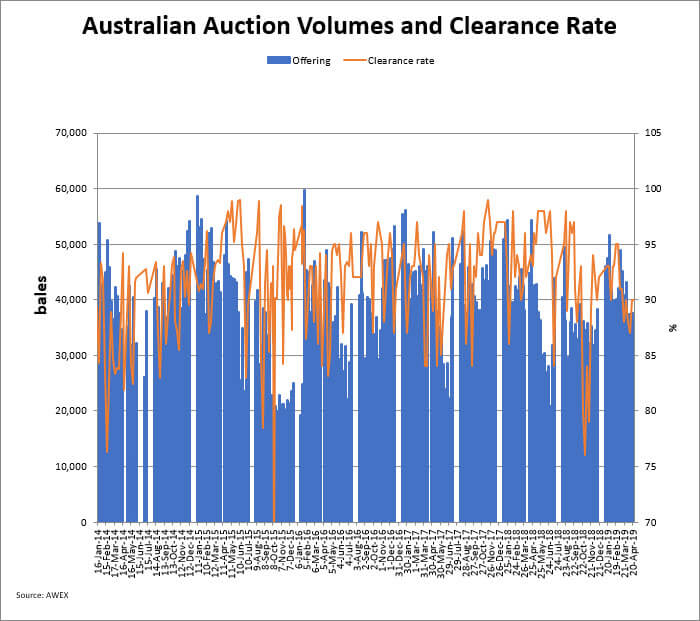
The final national offering was 42,065 bales and the overall clearance rate was 90%. Sales were held in all three centres of Sydney, Melbourne and Fremantle this week. Alongside this was the annual Sydney Royal Easter Show Feature Sale, showcasing the Australian wool industry to a wider audience. The sale also included three certified 1PP speciality lots, the pinnacle of Australian wool production. Congratulations to the growers of these wools.
Although this reversed the slow decay of the market price that has been trending for two months, for the time being, the AWEX reports stated that this drift is the longest since November 2003, as measured by the recent weeks’ sales.
The key feature this week was the aggressive buyer sentiment, as they attempted to secure meaningful available quantities due to the upcoming break. At the sales the main buyer focus was on the higher yielding wools, and these types were generally sold at levels slightly above those achieved at the previous sale. The lesser style wools were well supported but not to the same extent as the better types, pushing these wools down for the series.
In Sydney, Tuesday’s offering saw the best and spinners’ style wools comprise 20% of the offering, which attracted strong buyer competition. However, the bulk of the offering was lower yielding lots with low strength and high midbreaks, which were discounted. The Northern Regional Indicator gained 1 cent to 1,979 Aus cents per kg clean, and the clearance was 94.3%.
In Melbourne, Tuesday’s sale saw strong competition for lots with high yields and favourable additional measurements. Discounts on drought affected lots on Wednesday, eroding most of the previous day’s gains. The Southern Regional indicator rose 11 cents to 1,921 Aus cents per kg clean with a clearance rate of 90.9%.
The Fremantle market continued the pattern of recent weeks, with high yielding good style lots attracting keen buyer demand and lower yielding poorer style lots generating discounts. Wednesday’s sale was steady across all merino types as buyers sought to secure quantities before next week’s sale recess. The Western Regional Indicator rose by 1 cent to 2,065 Aus cents per kg clean. The Fremantle clearance rate was 82.5%.
Renewed buying interest from China helped stage the reversal this week. Chinese manufacturing sector figures from March 2019 produced a surprising turnaround deemed positive, with exporting factories the major beneficiaries it appears. To add sustenance to a better trade scenario, bank lending in China is said to have loosened substantially and finance is more accessible.
Australian wool export data up until the end February showed that China has reduced its import proportion of the clip from last full season of 75% down to 72%. If this figure holds until the end of this season, it will represent a drop of imports into China or 4.2% of the clip. But with the fall in production and lower yields, that drop will be significant when measured in actual clean kg exported to China in the 2018-19 season. India remained locked at 6% of Australian wool exports while Italy was up at 6% from 4% last season. Czech Republic’s share dropped to 4% from 5%.
No sale is scheduled in Week 43, the week after Easter beginning 29 April. The offering for Week 44 is expected to be up by 7.3% to 42,487 bales, while the offering for Week 45 is expected to be down by 3.8% to 41,168 bales.