Wool prices continued to fall at the Australian wool auctions this week as the large volume of drought affecting goods continued to be on offer. Further, the major contributing factors adding to the downturn were the global economic confidence filtering through to the wool textile industry amid the China-US tariff dispute, and the gloomy retail environment in mainland China and Europe.
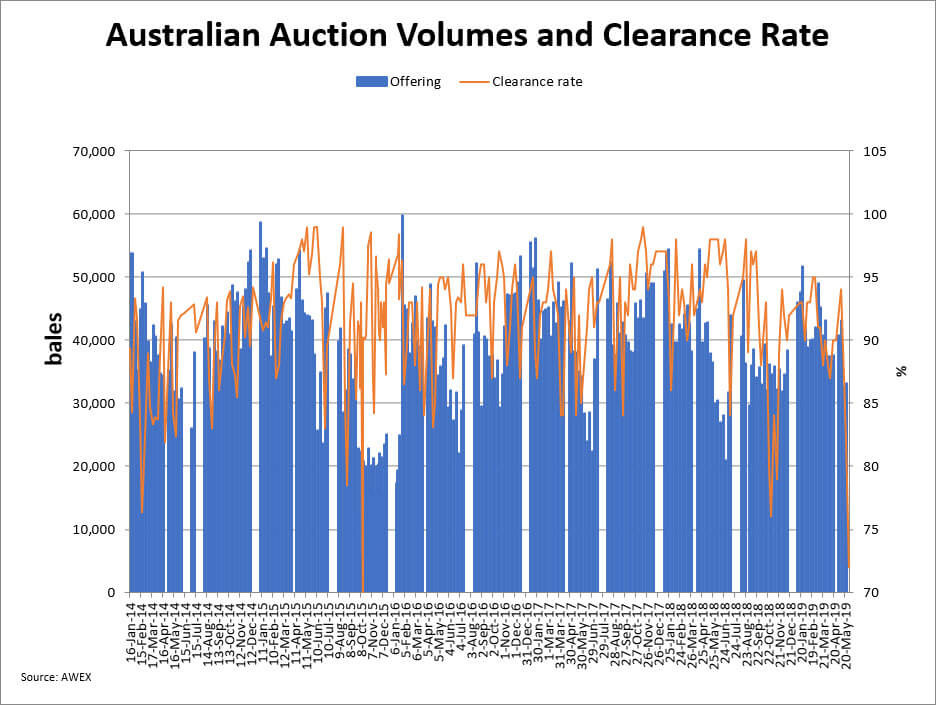
The Australian Wool Exchange (AWEX) Eastern Market Indicator (EMI) finished the week down 60 cents at 1,833 Aus cents a kg clean. In US dollar terms, the EMI closed this week 49 cents down at 1,260 US cents. 24,121 bales were offered nationally, compared with 33,156 bales last sale. The clearance rate was only 72% of the offering, while another 8.4% was withdrawn prior to sale.
This was the smallest sale and the lowest clearance rate of the season. AWEX reported that the value of wool sold was Aus$32.7m (AU$1,889 per bale), taking the season total to Aus$2.975bn (AU$2,163 per bale).
The market continued its downward movement on Wednesday before settling to some extent on Thursday. While the EMI has fallen by 119 cents in the last two weeks, it is still 57 cents above the lowest value recorded earlier this season. Predictably, all types and micron ranges were affected, with the crossbreds being most affected after their good run earlier in the season. Buyers for China were dominant, with support from buyers for Europe and India.
On Wednesday, the EMI lost 52 cents to 1,841 a kg clean and was down 43 cents at 1,266 US cents a kg. On Thursday, the decline was slower at just 8 cents to 1,833 Aus cents a kg and by 5 cents in US dollar terms to 1,261 a kg.
In Sydney, good, average and inferior type lots dominated Wednesday’s offering, which saw a clearance rate of 64%. Soft demand saw falls across all microns. The low volume of best style lots also eased. Thursday saw a larger number of best style lots achieve similar prices to Wednesday. Merino skirtings, crossbreds and oddments followed a similar pattern on both days. The Northern Regional Indicator lost 57 cents on Wednesday and another 11 cents on Thursday to end the week at 1,869 a kg clean with a clearance rate of 74%, compared to 84% the previous week.
In Melbourne, the sales pattern mostly mirrored Sydney’s sale. Wednesday saw just 6,700 bales on offer comprising mostly good, average and inferior styles. Buyers were very selective. On Thursday, a larger number of best style lots made the price slide further. Merino skirtings and crossbred lots followed a similar pattern, although oddments experienced marginal falls.
The Southern Regional Indicator lost 54 cents to 1,810 Aus cents a kg clean, with a clearance rate of 78%.
In Fremantle, just 4,388 bales were on offer this week, reducing the Western region auction to a one-day sale. Large losses were seen across all microns. Growers were hesitant to sell at this level, with 51 lots cleared. This was in addition to 10% of lots withdrawn prior to the sale. Over 56% of the merino skirting lots were cleared, with those sold easily. The Western Regional Indicator dropped 58 cents to 1,937 Aus cents a kg clean, with a clearance rate of 51%.
Next week has just over 31,000 bales rostered for auction followed by a week where just 20,000 bales are currently scheduled. South Africa has just two selling weeks left prior to its annual two-month break in sales, so a supply squeeze is on the horizon, but an injection of greater confidence and stronger demand is required.
Next week’s auction will see just 25,637 bales rostered. And in the following two weeks after that, the average offer works out to only 27,000 bales per week. Given the general gloom this week, the slightest upward shift in demand will push the market into a positive zone and supply could be a constraint.