The Australian wool market witnessed another week of tumultuous price reductions, with the EMI closing at its lowest level in more than two years.
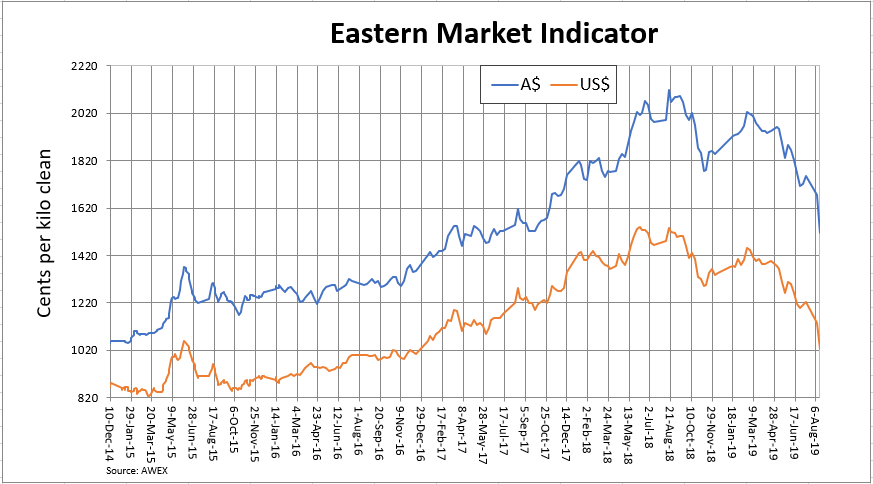
A continual lack of buyer confidence resulted in the EMI losing 163 a kg clean. Not surprisingly, wool growers were reluctant to sell at these levels, with 16.7% of the total bales on offer withdrawn prior to sale and posting a poor clearance rate. The suspension of wool auctions in South Africa, which reduced the overall global supply, did little to bolster demand in Australia.
The Australian Wool Exchange Eastern Market Indicator finished the week down 9.7% to 1,513 Aus cents a kg clean. In US dollar terms, the EMI lost 9.6%, or 109 US cents, at 1,026 US cents a kg clean. On Wednesday, the EMI plunged 112 cents to 1,564 Aus cents a kg clean and down 72 cents at 1,063 US cents a kg. On Thursday, the fall in EMI slowed down by 51 cents to 1,513 Aus cents a kg and down 37 cents in US dollar terms to 1,026 cents a kg clean.
The national offering was 10% lower at 47,379 bales, compared with 41,543 bales in the previous sale week of 8 August. The clearance plunged to 64% from 71% in the previous sale. The AWEX reported the total value of the wool sold at Aus$39.63m, taking the season total to Aus$203.85m.
In Sydney, the market experienced price falls of up to 125 cents on Wednesday, with reductions across all microns. Further falls were seen on Thursday, with price drops much smaller. The price falls for best style fine lots (< 18.5 µm) with favourable additional measurements were about a third or less of those for other types on both sale days. But these lots were in short supply. Merino skirtings and crossbreds followed the same trend as the merino fleece lots, with large falls on Wednesday and further smaller falls on Thursday. The Northern Regional Indicator lost 166 cents to Aus 1,538 cents a kg clean with a clearance rate of 65%, against 80% in the previous sale on 8 August.
A similar story was reported in Melbourne this week, with significant price reductions on Wednesday and further reductions on Thursday. Lower style lots with unfavourable additional measurements bore the brunt of the declines. Finer, best style lots (< 18.5 µm) and those with a ‘non mulesed’ declaration were able to attract some competition and lost about a third of the discounts provided on bulk of the southern offering. The southern Merino skirtings and crossbred markets followed the lead of the Merino fleeces market. The oddment market was quite stable in comparison, easing by about 35 cents. The Southern Regional Indicator closed 161 cents down to 1,489 cents a kg clean with a clearance rate of 70%, as against 74% in the previous week.
In Fremantle, the wool market was not immune to the falling trends in the east and lost significant ground, with price falls of up to 115 cents on Wednesday and up to 96 cents on Thursday. Merino skirtings followed the same trend. However, some oddment lots managed to hold their ground and even record price gains. There was strong seller resistance in Fremantle with 29.4% of merino fleece lots withdrawn prior to sale and 45% cleared. The Western Regional Indicator dropped 162 cents at 1,598 cents a kg clean with a clearance rate of just 45%, as against 46% in the previous week.
The sale tone was appalling with just three to four companies participating within the type categories. The two largest top makers, plus two traders, picked up the majority of the sold lots. Over half of the original scheduled volume failed to meet the price expectations of the sellers.
Sales will be held in the eastern centres only next week, with 33,696 bales currently rostered for sale, to be held on 21-22 August.