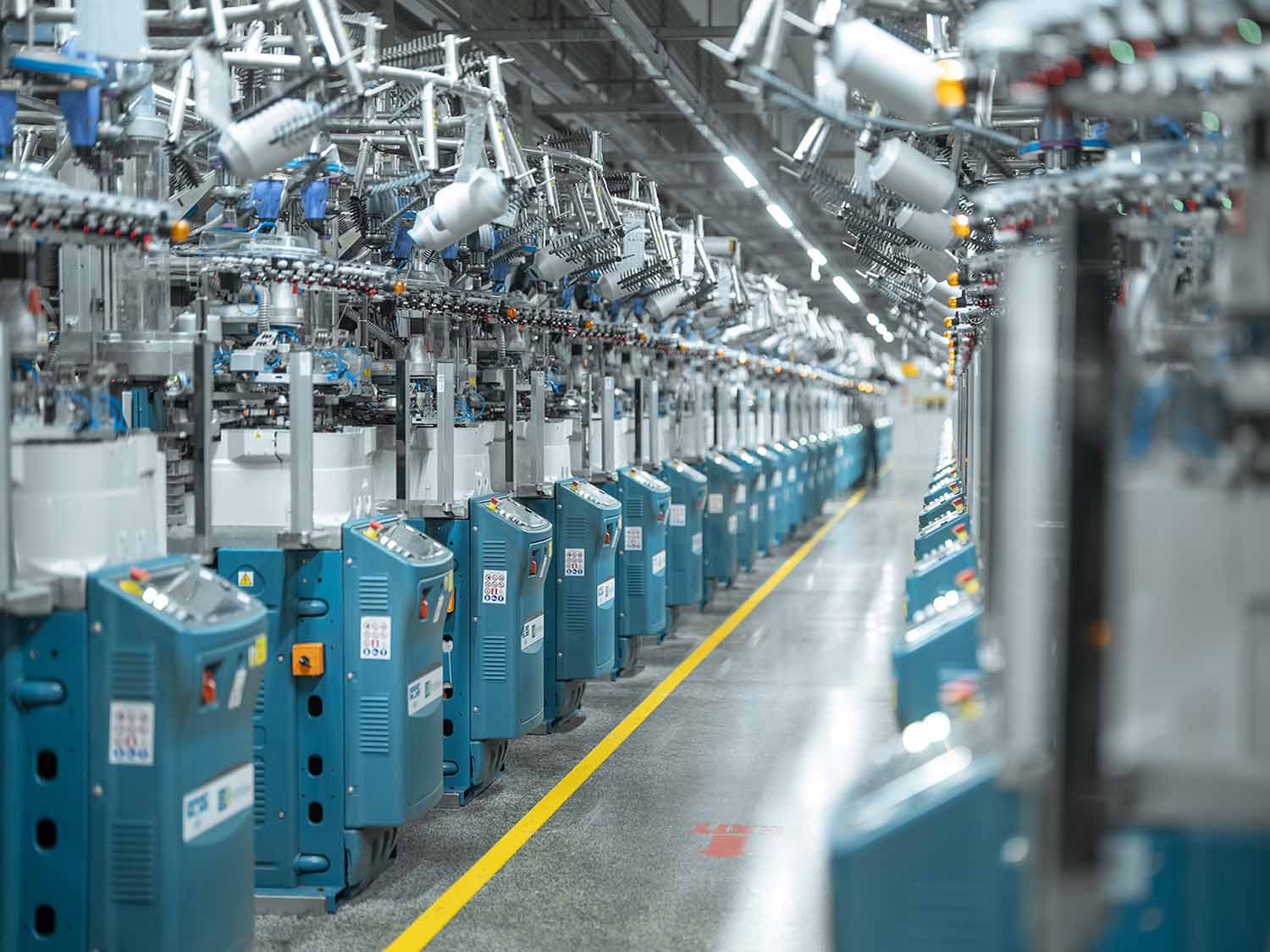
Software provider Unmade secures high-profile partnerships for customised knitwear. Tansy Fall speaks to CEO Hal Watts.
UK software company Unmade grabbed the attention of the global knitting industry when it was launched in 2013. Founded by CEO Hal Watts and fellow Royal College of Art graduates Ben Alun-Jones and Kirsty Emery, the London start-up has created a cloud-based software platform for industrial knitting machines, allowing for the design of a garment from scratch and its subsequent custom creation.
While the business was set up with a B2C focus, its founding trio quickly realised the potential for their software in the B2B market.
Unmade’s platform now enables top brands to communicate customised products created on an e-commerce platform with their global suppliers. Speaking to WTiN, Watts says: “We’ve been rebuilding the technology to empower the biggest brands in the world to move to an on-demand manufacturing solution. Because of the way we control the supply chain we can enable new types of customisation. So, we help brands navigate this space and build the best possible user experience for their customers.”
When Watts, Alun-Jones and Emery first set out with the ambition to create a software for on-demand manufacturing, they were running an innovation consultancy business. Through this company, they worked with the UK Olympic team on a project that focused on the aerodynamics of clothing. With knitwear making up a major part of the technical sportswear market, the team was drawn to this area of the textile and apparel industry. Watts says: “The reason we thought knitting was exciting […] is because you essentially start with a cone of yarn and you end up with a product. It’s much, much more flexible [than other areas]. With an industrial knitting machine, the exact same machine will make a Nike trainer and a Burberry scarf. The flexibility of that piece of hardware is really powerful once you can control it.”
One of Unmade’s most recent partnership is with fashion retailer Farfetch. José Neves, founder and CEO, Farfetch, comments: “We wanted to find a way of offering luxury and bespoke products to an audience who is increasingly knowledgeable about style and quality.” The addition of Unmade’s software to its supply chain enables Farfetch to maintain its position as the world’s largest luxury fashion e-tailer, with total sales reaching US$800 million in 2016. “We connect all of a brand’s supply chain to enable customised on-demand manufacturing of knitwear,” says Watts. Unmade also provides software to suppliers, ensuring a seamless end-to-end solution and efficient, effortless communication directly with the factories.
“Our order management system manages every order for every customer that comes in,” he continues. “We then pass that through to a factory based on what the product is. Today, with most of the products we do, we’ve picked a factory that’s going to manufacture them before they’re sold. Ultimately, we’d like to intelligently push orders to different factories on our network. We know where the customer lives when they’re placing an order because we have the shipping address, so we could intelligently pick factories based on the geography of the customer.”
For most brands, one of their biggest costs is holding stock and Watts adds that this is one of the reasons Unmade’s software is seeing success in the industry. “If they can move to a more flexible supply chain where they’re able to manufacture things post-purchase,” he says, “they become cash flow positive, so it’s very interesting to them to move to that kind of model.”
Unmade’s long term ambition is for on-demand manufacturing to be at the heart of the supply chain. However, Watts says the company is “realistic about the fact that the supply chain is primarily not on-demand” and that customised products are a way for Unmade to showcase “what we think is the future of the whole supply chain.”
Unmade’s USP is its ability to connect all aspects of product development and creation, and its software also incorporates shipping to the consumer. In the current supply chain, most factories aren’t connected to the end customer and there is a reluctance from brands to share their data with supplier – for example customer shipping data. Unmade’s software encrypts all that data and the platform is integrated directly with shipping companies such as DHL and FedEx. “We actually provide a connected supply chain, all the way through,” says Watts.
Expanding horizons
While Unmade has initially focused its software on the knitwear segment of the supply chain, it has plans to expand the range of products its platform is suitable for, aiming to incorporate print and embroidery in the near future. “It will start to get to the point where we can provide a very unified system across all product categories, and we’ll also be able to connect all of the brands’ factory partners together,” says Watts.
As well as working with the brands and their suppliers, Unmade has sought to collaborate with machinery manufacturers, although this has been a struggle for the start-up. Watts explains this has only been overcome in the last 18 months as the company has succeeded in building up its level of credibility through partnerships with major ‘billion-dollar brands’. This has encouraged machinery manufacturers to take Unmade seriously as an industry partner. “They see that it’s a good opportunity for them as well [for the companies to work together]. Certainly today, for all the machines that we support, we have direct relationships with the manufacturers of the hardware, to integrate them into our systems.”
Watts adds: “Most of the hardware manufacturers also have CAD/CAM systems to control the machine, so we had to explain that we’re not building a fully featured CAD/CAM system, what we’re building is the ability to automatically and rapidly generate manufacturing files, that vary on a base file. We don’t give the brand the ability to create a completely brand-new product from scratch. What we say is if you’ve got a product set up in our system, we’ll give you the ability to make variations on that product. It might be changing pattern, colours, sleeve lengths, things like that, but we don’t replace the existing CAD/CAM systems.”
In order to facilitate this, Unmade works closely with factories to develop a template product using a factory’s existing CAD/CAM system. Once the product is ready to be manufactured, the factory then sends Unmade the manufacturing file. That file is digested by Unmade’s system and uses artificial intelligence to establish which parts of the manufacturing file can be manipulated without compromising the product. For example, Watts says, when a consumer “modifies a product, our system will automatically take in the example file that has been created months ago, modify it and then output a manufacturing file that will make that new product. Then that goes directly to the factory and onto the machine. We put a server in the factory that picks up orders and pushes them to the machines.”
Unmade’s software doesn’t need to be integrated with existing CAD/CAM systems, provided it can read the manufacturing files, new customised files can be generated automatically. “We had to build a physics engine that models yarn and machines,” says Watts. “If a user picks blue, for example, that [colour yarn] will behave completely differently from yellow, just because the dyeing of the yarn means it just doesn’t manufacture in the same way.
“So, we model every yarn in our system and we also model every machine,” he continues. “We’ll make a test swatch on every machine in the factory that we’re going to control. Once we have that model for the yarn and the model for the machines, when we receive and order from a customer, we generate a file, with all the correct tensions, specifically for a given machine and a given yarn combination. That’s why we can bypass a lot of the headaches that usually have to be dealt with in sampling, because we know we’re going to get it right first time.”
With this system, Unmade is therefore enabling a customised product to be manufactured anywhere in the world within minutes, provided the factory and machine is connected to the Unmade pipeline. From the perspective of the supplier factory, being on the Unmade platform, and partaking in on-demand manufacturing, could lead to quicker payment for orders. Products are only manufactured when they have already been purchased, so the brand is cash rich and is likely to turnaround supplier payment quicker.
With such a focus on digitalisation of the supply chain, it is perhaps anomalous that a start-up such as Unmade is the first to market with a software product for integration across the knitting supply chain. However, Watts says: “If you think about Stoll and Shima Seiki [the most prominent industrial knitting machinery providers in the market], software is a tiny part of their business. And, the software we develop [is focused on] integration into e-commerce platforms, photography and consumer experience, and that is alien to them.
“Hopefully, once we’ve developed even closer relationships with the hardware manufacturers, we’d probably do a little bit less [of the machinery control], they would do a little bit more, and we would focus on connecting the dots, and providing the front-end experience. We had to build all the machine stuff because it didn’t exist.”
Have your say. Tweet and follow us @TFall_WTiN and @WTiNcomment