Lunar dust has proved to be troublesome during the Apollo missions. It can rapidly degrade spacesuits by abrading the fabric and clogging seals and other critical equipment, while having an affect on astronauts’ health. In the past, Apollo astronauts have reported effects to their skin, eyes and respiratory systems during these missions.
NASA is currently working towards an eventual return to the moon, and the European Space Agency plans to set up a permanent human outpost on the lunar surface. With this in mind, NASA has identified dust as a critical environmental challenge to overcome for future planetary surface missions.
Now, a group of engineers from Boeing and the University of North Dakota, US, has developed and tested a self-cleaning spacesuit using carbon nanotube technology to help solve the issue.
Technology
Kavya Manyapu, Leora Peltz and Pablo De Leon have developed a Spacesuit Integrated Carbon Nanotube Dust Ejection Removal (SPIcDER) system.
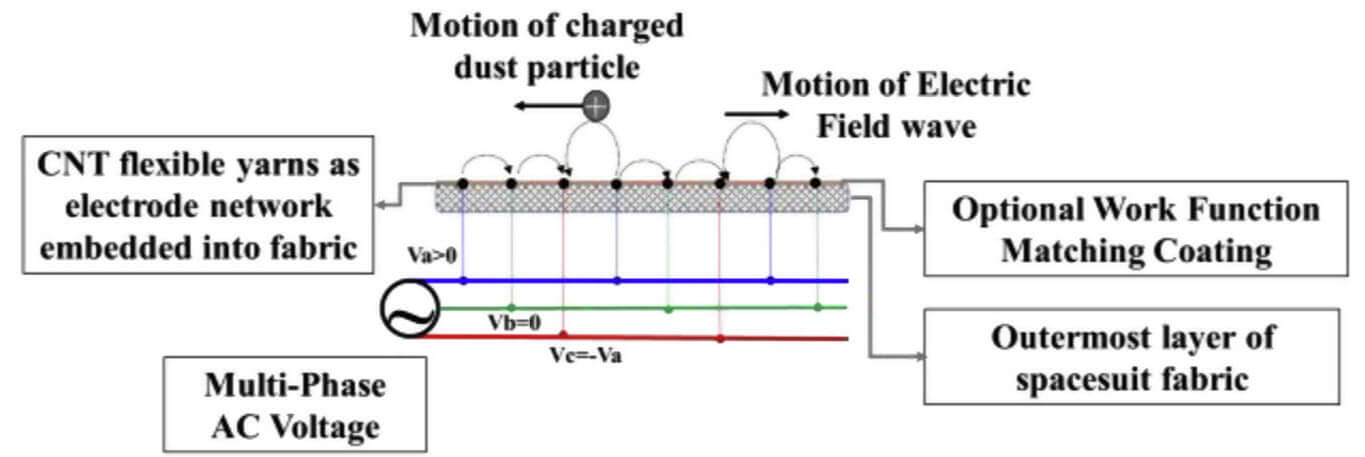
The technology works by incorporating parallel conductive yarns made of flexible carbon nanotube fibres embedded into the outer layer of the spacesuit.
The carbon nanotubes are energised with a multiphase AC voltage signal (aka a cleaning signal) that forms a travelling wave of an electric field around the suit. This helps in two ways – firstly, it prevents the accumulation of lunar dust, and secondly, this helps to repel dust that may have already accumulated.
More specifically, the spacesuit outer layer acts as a non-conducting substrate for electrodes. The electric field can levitate the dust particles and transport them away from the surface, while repelling the dust particles through electrostatic and dielectrophoretic forces.
The performance of the SPIcDER system could be further enhanced by adding a coating such as the Work Function Matching (WFM) coating developed by NASA that works to lower dust adhesion to the surface.
In fact, SPIcDER leverages the previously proven Electrodynamic Dust Shield active technology and the WFM coating technology developed by NASA, according to the engineers.
Why carbon nanotubes?
A spacesuit requires many things. For example, it needs to be flexible to ensure astronaut mobility and it needs to be abrasion resistant to withstand wear and tear.
When designing the self-cleaning space suit, the engineers needed to find an electrode material that ticked all these boxes.
Eventually, carbon nanotubes were applied as SPIcDER electrodes because the yarns are flexible and can conform to the spacesuit outer layer and the existing weaves of the material in which they are embedded. Additionally, the mechanical strength of carbon nanotubes are said to be an order of magnitude higher than highly conductive metallic materials such as copper. The fibres have superior resistance and resilience to flex fatigue, and the low density of carbon nanotubes makes it an ideal material over using metallic electrodes, according to the team.
Proof of concept
Proof of concept of the SPIcDER system was demonstrated through experiments conducted in ambient and vacuum conditions using spacesuit materials.
Through both real-time observations from experiments conducted using swatches made of spacesuit materials and large-scale spacesuit joint section prototypes, the research team gathered strong evidence that the SPIcDER system is capable of protecting spacesuits, and thus astronauts, from lunar dust.
The system demonstrated a capability to remove between 80 to 96% of the lunar dust simulant on small swatches and on the scaled prototype. And what’s more, in the scaled-up tests, only 4-16% of the area remained covered by dust after implementing the SPIcDER cleaning.
SPIcDER can also perform effectively in two operating modes – a continuous mode works to continuously repel any dust that reaches the proximity of the fabric, and a pulse mode works to remove dust that has already adhered to fabric prior to cleaning.
The research findings have been published in the journal Acta Astronautica.