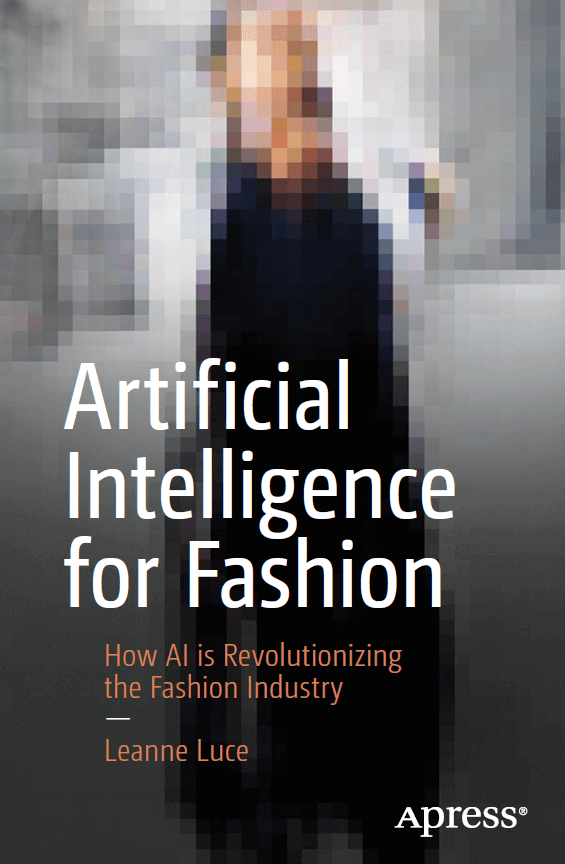
Leanne Luce
Apress
Full book review
2019
€25.99 soft cover and €19.99 e-book
ISBN 978-1-4842-3930-8 (print)
ISBN 978-1-4842-3931-5 (online)
The term artificial intelligence (AI) is used to encompass machine learning and deep learning innovations; both can be used to create an intelligent device that can understand the full complexity of the English language. The global AI market is expected to reach US$1.6tn by 2025, growing at a CAGR of 55.6% from 2018.
In this book, Leanne Luce, product manager at Google, begins by introducing herself, her career path, and her artificial intelligence journey. Leanne is to be congratulated for writing the most insightful yet in-depth overview of AI and its presence in the fashion industry.
The authoritative and comprehensive book starts with an introduction to AI and is then broken into parts (I-VI) that cover all aspects of the supply chain.
Part I
Part one gives detailed coverage of AI and provides the reader with definitions of the technologies, a clear understanding of computer intelligence and machine learning, and the growing application areas for AI, such as robotics. As the opening to the rest of the book, this part exceeds in articulating how both AI and machine learning methods enable devices to be intelligent and make predictive analytics.
Part II
The book moves on to how AI is impacting the end-consumer products, retail and e-commerce. Whilst technically explaining how commercial innovations work, this section provides the reader with some fantastic and relatable examples of AI. Examples include Chatbot Eliza, MemoMi’s smart mirror, Amazon’s Echo Look and Fashion-MNIST by e-commerce retailer, Zalando.
Part III
Still with a focus on the end-consumer, part three analyses how end-consumer attitudes are influencing the shift to subscription models – aside its higher cost of failure. AI has become a fundamental element for organisations to keep customers enthralled and has become part of business’ DNA; Stitch Fix, Rocksbox and Le Tote are prime examples of this, according to Luce. This part of the book concludes by shaping the future of data science, predictive analytics and cyber security.
Part IV
The book changes its direction by focusing on apparel manufacturing, starting with the design. This section looks at the emerging generative models of design by looking at artificial creativity, image-to-image translations and automating the mapping of garments. As the use cases for design in fashion are only just being explored, this part of the book highlights innovative examples whilst providing an easy-to-read technical overview of the technology.
Part V
It appears that for this section of the Book, Luce has looked at sustainability and automation in the supply chain and applied her AI expertise to produce two key sections: deep learning in inventory and robotics.
Luce realises that inventory management across apparel manufacturing is extremely complex and challenging to control accurate master data, historical data and forecasting fashion trends. Therefore, this part of the book looks at how AI is transforming manufacturing in terms of its demand forecasting, seasonal patterns and consumer behaviour.
The book then goes on to explain the functionality of the emerging cobots, ie collaborative robots and how AI is fundamental to its operation. Following a key case study about Softwear Automation, Luce clearly articulates that, irrespective of the growing presence of robotics in the industry, the key AI challenges of ethical automation, reshoring and design will occur.
Part VI
To conclude the book, Luce presents the final section as the future of AI. It is clearly articulated that, because of the new surge in technologies and methods being introduced in the market, AI has become more accessible now than ever before. Computer power and open source machine learning models are some examples given on what has contributed to this growth.
In my opinion as an analyst, artificial intelligence has not yet been articulated in an easy-to-read, yet detailed manner. However, I feel that this book successfully achieves in doing this by being written extremely well and effortlessly enlightens such a complex topic.
Visually, the book is full of commercial innovative examples which makes the technical elements easily relatable too, and the use of infographics also contributes to this. Personally, one of my favourite parts of the book are the quotes that open each chapter. For example, part IV starts with: The great thing about fashion is that it always looks forward —Oscar de la Renta.
I would highly recommend this book to all involved across the textile and apparel supply chains: academics; entrepreneurs looking to enter the fashion market; brands and retailers looking to implement the technology and more. The book will prove valuable to anyone, regardless of industry, that is interested in learning about AI because many other sources that are available are difficult to read and often refer to complex algorithms.