
Arequipa-based Calicampo produces hand-painted alpaca yarns dyed using natural materials sourced from the Peruvian landscape. This unique technique allows up to 50 colours to be applied to a single skein, offering an unlimited array of colour combinations. Francis Rainsford finds out more.
Background
In the alpaca world the name Calicampo is fast establishing itself as a brand that offers customers a unique range of alpaca products founded on inspirational colour selection, combined with innovative design and fibre selection.
A relative newcomer to the market, its story begins with Lonnie Helgeson, a master knitter from Minnesota, who branched out into her own colour design and dyeing of yarns when she became dissatisfied with the quality of hand-dyed yarns available to her in the US.
Defining her colouration method as ‘hand-painted’, she soon enhanced her creative reputation within the fashion clothing sector where her products were shown at various textile shows in the States. Her activity on this circuit eventually brought her into contact with Miguel Paz, an importer and distributor of alpaca yarns in the US via his company Misti International Inc.
Miguel, a Peruvian by birth, grew up in Arequipa where he learnt the alpaca yarn business and, together with Lonnie, formed a new partnership to expand the sales of uniquely coloured alpaca yarns within the States, as well as beyond its borders.
The frailties of having overall production control and the operational costs of importing ecru alpaca yarn into the US to be hand-painted were soon evident. The partnership therefore took the decision to establish its production facilities in Arequipa where they were joined forces with Diana Yriberry, a textile designer and boutique owner.
The three partners set up their dyeing plant operation in the Zamacola district of the city in 2007 and named the company Calicampo S.A.C.
Hand-painted production
Whilst primarily sourcing and hand-painting its own alpaca and cotton yarns in Arequipa for sale in the US market, Calicampo also offers its dyeing service to other customers as well.
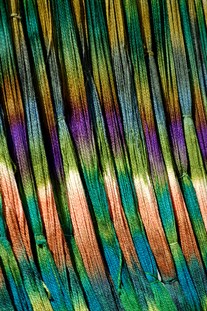
Handling third party customers’ yarns has the added benefit of learning from the experience of applying the hand-painted colouration procedure on fibres and blends not usually part of the company’s own portfolio, such as 100% wool and wool/alpaca.
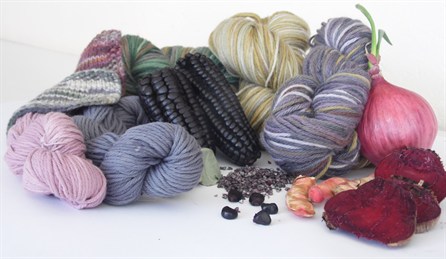
The company uses two distinct routes for its colouration procedure: synthetic dyes from industrial chemical suppliers who meet European Environmental regulations and natural plant dyes sourced in Peru. Cochineal, beetroot, onion, purple maize and eucalyptus are but a few on a very substantial list.
The hand-painting technology allows up to 50 colours to be applied to a skein of yarn, thus offering an infinite array of colour combinations in a totally manual operational process according to Lonnie’s own colour creations or her interpretation of a customer’s idea.
Once the combination of colours is established, the number and individual amount of colours to be applied is mapped out for the operative, conforming to the overall circumference and weight of the skein.
The dyeing operatives then apply each colour manually to the skein which receives a final colour fixation treatment to prevent fading or bleeding after washing. The quality of the hand-painted process of each batch is tested to comply with international light and wet fastness standards.
Essentially an artisanal system run on a production line basis, each product has a uniqueness that comes from slight individual variances that occur with any handmade article. Thus, it can be truly said that no yarn or garment is ever precisely the same as another.
With a staff of 17 personnel, Calicampo’s hand-painted facility can produce around 1,500 kgs of dyed yarns per month. The team has recently developed yarns whose hues are tone-on-tone in differing intensities, giving a more solid overall colour effect.
Three years ago the company launched a range of its own handknitted items which comprise of an annual autumn/winter women’s collection of baby alpaca garments and a spring women’s collection made from Peruvian pima cotton, pima/silk and organic tanguis cotton.
Commercial growth
It would be a reasonable assumption that a business employing design interpretations and colour inspirations with natural fibres would have sound business ethics. It will come as no surprise then to learn that Calicampo’s business ethics are governed by strong principles of fair trade.
In April of this year the company was awarded the Certificacion de Comercio Justo, a fair trade recognition administered by the Peruvian government’s foreign trade promotional body, PromPeru. The company was trained and evaluated over a three-year period in order to obtain the certification which underpins the strategy laid down by its three partners.
The transition of the business from yarn dyeing to knitwear production has been both a gradual and natural move that has seen the company invest in three 3-gauge manual knitting frames for garment prototype development, as well as an extensive quality training programme for its handknitting operatives.
The increase in production facilities in Arequipa has been a direct response to the commercial growth experienced by the company in its biggest market, the US, driven by the activities of Miguel Paz’s sales through Misti International. The company has also witnessed an increased demand for its products in its home market of Peru.
For the past four years, the company has taken a stand at Peru Moda in Lima, the country’s flagship textile show where the attendance of both domestic and foreign textile buyers has risen year on year. Additionally, the company has also shown at Ethical Fashion Show, Paris and twice at Magic, Las Vegas, which it believes has been a significant factor in enabling it to open up new export markets - notably Spain, France, the UK, Norway and New Zealand.
Indeed, word of mouth bouquets from satisfied customers, together with a policy of participating in textile fairs where it can display the uniqueness of its products to trade and public alike, has resulted in a greater consumer awareness that has been reflected in a pattern of steady growth and turnover for the company.
Future
The company’s skilful management of creativity, handcraftsmanship, colour and natural fibres, together with its philosophy of fairness in business, would seem to be aptly borne out in its name, Calicampo, which is a broadly interpreted fusion of the Spanish words for heating or warmth, ‘calefaccion’, and field (vision), ‘campo’.
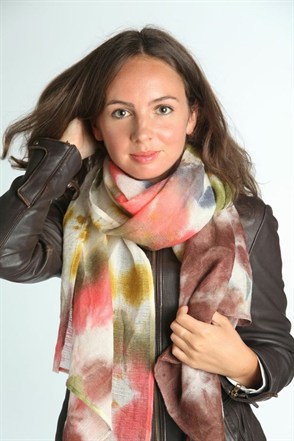
A recent product development undergoing trial for the near future is the application of the hand-painting technique on a knitted ecru baby alpaca scarf, allowing the possibility of greater control of the colour distribution, as well as other visual effects.
Calicampo’s strategy in the medium-to-long-term will be to work at strengthening its position as a leading supplier and innovator of natural dyestuffs in the textile industry. The company will also seek to develop its reputation as an exceptional point of product sourcing for designers and businesses who want to create hand knitted collections using natural fibres, produced under ethical and fair trade conditions.
www.calicampo.com