1. Introduction 
WTiN Intelligence: Digital Textiles continues to provide insight into a unique and fast-moving industry that is consistently changing and growing. The first half of 2020 has primarily been shaped by the Covid-19 pandemic and the social, business and economic ramifications of this which are likely to be felt for a long time. Undoubtedly, there has already been an impact on both day-to-day business and strategic plans for 2020. With that being said, WTiN has tracked the effects of significant events in previous years, including recession periods and Brexit before the current pandemic. In this report, we will look at the consolidation on the textile inkjet printing industry throughout the years, up to present day.
Qualitative analysis of previous consolidation waves will provide a better understanding as to where the industry currently lies within the consolidation life cycle and when we foresee the next wave.
Most, if not all, industries consolidate as they mature. Initially, one or two companies dominate the industry by maintaining a monopoly, before becoming fragmented as new competitors enter the market. With time, consolidation occurs, which concludes with a small handful of surviving companies with high market shares reliant on demand and diversification for growth.
Merger and acquisition (M&A) activity is frequently adopted by organisations from around the globe to achieve growth. The rationale behind this activity is the achievement of organisational strategic objectives. In most cases, M&As are used synonymously, but there are specific points of difference which help to determine whether an activity is a merger or an acquisition.
A merger involves one or more companies coming together to form an entirely new entity through losing their separate legal entities, to achieve common objectives. While an acquisition involves one entity purchasing the controlling ownership of a stake in another company while retaining their separate legal entities. However, despite these differences, the two words are often used in the same sense. On an international level, merger and acquisition activity is concerned with the buying and selling of a company.
The global textile industry has experienced a series of mergers and acquisitions in the previous decade involving many of its previously independent members. A crucial part of the textile industry is the inkjet market, which accounted for 3.08 billion sqm of fabric digitally printed in 2019 [1]. With that being said, we anticipate growth to continue - though not at the same rate as in previous years, we do expect the adoption of digital technologies to continue increasing with time. In line with this growth, consolidation within the industry is inevitable. This report will attempt to outline the background from which the textile inkjet M&A movement has grown, with a focus on the most recent wave of consolidation (2014-2019). The scope of the movement, together with the effect of M&As on the industry, will also be addressed.
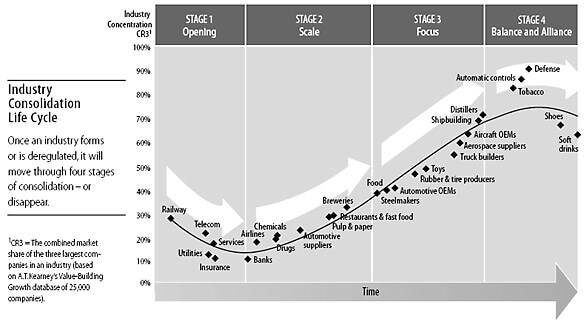
Research on mergers around the globe reveals that most industries progress predictably through a consolidation life cycle (see Figure 1) [2]. Companies can plot, with some precision, where they fall in the sequence. The most successful, vital players within the textile inkjet market will treat this environment of consolidation as an opportunity, understanding that the vendors who create and execute the best consolidation strategies will emerge among the shortlist of companies dominating the post-consolidation print industry. WTiN Intelligence: Digital Textiles has assessed that the textile inkjet printing industry sits in the second stage (Scale) of what is known as the Consolidation S Curve (Figure 1).
Stage 1: Opening phase
The understanding of where in the cycle an industry is should be the cornerstone of a company's long-term strategic plan. Figure 1 shows the 4 stages within the cycle. Stage 1 is referred to as the Opening phase. M&A activity typically begins slowly at the Opening phase, when an industry is in its infancy. Typically, a firm may be alone in the industry at this stage. It may be a small start-up company or a proven company that used R&D funds and expertise to develop something new. However, this 100% industry concentration quickly drops off as competitors quickly arise to create the frontier of industry consolidation [2]. The key to being successful at Stage 1 is by aggressively defending the first-mover advantage. A first-mover is a company that gains competitive advantage by being the first to bring a new product or service to the market. Companies in Stage 1 industries are first-movers and they stay ahead of the curve by building scale, establishing barriers to entry by protecting proprietary technology and creating a global footprint. Typical Stage 1 companies include newly deregulated or privatised industries such as energy, telecommunications, and banking. Start-ups in new fields such as biotechnology also occupy this space.
Stage 2: Scale phase
Like the Opening phase, Stage 2 requires a significant amount of capital to build scale. The goal of most companies at this stage is to differentiate their products and services from competitors within the industry. Besides this, the products and services should better reflect customer's needs. This can be achieved through intense R&D. Competition at this stage intensifies as major players begin to merge, buying up competitors and forming empires. Due to the high level of M&A activity, companies must hone their merger-integration skills, including learning how to carefully protect their core culture as they absorb new companies. By doing so, this will determine the success of the merger or acquisition. Some experts suggest that the top three players in a Stage 2 industry will own 15%-45% of the market share as the industry consolidates rapidly [2].
The textile inkjet industry falls into Stage 2 of the industry consolidation life cycle alongside airlines, hotel chains, automotive suppliers and the pharmaceutical industry. Dover Group, in its recent acquisition of JK group and MS Printing Solutions and others, is a classic example of a Stage 2 company successfully positioning itself for later rounds of consolidation that will yield the industry's giants.
Stage 3: Focus phase
Moving on, we have Stage 3: the Focus phase. Companies within this stage focus on expanding their core business and continue to aggressively outgrow the competition. The goal at this stage is to rise to the top of a small number of global industry powerhouses, hence megadeals and large-scale consolidation play a major role in this stage. Underperformers at this level will be attacked and companies should identify other major players that will likely survive into the next and final stage. An example of a company attempting to position itself in this stage is Xerox. Although Xerox has now suspended its pursuit of rival HP, late last year Xerox Holdings made a bid to buy the company. However, this pursuit was halted, citing the growing threat of the coronavirus pandemic as the reason for postponement [3]. Focus phase industries include automotive OEMs, shipbuilders, steel producers and distillers.
Stage 4: Balance and alliance
At this stage, industry concentration diminishes and the curve plateaus. There are usually fewer firms and those that survive will be larger and more dominant. Research suggests that the top three companies at this stage claim as much as 70-90% of the market [2]. Key to success at this stage is being aware of the potential for industry regulation and the danger of being toppled over by a rival company. While innovations continue, they are not as radical as in previous stages. Laundry detergents are examples of mature products in Stage 4 of the 'Consolidation Curve'.
1.1. Why do companies engage in mergers and acquisitions?
The adoption of newer digital printing methods, especially in European countries, is steadily growing. This is mostly due to the quick turnaround times and the environmentally friendly benefits the technology has to offer in comparison to conventional textile printing methods (rotary screen or flatbed). Consequently, the tech-driven textile inkjet printing industry is drawing the attention of private equity and strategic investors. Below are some of the reasons why companies engage in M&As:
- Growth – This is the most common reason for M&A activity. Most of the companies that engage in M&As are looking to increase their market share within an industry. They also do so to leapfrog their rivals even though in context, it takes years if not decades for the company to double in size via organic growth.
- Synergies – Rather than starting from scratch, companies merge to take advantage of synergies and economies of scale. For instance, usually, two companies combine and can consolidate duplicate resources like manufacturing facilities, research projects etc.
- Domination – Companies engage in M&As to dominate their sectors. By acquiring new entrants as well as smaller companies, key players within an industry can dominate. However, if two giants merged that would result in a potential monopoly which is usually frowned upon as it can harm healthy competition. [4]
- Competition – Companies compete within various industries and this is a primary motivation of why M&A activity occurs along the industry consolidation cycle from Stages 1-4. Venture capitalists are interested in Stage 2 and 3 of the Consolidation Life Cycle as that is a sweet spot: the two phases are a period of accelerated growth and the financials of the eventual winners and losers look strikingly similar [5]. The reality is that venture capitalist invest in thriving industries.
2. Scope of mergers and acquisitions in the textile inkjet printing industry
2.1. OEMs
The textile inkjet printing industry has been subjected to a considerable amount of changes. With the M&As of the past couple of years, we can see a new landscape forming. The adoption of digital technologies is growing but we see that the old giants of the screen print era are still there, albeit largely under changed ownership. For instance, companies such as MS Printing Solutions, Reggiani machines, Stork (now SPGPrints since 2013), Zimmer Austria, Ichinose (Toshin) but to mention a few, were once upon a time big names in rotary and flat screen technology and while many still are, these companies are also now large players in the textile inkjet market. The penetration of digital textile printing into the wider textile printing industry has seen some increase, although it is still small at 6.9% of total printed fabric globally [1]. Therefore, analogue printing remains a significant technology within the market.
With that being said, from the M&A activities that have been going on within the industry segment, the textile inkjet market falls under Stage 2 of the ‘Consolidation Curve’ because the competition is intense and significant players are merging.
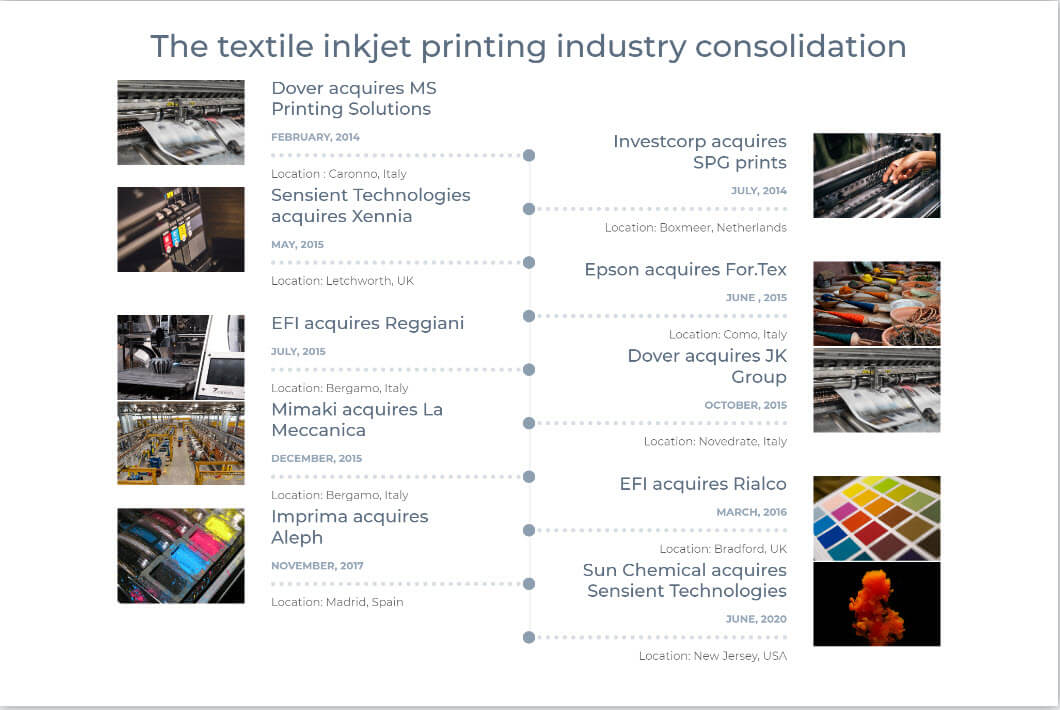
From the timeline in Figure 2, we see that for this wave of consolidation, the M&As commenced in February 2014 with the purchase of MS Printing Solutions by Dover Corporation. Dover, a diversified global manufacturer, acquired Italian-based MS Printing Solutions S.r.l. a designer, manufacturer and distributor of innovative digital inkjet printing systems serving the textile and speciality material markets. This acquisition was carried out to broaden Dover's served markets into the textile and speciality materials markets and allowed the company to leverage existing MS technology across the segment. Concerning the industry’s Consolidation Life Cycle (Figure 1), Dover's move falls in the category of Stage 2, ie. the Scale. This stage is all about building economies of scale. As demonstrated by this acquisition, significant players such as Dover began to emerge, buying up competitors and forming empires. According to a Harvard Business Review, "the top three players in a Stage 2 industry will own 15%-45% of their market, as the industry consolidates rapidly." [2]
Within the same year, SPGPrints, a global provider of integrated solutions for digital and rotary-screen textile printing, was bought from Bencis Capital Partners by Investcorp in a transaction valuing the company at €240 million. Bencis acquired a majority stake in SPGPrints from the Dutch Stork group in 2007 and the final sale to Investcorp went through in July 2014 [6].
The following year, July 2015, Italian textile printing specialist Reggiani Macchine was acquired by US wide-format printer manufacturer EFI. The strategic acquisition of Reggiani Macchine, whose technologies would be rebranded as EFI Reggiani, was executed in a bid by EFI to establish an industry-leading presence in high-growth inkjet textile printing. In other words, the end goal was scaling up and increasing market share within the industry.
Japanese OEM Mimaki acquired a rival company, another Italian company La Meccanica, which completed in 2016. By doing so, Mimaki's goal was to expand its presence in the digital printing sector. Considering La Meccanica had been established for over 40 years with a production facility located in Bergamo, Italy, covering 5,000 sqm, this was an excellent scaling opportunity for Mimaki, expanding its wealth of expertise and its production capacity as well as capabilities.
In the same year, printing giant Epson acquired textile machinery company, Robustelli. The purchase agreement aimed to drive synergies and further increase customer value by expanding the scope of the two companies' longstanding co-operation in digital inkjet textile printing.
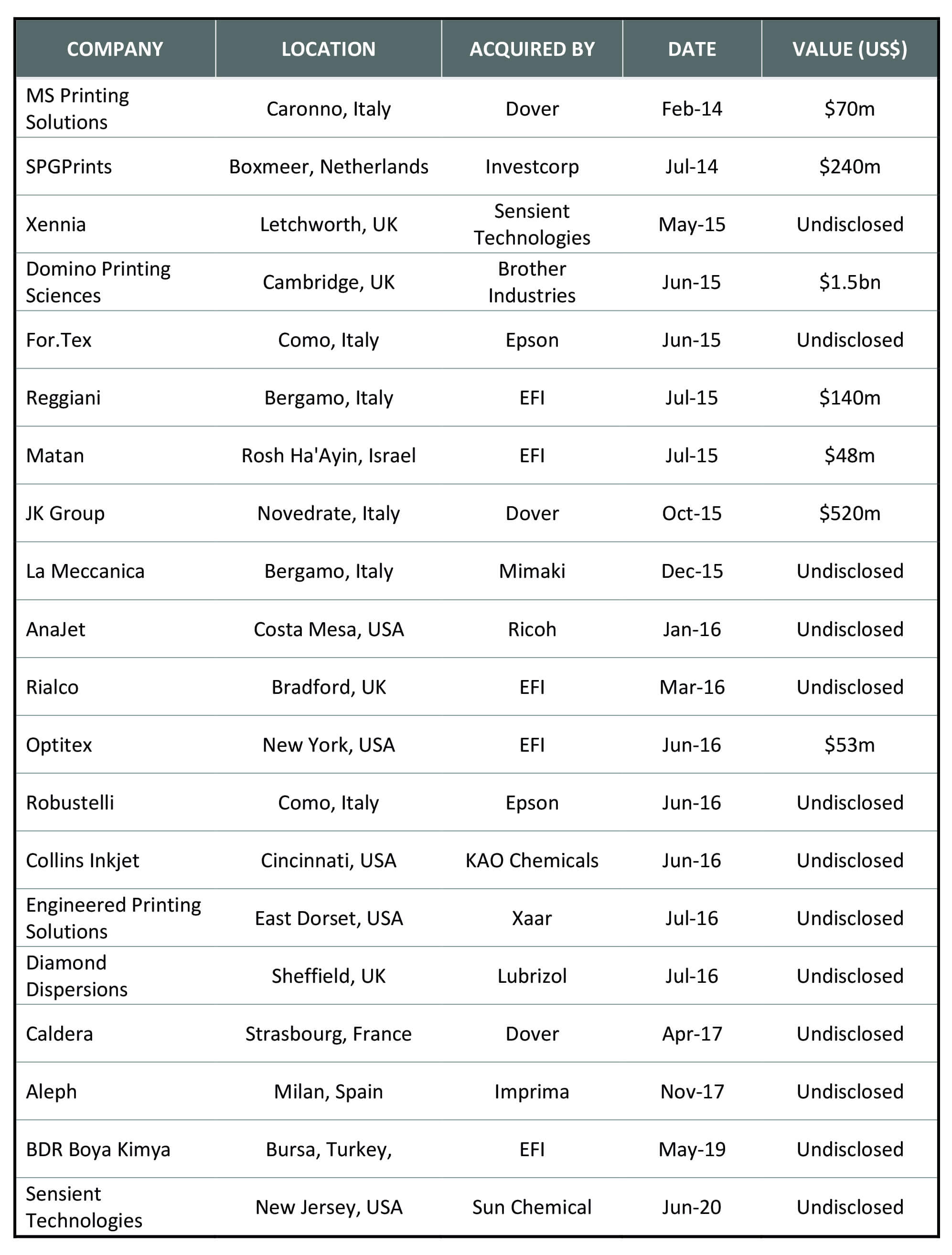
The above examples are but a few from the many that are highlighted in Table 1. Which brings us to the question: "ls this consolidation trend going to continue?". Printing giants will likely continue to purchase new/small companies because it is easier to do than trying to start from scratch. There is also pressure on OEMs to address multiple markets and they tend to spend considerable investments in R&D to adapt their technology to adjacent markets. Lastly, the majority are trying to stay ahead of the curve.
However, with the current Covid-19 pandemic, the momentum of consolidation has been interrupted slightly. In the last six months, we have only heard of one most recent acquisition, ie. Sun Chemical and its parent company, DIC Corporation acquiring Sensient's digital inks business. Another interesting potential acquisition was Xerox launching a takeover bid for HP late last year. However, Xerox has since backed out of the HP takeover due to the pandemic.
Nonetheless, as there are large numbers of acquisitions occurring in Stage 2, companies must hone their merger-integration skills. For instance, they need to learn how to protect their core culture carefully as they absorb new companies and focus on retaining the best employees of acquired companies - this will determine the success of the acquisition. Crossing over to Stage 3 (Focus) is eventually inevitable and first-movers are usually the ones that have successfully captured their significant competitors in the most important markets and have expanded their global reach.
2.2. Print head manufacturers
The print head manufacturing sector is mainly dominated by Japanese and North American manufacturers. This sector within the textile inkjet industry is likely to fall under Stage 3 because the top three industry players at this point control between 35% and 70% of the market. According to data from WTiN Intelligence: Digital Textiles there are generally six major players (ie Kyocera, Epson, Konica Minolta, Richo, Fuji Dimatix and Seiko) within the print head manufacturing sector [1]. Although M&A activity within this sector has been minimal, there is some worth pointing out. For example, in 2006, Fujifilm acquired inkjet print head developer Dimatix to accelerate its growth within the industry. This has proved to be a successful acquisition as the company how has the third largest share in the print head market [1].
The most recent M&A activity within the print head manufacturing sector includes Konica Minolta purchasing Panasonic's print head business in 2018. This acquisition was aimed at strengthening Konica Minolta's inkjet print head business, including its R&D and production [7]. This runs in line with Stage 2 of the Consolidation Curve, which is centered around the expansion of economies of scale. However, the wider industry is still in Stage 3 because the top key players control much of the market.
Interestingly, Xaar, an independent manufacturer of piezo-based drop-on-demand inkjet technologies, decided to cease activities related to its P4 Thin Film Technology at the end of last year. This decision was brought about due to financial pressures. Could this be an opportunity for investors to enable the continuation of Xaar's 5601 Thin Film programme?
2.3. Inks
The same companies that acquired the equipment manufacturers have also been buying ink manufacturers. For instance, in October 2015, Dover Corporation increased its impact in the digital textile industry by acquiring JK Group. JK Group is a collective of well-known digital textile printing brands Kiian Digital, J-Teck and Sawgrass Industrial. The Group has now become an operating company within the Printing & Identification platform of Dover's Engineered Systems segment.
EFI made a similar move by purchasing dye and colour systems developer Rialco in March 2016. At the time, Rialco was one of Europe's leading suppliers of dye powders and colour products for digital print and industrial manufacturing industries. Another critical point to note is that Rialco served the dye-sublimation ink market, which is one of the fastest-growing sectors of the global ink industry. WTiN Intelligence: Digital Textiles' ink market review for 2018 states that dye-sublimation ink continues to be the most consumed ink type, with a 50% market share [8]. Also, just last year, EFI acquired BDR Boya Kimya, a Turkish manufacturer of reactive inkjet inks for industrial digital textile printing.
These strategic acquisitions were for the sole purpose of increasing scale within the industry and to bolster EFI Reggiani's presence in crucial textile markets such as Turkey, in this case. We see the pattern of OEMs not only buying competitor machinery manufacturers but also trying to control inks too, to have a total package for consumers.
Other notable acquisitions by ink manufacturers have been Sensient Imaging Technologies purchase of Xennia Technology Ltd, a UK manufacturer of speciality inks used in the textile inkjet printing industry in 2015. Prior to this, TenCate acquired Xennia in 2008 and then Sensient bought Xennia from them. However, in June 2020, Sun Chemical, and its parent company, DIC Corporation, acquired Sensient's digital inks business as previously mentioned. This strategic acquisition will allow Sun Chemical and DIC to expand its inkjet ink capabilities and expertise using complementary technologies that will further strengthen its services and solutions to its customers and distributor partners. With that being said, the ink manufacturing sector would be placed in Stage 2 on the industry Consolidation Curve as a substantial number of acquisitions are occurring at this stage.
2.4. Paper manufacturers
Moving on to speciality paper manufacturers, we have not witnessed as many mergers and acquisitions in comparison to both inks and OEMs. However, a few to take note of include Neenah Paper acquiring Dutch manufacturer of speciality papers Coldenhove Papier in 2017, becoming Neenah Coldenhove. The following year, Sappi Limited, a global producer of dissolving pulp, specialities and packaging papers, printing and writing papers and biomaterials bought Cham Paper Group Holding AG (CPG), a manufacturer of coated speciality papers. This strategic acquisition was made to support Sappi's diversification strategy and to strengthen Sappi Europe's specialities and packaging papers footprint and skills.
Figure 3. Speciality paper manufacturers that have undergone M&A activity in the recent years
Most recently, in February 2020, Koehler Paper Group acquired Beaver Paper, an experienced specialty paper producer with bases in Los Angeles and Atlanta, US. German paper manufacturer Koehler Paper Group has been in the industry for a while but, until now, dye-sublimation transfer papers for digital textile printing have not featured particularly high on its list of priorities. This is a classic example of a Stage 2 company successfully positioning itself for later rounds of consolidation that will yield the industry's giants. The acquisition serves as an opportunity for the expertise of two global leaders in their sector of the paper industry.
3. Effects of mergers and acquisitions
The effects of M&A activity on individual firms vary and can arise from the adoption of more efficient production, marketing, distribution, and management methods. Efficient production methods increase economies of scale (cost advantages reaped by companies when production becomes efficient) as a result of factors such as specialisation. However, research suggests that the benefits of economies of scale are likely to be achieved only after a considerable number of years as it takes a while for firms to restructure their production and processes following the merger or acquisition [9].
M&As have varying impacts as far as market competition is concerned. Industries have different levels of competition after M&A activity. In this case, the textile inkjet printing industry is relatively competitive as it has not yet plateaued. The level of competition within the industry is increasing all the time. As new technologies become more widely available at affordable prices smaller, dynamic businesses can enter the industry on a level playing field with more significant, established players. Combined with the recent trend towards sustainability and more flexible print runs, a decisive edge is being given to those businesses prepared to invest in the newest textile inkjet printing technologies.
Nonetheless, M&A activity can be a catalyst for dynamism, allowing more detailed changes to take place. For instance, improved managerial skills can result from M&A activities by installing better management teams that would effortlessly exploit existing resources more productively. M&As can also incite innovation as competition increases, research and technology consolidates, and companies try to stay ahead of each other.
What's more, M&A activity tends to change the market structure. For instance, a merger of two or more companies within an industry is likely to induce a reaction of other companies in the industry, which might result in a domino effect of more buying and selling of companies. A competitor could regard it advantageous to merge with a third company or with the new company created from the merger.
On the downside, from an employee point of view M&A activity can result in the loss of jobs. The M&A process invariably consolidates positions within the companies that are duplicate. This often means that there is a higher chance of layoffs, which would put people out of work. In the long run, this may seriously undermine operational capabilities and employee morale. Nonetheless, consolidation is inevitable in any industry, and in most cases, the pros surpass the cons. A company's long-term success depends on how competitive the industry is as competition drives innovation.
4. What does it take to stay ahead of the curve?
With the ongoing Covid-19 pandemic, it is highly unlikely that the wave of consolidation will be as strong as that which we saw previously between 2014-2019. Undoubtedly, the most successful players will treat this environment of consolidation as an opportunity, understanding that first-movers who create and execute the best consolidation strategies will emerge as winners dominating the post-consolidation textile inkjet printing industry.
Also, to stay ahead of the curve, players within the industry should carefully consider the type of work they expect to be doing over the next 12-24 months. Besides this, they need to consider who their competitors will be and what products and services they will be equipped with to deliver to customers post Covid-19. Then, they must arm themselves with their next investment to match the capacity. Investing in the latest generation of printing machinery, for instance, will enable printing higher volumes in a shorter period.
Taking advantage of automation is another way to stay ahead of the curve. Going digital or adopting hybrid technology can increase the level of automation in a production line. In line with Industry 4.0, automation technologies deliver adaptive and flexible print solutions, allowing a business to respond quickly to changing market conditions and consumer needs.
Software plays a vital role in the move to automation and streamlining production – which will help companies to increase market share. As earlier mentioned, EFI bought Optitex and Dover bought RIP software company Caldera. Ultimately, staying ahead of the curve would involve merging with software companies so key players have a clearer understanding of the various segments within the textile inkjet printing market. Besides, by doing so, they will be able to provide a complete packaged product and service. From a venture capitalists' point of view, this could be a potential consolidation wave to look out for.
Additionally, printing machines need maintenance and players within the industry should consider this because by investing in new and advanced machinery. It will be beneficial in the long run as they won't have to spend much on replacing outdated machines. With the advancement in technology, newer machines tend to be more robust. Hence, investing in new machinery will hopefully give a longer service life.
5. Conclusion
As the consolidation of the textile inkjet printing market continues, we are seeing more new players entering the textile inkjet printing industry. For example, last year global technology giant HP entered the textile dye-sublimation printing market with its three digital textile printers, which can print both direct to textile and using transfer paper. It was then announced sometime last year that Xerox was looking at acquiring rival company HP. However, due to the ongoing Covid-19 pandemic and subsequent economic downturn, Xerox officially ended its much-publicised takeover attempt of printing technology giant HP. With that being said, a new wave of M&As post Covid-19 is likely to happen. More and more companies are seeing the benefits of being in the textile market – for instance the move from signage to soft signage – so we expect to see more new players coming from traditional printing markets. However, for now, companies are staying conscious of the damaging impact of Covid-19 not only on health but on global economies too. At this point, it is highly unlikely that we will be heading towards a period of increased acquisitions and consolidation in the textile inkjet printing industry but there is no doubt once the storm passes M&As will be back on the agenda – particularly with the new landscape that emerges post Covid-19.
References
[1] S. Masuwa, “2019 digital textile industry review,” 2020.
[2] G. K. Deans, F. Kroeger, and S. Zeisel, “The Consolidation Curve,” Havard Business Review, 2002. [Online]. Available: https://hbr.org/2002/12/the-consolidation-curve. [Accessed: 08-Jun-2020].
[3] M. Thomas, “Xerox halts pursuit of HP amid Covid-19 upheaval,” WTiN, 2020. [Online]. Available: https://www.wtin.com/article/?articleid=4295458162. [Accessed: 19-Jun-2020].
[4] Congressional Research Services, “Antitrust and ‘Big Tech,’” 2019.
[5] B. Zider, “How Venture Capital Works,” Harvard Business Review, 1998. [Online]. Available: https://hbr.org/1998/11/how-venture-capital-works. [Accessed: 22-Jun-2020].
[6] Investcorp, “Investcorp agrees to acquire SPGPrints Group B.V.,” PR Newswire, 2014. [Online]. Available: https://www.prnewswire.com/news-releases/investcorp-agrees-to-acquire-spgprints-group-bv-266575511.html. [Accessed: 22-Jun-2020].
[7] N. Cleary, “Konica Minolta buys Panasonic printhead business,” Graphics to Industrial Printing Journal, 2018. [Online]. Available: https://www.nessancleary.co.uk/konica-minolta-buys-panasonic-printhead-business/. [Accessed: 15-Jun-2020].
[8] M. C. Orozco and S. Masuwa, “Digital textile ink market review – 2018,” WTiN, 2019. [Online]. Available: https://www.wtin.com/article/2019/july/080719/digital-textile-ink-market-review-2018/. [Accessed: 11-Sep-2019].
[9] The Bureau of Industry Economics, “Mergers and acquisitions,” 1990.