Is continuous dyeing in solid shades a viable technology for wool fabrics? Steven McNeil and Samuel Leighs, of the Textile Team at AgResearch New Zealand, describe the results of laboratory tests.
Abstract
Continuous dyeing of wool fabrics has the potential to reduce water, chemicals, labour, and time. Dyeing in solid shades may be less technically demanding than printing patterns, especially with regards to pretreatments. The investigation reported here looked at four issues with the potential to cause problems for low-water, continuous dyeing of wool in solid colours: the viscosity of highly concentrated dye liquors; the wetting of fabrics (untreated and pretreated); the resistance of sprayed liquors to dripping from fabrics; and the composition of spray-applied dye liquors required for good steam fixation.
None of the issues investigated proved to be a problem and the potential of continuous wool printing was confirmed. A pretreatment involving the pad-dry application of a re-wetting agent showed some promise as an alternative to chlorination. AgResearch seeks to engage with the industry to develop this approach to wool colouration.
Keywords
Wool fabric, continuous dyeing, spraying, padding, printing
Introduction
Continuous dyeing of wool fabrics in solid shades offers several advantages over conventional batch processing, such as savings in water, chemicals, labour, and time, but does require greater capital investment.1,2 This approach includes rotary and roller printing, padding and spraying, and is attracting attention. For instance, Boling et al. achieved promising results using an airbrush to apply reactive dyes to wool.3
Consumers who choose wool products tend to be conscious of the environment and well-informed, and the wool industry has endeavoured to stay at the forefront of sustainability by, for instance, developing technologies to reduce the footprint of wool products,4 investigating the high-profile issue of aquatic biodegradation as far back as 1994,5 and enhancing lifecycle analysis to more realistically include use6 and social dimensions.7
Continuous printing of wool fabric with patterns is an established process; however, it requires that the wool be given a chlorination pretreatment to increase hydrophilicity and ensure good dye fixation and print definition.8,9 Chlorination adds to the cost and environmental footprint, which has led to investigation of alternatives such as those based on polymers,8 sulphitolysis/surfactant,10 plasma11 and enzymes.12 These alternatives do not appear to be in commercial use. The pretreatment requirements may be significantly less for solid shades than for printed patterns.
As part of its support for the global wool industry, AgResearch conducted a preliminary investigation into continuous dyeing of wool fabrics in solid colours and attempted to identify technical issues requiring further research. Four topics were investigated: (i) how very high concentrations of dye effect the viscosity of dye liquors; (ii) the wetting of fabrics (untreated and pretreated) and the spread of liquids; (iii) the resistance of sprayed liquor to dripping from fabrics held vertically; and (iv) the composition of spray-applied dye liquors required for good steam fixation and migration. All measurements were repeated between three and ten times. Three fabrics were used: untreated, chlorinated, and pretreated with wetting agent.
1. Materials and fabric pretreatments
1.1 Fabric
The fabric employed was 100% wool, 300 g/m2, plain woven from worsted yarn (sourced from a local manufacturer), a common construction for upholstery fabric. The fabric was scoured with non-ionic surfactant (0.1 g/L, Teric GN9, Orica, Australia) then thoroughly rinsed. Fabric was pretreated by chlorination and application of a re-wetting agent.
1.2 Dye and colour measurement
Optilan/Sandolan Red MF-2BL was chosen, as it is a member of the standard trichromat for Optilan/Sandolan MF dyes, which are intermediate between acid milling and acid levelling types. Liquors were prepared with Glauber’s salt (10 g/L), Lyogen MF (1 g/L, Clariant) and sodium acetate (1 g/L) at pH 5.0 (acetic acid). Dye was added at 1, 10, 20 and 30 g/L, and the liquors referred to as 1, 10, 20 and 30 respectively. The lowest concentration of dye was comparable to that used in conventional batch/jet dyeing of wool. Fabric colours were measured with a Colour-guide 45/0 spectrophotometer (Mahlo, Germany) with D65/10° illuminant/observer.
2. Viscosities of highly concentrated dye liquors
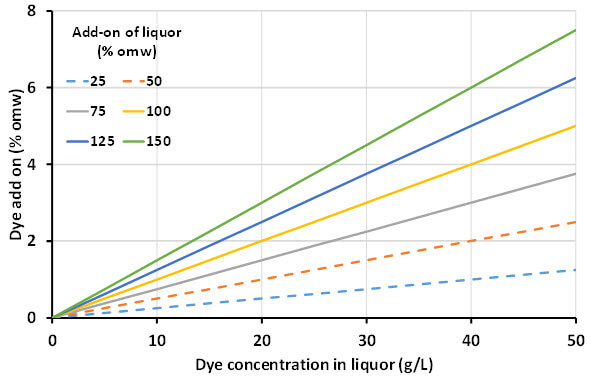
Low-water dyeing requires that the concentrations of dyes in the dying liquors (ie the liquids applied to the fabrics) are significantly higher than those employed in batch dyeing. Therefore, it is necessary to know if high concentrations of dye would increase the viscosity of the liquors to such a degree that it would cause problems for spray and pad applications.13 The highest practicable dye concentration could limit how low the liquor-to-wool ratio could be for a given add-on of dye (Figure 1).
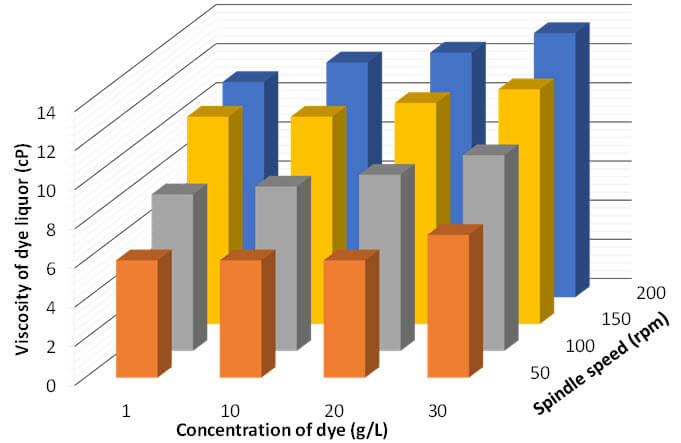
As the viscosity of a fluid increases, it will tend to form larger droplets when sprayed, reducing the uniformity of application and requiring more sophisticated spraying equipment. The viscosities of dye liquors were measured with a Brookfield Rheometer at 22°C (Figure 2). For comparison, the viscosities of water, milk and olive oil are around 1, 3 and 120 cP at 20°C. Increasing the concentration of dye only slightly raised the viscosity; thus, it is unlikely that the viscosities of any of the dye liquors would be high enough to cause problems in application.
3. Fabric wetting
3.1 Single droplet applications
Distilled water and dye liquors 1 and 30 were applied to the three fabrics drop-wise and the time taken for the droplets to wet into the fabrics determined. When applied to untreated (ie scoured-only) fabric, the water and dye liquor 1 beaded noticeably more than dye liquor 30, suggesting the dye had a small wetting effect. None of the liquids beaded on the pretreated fabrics, and all of them were absorbed within a few seconds.
3.2 One millilitre applications
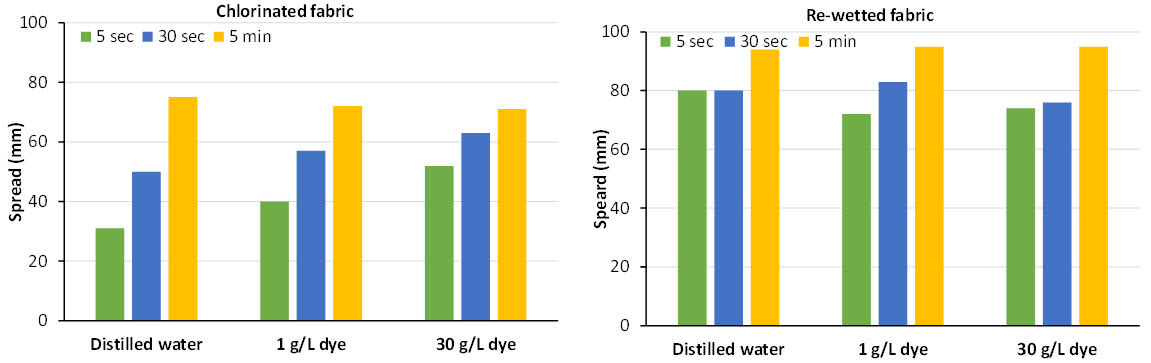
To further assess the behaviours of the dye liquors and water on the fabrics, 1 mL applications were made, and their spread measured after various times (Figure 3). On untreated fabric (not shown), each liquid spread 17mm at all three times. All the liquids gave their greatest spreading on the re-wetted fabric, followed by the chlorinated fabric. The differences in spreading between the various liquids, on a given fabric at a given time, were small. For the two pretreated fabrics, but not the untreated one, the liquids continued to spread after 30 seconds.
This simple experiment demonstrated that on untreated wool fabric, the dye liquors spread to the same extent as water. It should be noted that the dye liquor did not contain wetting agent, but this would warrant investigation in the future. The results also show that the re-wetting treatment gave faster and more extensive spreading than chlorination.
4. Resistance of spray applied liquors towards dripping
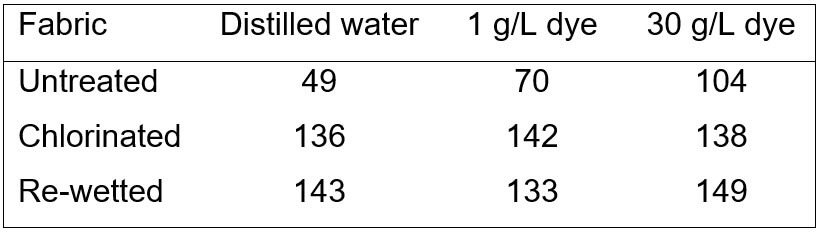
Water and dye liquors were sprayed on to one side of fabric pieces that were suspended vertically. Spaying was continued until at least five droplets fell from the fabrics; the add-ons of the liquids were determined from the weight changes of the fabrics. The liquids had been heated to 65°C before application to the fabrics, to approximate likely industrial practice.
Both the chlorination and re-wetting pretreatments increased the weight of each liquid that could be applied to fabric without dripping (Table 1). Liquid that built-up on the surface of the fabrics dripped. Thus, increasing the rate and amount of the fabrics’ adsorption of liquid meant that more liquid could be applied before dripping commenced. For the fabrics that wetted quickly (ie the pretreated ones), there was negligible difference between the water and the dye liquors, suggesting the Lyogen MF (in the dye liquors) was not having an effect. In contrast, with the untreated fabric, the dye liquors were significantly more resistant to dripping than the water, suggesting that the Lyogen MF or small increases in viscosity (Figure 2) were increasing the resistance to dripping.
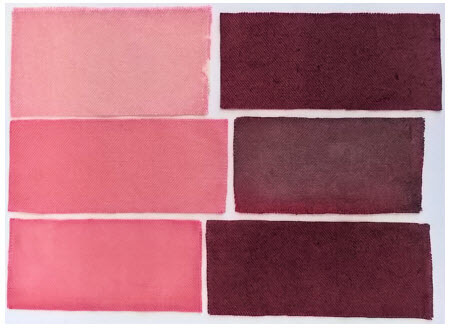
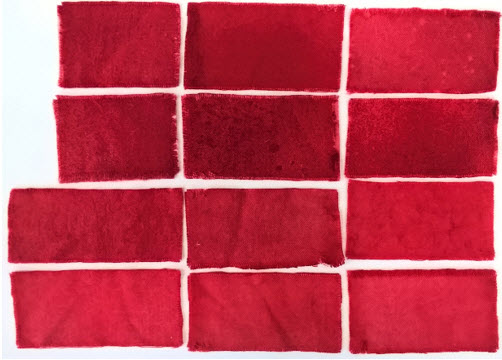
Even the liquor with the lowest concentration of dye (1 g/L) imparted a strong colour to the chlorinated and re-wetted fabrics and a pale colour to the untreated fabric (Figure 4). It is worthwhile to consider the amount of dye that was applied to the fabrics at the point that dripping commenced. The average add-on of the chlorinated and re-wetted fabrics for the three dye liquors was around 140%. Therefore, the add-ons of dye were around 0.14% omw and 4.2% omw respectively for the 1 g/L and 30 g/L dye liquors. Even allowing for a reduction in add-on of, say, 10%, to reduce the risk of dripping, it is clear that significant levels of dye can be applied without dripping.
5. Water requirements of liquors for effective steam fixation
A new set of dye liquors was used in this part of the study, because of the requirement to apply a given level of dye (2% omw) to the fabric, with different levels of water (Table 2). The dye liquors also contained Glauber’s salt, Lyogen MF, sodium acetate and acetic acid, as per the dye liquors used in other parts of this study, and were heated to 65°C before application. One liquor also contained a high level of urea, an important component of many printing formulations.
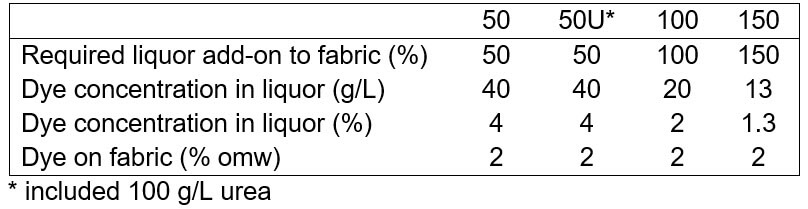
The four dye liquors were each sprayed on to the three types of fabric that were held vertically. Dye liquor was only applied to one face of each fabric, to enable the extent of penetration to be gauged. The spraying was done more slowly than in the Resistance to Dripping study, and in some cases continued beyond the point at which dripping started, to achieve the required application levels. Immediately after spraying, the fabrics were steamed for 30 minutes with dry steam. The fabrics were then air dried, and their colours measured. The fabrics were then washed in a domestic top-loading washing machine using a 40°C ‘woollen’ wash cycle, with Wool Mix detergent (30 mL) and cotton make-weights (1.3 kg). The fabrics were washed in small woven polyester mesh bags, to minimise fraying, and washed in three lots to keep the fabrics that had received the different pretreatments separate. After washing, the fabrics were air dried and their colours measured again.
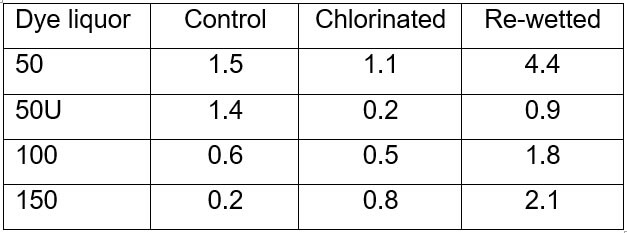
Changes in colour during washing are shown in Table 3. Increasing the amount of liquor (which was predominantly water) from 50 to 100% reduced the colour change during washing of the three fabrics; whereas, increasing it from 100 to 150% had a negligible effect. The re-wetted fabric tended to give the greatest colour change during washing, unless urea was in the dye liquor. The high level of urea employed significantly increased the fastness of colour to washing for the re-wetted and chlorinated fabrics, but not for the control fabric. Reasonably strong colours could be achieved on untreated wool when the dye concentration was high (Figure 5). For instance, an add-on of 104% omw, of a liquor containing 30 g/L of dye, gave 3.1% dye omw.
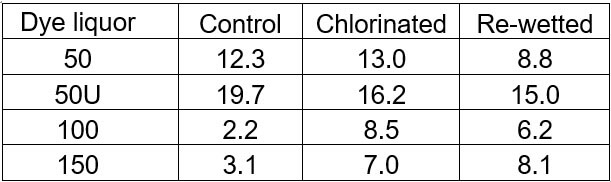
It is important that dyes migrate well during steaming. Increasing the level of water tended to reduce the differences in colour between the faces, indicating better migration (Table 4). Interestingly, the smallest colour differences were on the untreated fabric, suggesting that poor initial adsorption of dye enabled it to migrate well during steaming. In contrast, the dye was less mobile during steaming of the pretreated fabrics.
6. Conclusions
Increasing the concentration of dye from 1 to 30 g/L only gave a slight increase in viscosity, so is unlikely to cause problems for spray or pad applications. Simple wetting experiments showed that the dye liquors spread to the same extent as water on untreated fabric. The re-wetting pretreatment significantly enhanced wetting and spreading, suggesting it warrants further investigation.
The amounts of liquids that could be sprayed on to fabrics held vertically before the onset of dripping ranged from 49% to 149% omw, depending on the liquid and fabric. Both pretreatments hindered dripping by a speeding-up the penetration of liquids. Significant levels of dye, ie up to 4.2% omw, could be applied to both chlorinated and re-wetted fabric, imparting deep colours and thereby suggesting that the dripping of spray-applied dye liquors would not be an impediment to low-water, continuous dyeing of wool fabrics.
The spray-steam-wash investigation showed that a level of water below 50% omw was too low for either good penetration to the back of the fabric or good colour fastness to washing. There was little advantage in applying more than 100% omw of water. Good colours and migration were achieved, even on untreated fabric. Urea in the dye liquor did not enhance penetration, but it did increase the colour fastness to washing of the chlorinated and re-wetted fabrics, although not the untreated fabric.
This work has confirmed the potential of continuous wool dyeing. AgResearch seeks to engage with industry for further research into this approach. Many aspects of current printing technology may be usefully employed to assist the continuous printing of wool in solid colours. For instance, thickeners, wetting agents and dye solvents could reasonably be expected to enhance printing. Well-engineered formulations and processes would reduce the demands made on the pretreatment, increasing the likelihood of an alternative to chlorination being developed, or allowing pretreatments to be dispensed with altogether.