Abstract
Recent years have witnessed a drastic change in the textile processing industry, with greater consumer awareness and demand for better quality textile garments. To survive in this competitive arena, the processor has no other options but to meet the demanded quality standards – particularly, very good overall fastness and, specifically, wet rubbing fastness. It is a well-established fact that dyed cellulosic fabrics with proper washing-off of unfixed dye can improve the wash fastness of dark shades to rating 5 but corresponding improvement in wet rub fastness cannot be achieved. This paper gives a brief technical introduction to the rubbing fastness improver product (Rubfast-467) developed by Sarex. The treated fabrics were assessed for their rubbing fastness property using a Crockmeter and confirmation of the hypothesis was done using scanning electron microscope.
Keywords - Rubbing fastness, Crockmeter, Indigo dyed denim, Sulphur dyed, SEM
1. Introduction
Colour fastness is the resistance of a material to changing its colour or transferring its colorants to adjacent materials, or both. Generally, fastness properties are expressed in ratings of fastness and they range from rating 5, which means unchanged, to rating 1, which means major changes. Rubbing is the transference of small dye particles from dyed textile material to different surfaces, mainly by action of rubbing or abrasion. The rubbing fastness can be determined by using an instrument called a Crockmeter, which works on the principle of abrasion. In wet rubbing, unfixed dyes will dissolve in water and then be transferred to the test fabric, hence resulting in poor wet rubbing fastness. In wet crocking, both colour and the coloured short fibres are transferred to the crocking cloth. Through microscopic examination it has been established that under wet rubbing conditions, samples get damaged and microscopically small dye particles stain to adjacent white fabric. Achieving good wet rub fastness is always more of a challenge than dry rub fastness. Staining is more prominent for emerised or micro-sanded, dark shades of cotton fabric.
Colour fastness to rubbing is always important for every dyed or printed fabric. In dyed and printed textile materials, the unfixed dye particles are mechanically held on the surface and these particles are rubbed off easily by the wearer or any other cloth of contact.
In dry rubbing, initially the periphery of the coloured specimen gets ruptured, so that the loosely or unfixed dye particles are removed and adheres to the surface fibres of the crocking cloth. In wet rubbing, unfixed dyes will dissolve in water and then it is transferred to the test fabric, hence resulting in poor wet rubbing fastness. In wet rubbing, both colour and the coloured short fibres are transferred to the crocking cloth.
Although, both dry and wet rub fastness tests are conducted in a similar manner, in case of wet rubbing the crocking cloth is in a wet condition. Invariably, in all cases, moisture introduced into wet crocking cloth deteriorates wet rub fastness in comparison with dry rubbing. Due to the moisture present in the crocking cloth, the coefficient of friction in wet rubbing is nearly double that in dry rubbing tests, therefore the wet rubbing ratings of the same sample are always poorer than the dry rubbing. This is the reason why the processor's fabrics are rejected by the customer on the grounds of poor wet rub fastness.
When the Crockmeter finger with test fabric slides over the specimen, due to friction there is colour transfer from the coloured specimen to the white crocking cloth. Due to the abrasion the deep dyed fibres break into micro fibrils and stick onto the crocking cloth permanently. Rubbing can occur under dry and wet conditions.
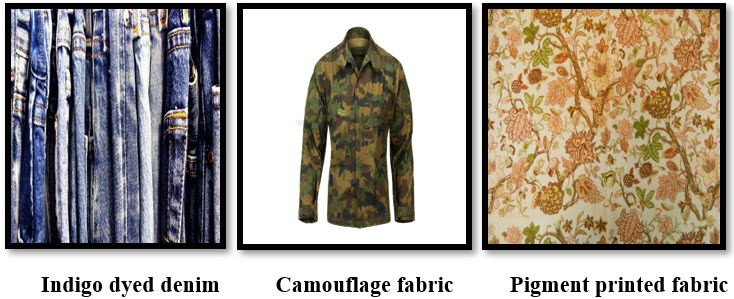
Understanding the requirement of the end users, Sarex has developed a speciality finishing agent Rubfast-467 to improve dry and wet rub fastness for all types of dyed and printed fabrics and their blends. Also, denim fabric finished with Rubfast-467 exhibits excellent wet rubbing fastness
- Unique features of Rubfast-467
- Improves wet and dry rub fastness by 1.5-2 units on various substrates with different classes of dyestuff
- Suitable for direct, reactive, sulphur, indigo and pigment dyed fabrics
- Formaldehyde free
- Does not hamper washing fastness of the fabric
2. Materials and Methods
2.1 Application procedure of Rubfast-467 on textile substrates
Different cotton fabrics dyed with direct dye or reactive dye, as well as vat-dyed camouflage fabric, pigment-printed cotton fabric and indigo-dyed denim, were treated with 30gpl Rubfast-467 by padding, with 70% expression, and dried at 160oC for 2 min. The padding bath was prepared by taking 0.3-0.6 g/l acetic acid. To this, 30gpl Rubfast-467 was added and mixed uniformly. The total volume was made to 100 by adding water of pH 5.8-6.2 and the solution was mixed uniformly.
A solution of 30 g/l Rubfast-467 will appear slight hazy and turbid with pH 3.7-4.2.
2.2. Colour fastness to rubbing – ISO 105-X12:2016
A Crockmeter consisting of a circular rubbing surface finger measuring 16mm in diameter, exerting a downward force of 9N, was used for the testing of dry and wet rubbing fastness. A specimen was mounted on a holding clamp parallel to the rubbing track on the baseboard. The specimen was laid flat on the baseboard and two tests were performed, one along the direction of the warp and other of the weft. A white bleached dry rubbing cloth was mounted on the finger of the Crockmeter and rested on the specimen. The specimen was rubbed back and forth over a straight track of 100mm long for 10 cycles. The procedure for wet rubbing remained the same, only in this case a white bleached cotton fabric saturated with water, ie 100% pick-up, was clamped on the finger and rubbed back and forth for 10 cycles.
2.3. Scanning electron microscopy (SEM)
Surface analysis of the finished and unfinished fabrics treated with Rubfast-467 was carried out using a scanning electron microscope (JEOL, Japan). The samples were sputter coated with gold layers and images were recorded using the scanning electron microscope.
3. Results & Discussion
Figure 1 shows the dry and wet crocking fastness of: direct dyed cotton knit with 2% Scarlet 4BS; reactive dyed fabric with 4% shade; indigo dyed denim; vat dyed camouflage fabric; and pigment printed cotton fabric, respectively, before and after treatment with Rubfast-467. From Figure 1 it is clearly seen that the treated fabric shows improvement in dry and wet rubbing fastness in all the substrates. There is a significant improvement of rating 1-1.5 units in all the treated fabrics for wet rubbing fastness, which is very significant. This may be due to the chemical Rubfast-467, which may be forming a transparent film on the surface of the fabric and thus protecting the dye particles from leeching out due to an external abrasion force. The film formation on the fibre has been proved by chemical characterisation technique, ie by Scanning Electron Micrograph.
Figures 2a and 2b shows the scanning electron microscopy (SEM) of the cotton surface and it is seen that Rubfast-467 aqueous emulsion had the ability to stabilise the structure. Figure 2b shows that Rubfast-467 formed a uniform thin film on the surface, which had good mechanical properties and which protected the fibres from fibrillating and abrading during the dry and wet rubbing action, thus giving a better rating than the unfinished fabric. In unfinished fabric (Figure 2a), it can be seen that the fibre structure gets ruptured and fibrillation takes place, thus leading to lower wet rubbing fastness. Also, this film protects the dye on the fibre from resolubilising and leaching out when in contact with wet abrading material.
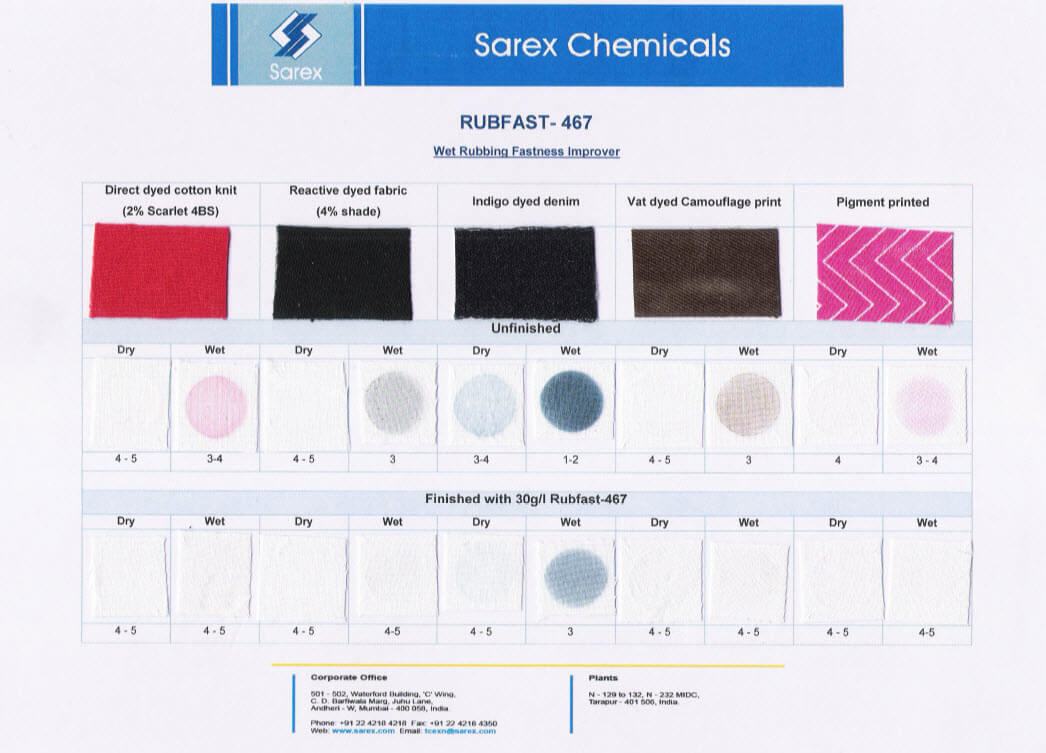
Fig. 1: Rubbing fastness results of fabrics treated with Rubfast-467
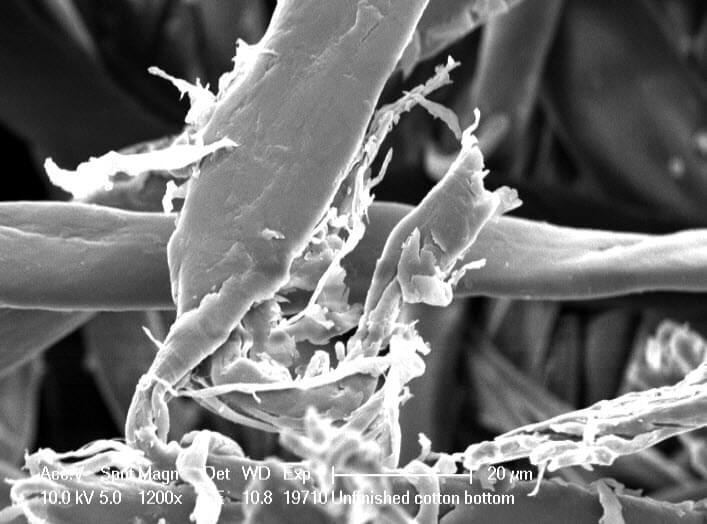
Fig. 2a: Unfinished abraded cotton fabric
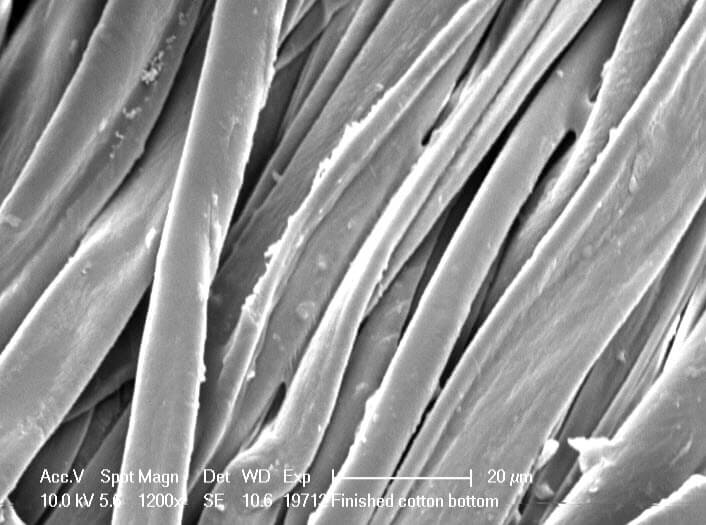
Fig. 2b Finished abraded cotton fabric
4. Conclusion
Not all dyes are suitable for all kinds of fabric. A dye must have all the important properties of fastness. Among all fastness issues, the most frequently encountered is undoubtedly rubbing fastness. Rubbing fastness depends on factors such as material characteristics, selection of dyes/depth of shade, and dyeing/printing procedure. In this article Sarex has successfully developed and showcased the performance of Rubfast-467 as a solution for improving the rubbing fastness of different dyed and printed substrates.