US cotton futures were sharply down midweek as the market reacted to the bearish USDA reports, which caught the market by surprise showing increased supplies for the coming year. The carry-over stock was higher, and production was estimated higher at 19.24 million bales. US ending stocks were raised from 4.0 million bales to 4.6 million bales. Speculators were the biggest sellers on that day and might need to sell more later. US weather was good in the Delta and Southeast, but it was still hot and dry from West Texas to the west. By the weekend, cotton markets saw some relief on news that China and the US will meet end of the month in attempt to get trade talks restarted.
US cotton in the December contract shed US cents 3.84 week-on-week to close the week at US cents 81.39 per pound. March settled at US cents 81.71 per pound down from US cents 85.71 last week. Nearby October contract settled at US cents 81.75 per pound, down US cents 4.11 on the week.
Global spot benchmark, the Cotlook A Index, continued to give back for the third consecutive week. The Index rolled back US cent 5.55 on the week to close at US cents 91.75 per pound, despite gaining US cent 1 at the end of the week.
In China, cotton futures on Zhengzhou Commodity Futures were weak, but on-call discussions and trades increased. Producers mainly focused on sales while spot premium to futures were unchanged. Xinjiang-origin cotton from Jiangsu warehouses were at 16.20-16.30 yuan a kg (US cents 107 per pound). Meanwhile, the China Cotton Index edged down 2 Yuan, to close at 16,291 a ton (US cents 107 a pound).
In Pakistan, cotton markets remained under pressure this week in line with world markets, while Karachi Cotton Association spot rates declined PakRs1,000 week-on-week to close at PakRs8,160 per maund ex-Karachi. Prices plunged sharply in the opening the week due to PakRe-US$ exchange rate volatility forcing exporters to stay out of the trading ring. Cotton experts were of the view that prices will remain under pressure for a few more weeks; however, they will stop falling rapidly due to the demand and supply gap. According to Pakistan Central Cotton Committee data, cotton sowing target of 2.95 million hectares were missed by around 10% as only 2.66 hectares could be utilised under cotton. At the weekend, buyers were at the forefront, actively replenishing their inventories. However, short supply of quality lint coupled with reluctance on part of ginners to sell their stocks kept trading restricted.
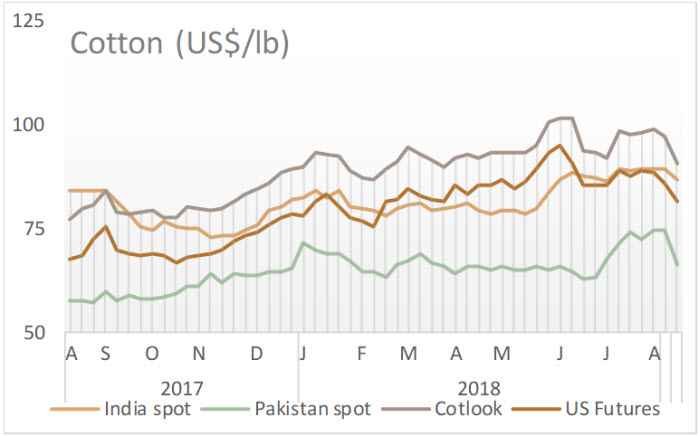
In India, cotton prices moved down further with coarser varieties falling INR100-200 per candy and finer cotton cheaper by INR600-1,700 a candy. Benchmark Gujarat Shankar-6 was traded at INR47,700 a candy, down INR600 from last week. World markets were watching India as there were questions developing about the Indian monsoon. The rains were below normal, but generally good enough to support crops. However, reports indicate that August was much drier, and that was not good for the agricultural producers.
Cotton yarn see better sales in China
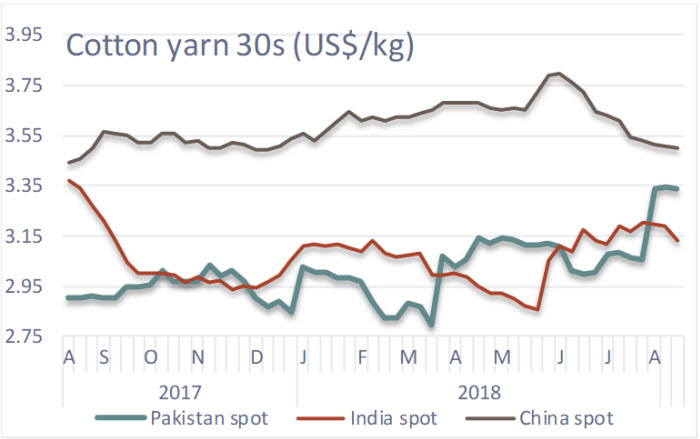
Cotton yarn markets were under adjustment in China as producers reported slightly better sales, with inventories at medium to lower positions. Conventional yarn sold well, and 32s continued to see the best sales. Prices moved up slightly for 21s and 40s count yarns amid adjustment. With the market gradually going into a traditional ‘Golden September and silver October’ season, sales will turn better as a whole. 32s cotton yarn prices inched up to 24.10 yuan a kg (US$3.50 a kg) while 40s were up at 25.10 yuan a kg (US$3.64 a kg), both down US cents 1-2 due to weak yuan.
In Pakistan, as many as 45 spinning mills in Punjab region will be closed for a week due to short arrival of cotton and instable prices. This will the first time that such a large number of mills will be closed for a long time. At the moment, deliveries will continue for some days as transportation will not be available to due to Eid ul Azha. Meanwhile, reports showed that cotton yarn exports have declined drastically up to 65% during the last one week.
30s carded prices in Karachi rolled over at PakRs180-190 per pound (US$3.22-3.40 a kg), while 32s combed in Faisalabad inched up PakRs1 at upper end to PakRs186.50-195.50 per pound (US$3.34-3.50 a kg, up US cent 1).
In India, 30s combed cotton yarn for knitting was flat at INR220 a kg (US$3.13 a kg) in Ludhiana, down US cents 6 due to a sharp fall in INR.