Cotton Futures were lower again this week on the stronger US$ and weaker equity stock market. Speculators were the best sellers as farmers continued harvesting. Reports indicate good harvest conditions in most areas, although progress has been slow. The harvest in only four states has progressed ahead of the five-year averages: Missouri (89%); North Carolina (74%), Tennessee (79%); and Virginia (80%). Only two of 15 reporting states the harvest was below the halfway mark: in Texas (47%); and Kansas (25%). Spot market conditions were weak, and ICE-certified stocks increased in the last couple of weeks at a rapid pace. USDA showed that the harvest is still moving much slower than average. Thus, the market needs fresh demand. Export sales for the last few weeks were poor and showed no signs of improvement. Midweek had seen gains, influenced by positioning ahead of December deliveries and outside markets.
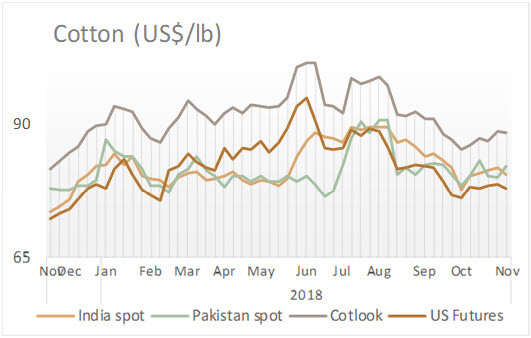
Nearby December contracts moderated US cents 1.20 week-on-week to close at US cents 74.92 per pound, while March was down US cent 1.07 to close at US cents 77.22, widening the premium over front month to US cents 2.30. December 2019 edged down US cent 0.66 to close at US cents 76.55 per pound.
Global spot benchmark, the Cotlook A index, inched up US cent 0.45 week on week to close at US cents 86.75 per pound. In China, spot cotton market was weak as most players retreated to the sidelines given tumble in futures market. Spot market was at a stalemate and Futures trading increased due to wider price spread. The China Cotton Index continued to recede this week by 74 Yuan, to close at 15,508 a ton (US cents 102 a pound).
In Pakistan, trading activity on the cotton market remained selective on grade issue and few bales changed hands. The Karachi Cotton Association (KCA) spot rate stood unchanged at PakRs 8,960 per maund ex-Karachi. Reports indicate that most buyers made deals for second grade of lint on bargaining prices during the week. Meanwhile, downstream textile mills consolidated their long positions, while the market remained on steadier tones. However, due to liquidity crunch, mills were stuck at reclaiming funds and slow arrival of better cottonseed at ginneries remained thin. In domestic market, mills and spinners would remain keeping an eye on better lint on the back of production of better-quality cloth and yarn.
In India, cotton prices moderated as arrivals increased this week. Benchmark Gujarat Shankar-6 traded at INR44,900 per candy, down INR1,100 week-on-week. Other varieties were cheaper by INR300-1,200 per candy. Daily arrivals although averaged 1.52 lakh bales were still below the normal of 1.70 bales in this time of the marketing year. Arrivals generally peak to more than 2 lakh bales in December/January and taper off by March. Meanwhile, cotton procurement in Telangana, started last week, and has gathered momentum as prices in some areas eased to touch the minimum support price. The government has fixed minimum support price for the medium-staple variety of cotton at INR5,150 per quintal, and that for long staple at INR5,450 per quintal. Even in the peak arrivals season, prices remained elevated due to delay in new crop by almost a month and concerns over the crop size due to drought in top two states Maharashtra and Karnataka.
Cotton yarn
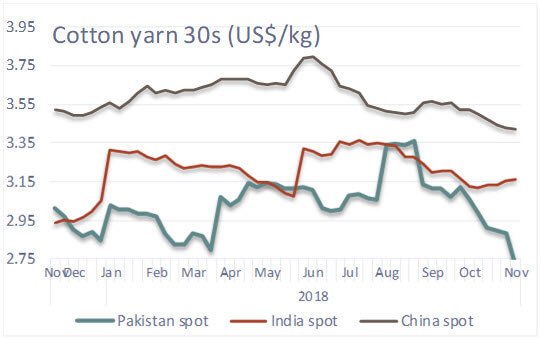
Cotton yarn prices were seen easing in China and Pakistan for select specs but remained unchanged in India as the currency gained against the US$. In China, prices of cotton yarn in some individual varieties went down, and cotton 32s and 40s sold well despite some price moderation. In Pakistan, cotton yarn prices were stable to soft in Karachi yarn market while they mostly sobered in Faisalabad market at the either end of the price range. However, the declines were sharper and not in line with cotton fibre prices, implying weak demand. In India, cotton prices rolled over as cotton prices had been volatile both ways despite the ongoing cotton marketing season. Overall, cotton yarn markets will remain in correction in coming week, and prices may continue to moderate slightly for now.
In China, 32s cotton yarn prices edged down to 23.55 Yuan a kg (US$3.40 a kg) while 40s were flat at 24.60 Yuan a kg (US$3.55 a kg). Coarser yarn prices of 16s declined to 14.70 Yuan a kg (US$2.12 a kg, down US cents 4) while 21s moderated to 18.80 Yuan a kg (US$2.71 a kg down US cent 1). In Pakistan, 30s carded prices in Karachi were stable at PakRs172-178 per pound (US$2.82-2.92 a kg), while 32s cone in Faisalabad eased PakRs13 at the lower end to PakRs145-170 per pound (US$2.38-2.79, down US cents 21). In India, 30s carded cotton yarn for knitting rolled over at INR230 a kg (US$3.23 a kg, up US cents 3 due to strong INR) in Coimbatore while export offers were flat at US$2.90 a kg.