Cotton Futures were a little lower after trading both ways of unchanged. Speculators were on both sides of the market as farmers continued to work on harvesting. Reports indicated good harvest conditions in most areas. Cash market conditions were weak, and ICE-certified stocks have been increasing in the last couple of weeks at a rapid pace. The USDA report showed that bolls are finally about to open, and harvest was moving slightly slower than average. The market needs fresh demand as export sales have been poor for the last few weeks and showed no real signs of improvement at the moment. Export orders need to increase soon for prices to gain significantly traction this year, but such increase needs to come from outside China. India is bagging all Chinese business and therefore prices are much stronger.
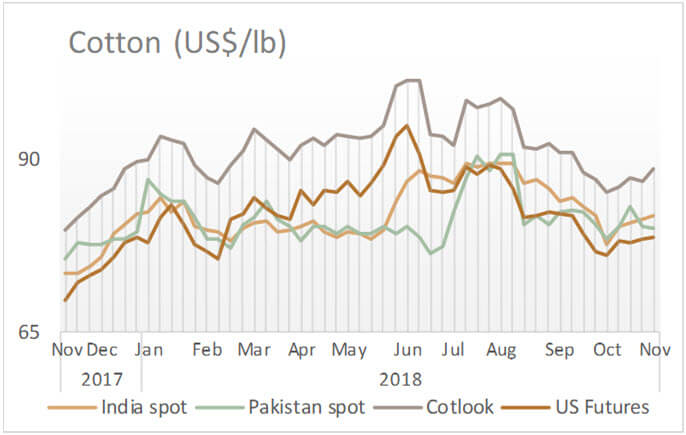
Nearby December contracts moderated US cents 1.97 week-on-week to close at US cents 76.12 per pound, while March was down US cent 1.57 to close at US cents 78.29, widening the premium over the month to US cents 2.17. December 2019 also edged down US cent 1.08 to close at US cents 77.21 per pound.
Global spot benchmark, the Cotlook A Index, also edged down by US cents 2.05 week-on-week to close at US cents 86.30 per pound.
In China, the cotton spot market was stable, with ginneries less willing to sell at lower prices. Mechanically-harvested Northern-Xinjiang-origin materials were quoted at 15.80-15.90 Yuan a kg (US cents 103-104 per pound), self-lifting. Buyers were cautious on their purchases and stocking. Meanwhile, the China Cotton Index continued to slip this week by 24 Yuan, to close at 15,582 a ton (US cents 102 a pound).
In Pakistan, cotton trading volume expanded in the local market as current rates attracted mills ahead of the Pakistan Cotton Ginners' Association fortnightly report. The official spot rate moderated PakRs100 on the week to PakRs8,960 per maund ex-Karachi. Reports showed that mills indulged in fresh buying of lint as there were rising anticipations that cotton arrivals may be lower, a factor that propelled buyers to conclude deals over the current levels. According to market experts, a certain type of uncertainties prevailed in the market. Like other commercial centres across the globe, the local cotton market was moving but cautiously.
Cotton prices in India started marching up after reports said that output may decline 11% this year on drought in major growing states of Gujarat and Maharashtra. The second and third pickings may be adversely impacted and cotton price may swing in coming weeks. Experts have pegged total cotton output estimate at 32.5-33 million bales (of 170 kg each) for the crop year 2018-19, down from 36.5 million bales in 2017-18. The Cotton Association of India, however, forecast output at 34.3 million bales in its October estimates for the current season.
The new cotton season started with a marginal 1.5 million bales of opening stock compared to 2.3 million bales last year. And the likelihood that demand from China is set to rise following the US-China trade war implies that India’s cotton exports will remain firm this year. Rising demand and lower output may trigger sharp price rises this year which may dent domestic textile mills’ margin. Benchmark Gujarat Shankar-6 was traded at INR46,000 per candy unchanged from last week while other varieties were dearer by INR100-700 per candy during the week.
Cotton yarn
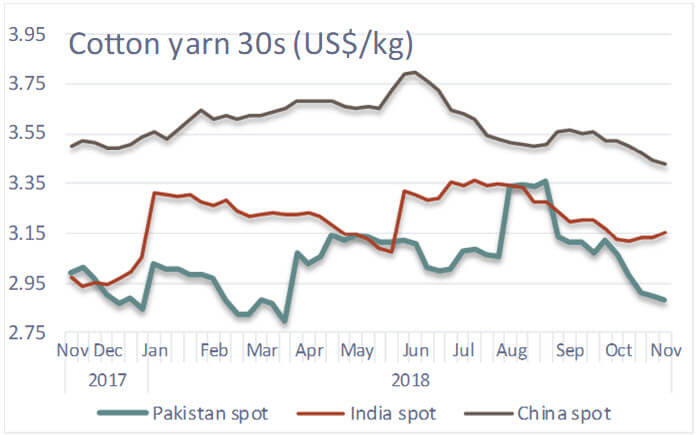
Cotton yarn prices were seen moderating briskly in China and Pakistan this week as cotton fibre prices sustained the declining trend. Cotton Futures were lower, spot benchmark eased and the China Cotton Index continued to fall, albeit slowly. In China, prices of cotton yarn of individual varieties continued to range bound with a drop, while demand for 32s and 40s was good and sold well. Major trading prices in Jiangsu and Zhejiang markets were seen falling more than 1% week-on-week. 32s cotton yarn prices edged down to 23.60 Yuan a kg (US$3.40 a kg) while 40s fell to 24.60 Yuan a kg (US$3.55 a kg) both down US cents 2. Coarser yarn prices of 16s declined faster to 15.00 Yuan a kg (US$2.16 a kg) while 21s moderated to 18.90 Yuan a kg (US$2.72 a kg) both down US cents 3.
In Pakistan, cotton yarn markets of Karachi and Faisalabad were under correction this week, as prices started to go down in line with cotton fibre cost and receding demand. 30s carded prices in Karachi fell to PakRs172-178 per pound (US$2.82-2.92 a kg, down US cents 6), while 32s cone in Faisalabad eased PakRs8-10 to PakRs158-170 per pound (US$2.59-2.79, down US cents 14).
In India, cotton yarn prices remained unchanged as the cotton buying season was progressing with firming prices. 30s carded cotton yarn for knitting remained unchanged at INR230 a kg (US$3.20 a kg, up US cents 4 due to strong INR) in Coimbatore while export offers were flat at US$2.90 a kg.