Cotton futures were higher hitting new highs for the move that appeared to be speculative buying. There did not seem to be much fundamental news to cause the buying, but technical has been holding and some short covering was seen. After the close, reports said that there were some moves in US administration to lift tariffs on China in hopes to encourage quicker and more complete settlement to the trade war. However, there were many who still wanted to be tough on China, so the battle continues. World production and supplies were still lower due to bad weather in the growing season for major producers around the world, including India, Pakistan, and Australia. China had problems with its indecent weather, and has been forced to import large volumes of cotton this year. Demand for US cotton remained disappointed as China has not bought any US crop this year. The US has had disputes this year with other major importers such as Turkey. With US prices down, China may start looking at the US crop, but there are worries about quality due to extreme growing conditions in Texas and Southeast over the summer and fall.
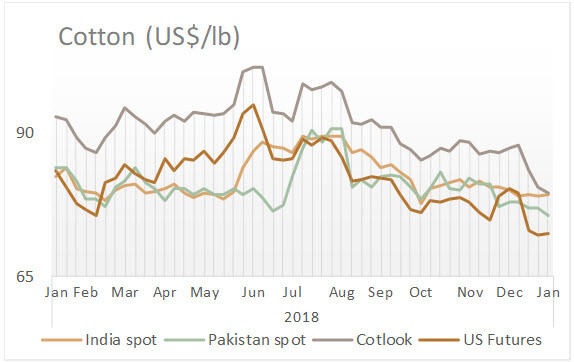
March contracts settled at US cents 73.89 per pound, US cents 1.40 up from last week while December settled up US cents 1.13 at US cents 74.77 per pound
Global spot benchmark, the Cotlook A index, gained US cent 1.40 on the week to close at US cents 83.80 per pound.
In China, spot cotton market were range bound, with domestic cotton of high quality enjoying decent trades, but high-quality goods were scant. Hebei-origin grade-3128 was offered at 15 Yuan a kg (US cents 101 per pound). Most suppliers offered flat, while ginners mostly concluded operations and were shutting down for Lunar New Year break. The China Cotton Index gained 55 Yuan this week, to close at 15,433 a ton (US cents 103 a pound).
In Pakistan, cotton prices were steady as small spinners and traders continued buying operations. As it is clear that the crop size would not be more than 10.8 million bales against the estimated domestic consumption between 13-15 million bales, leading textile spinners seem reluctant to enter the trading. For the week, the Karachi Cotton Association kept its spot rates steady at PakRs8,860 per maund ex-Karachi. Cotton growers and ginners have objected to Economic Coordination Committee’s withdrawal of tax and duty on the import of cotton. The PCGA stated that the decision was likely to affect the cotton production in 2019-20.
In India, spot cotton price movement was mixed this week with coarser varieties declining, medium and higher varieties gaining. Benchmark, Gujarat Shankar-6 was traded this week at INR42,700 per candy (US cents 76.58 per pound) , INR100 down from last week.
Cotton yarn
Cotton yarn markets were modest in China this week, with fair sales of combed 32s. Major producers in Shandong offered discounts for firm deals. The prices of 32s in Xiaoshan and Shaoxing were steady. Although cotton yarn markets were under weak correction this week amid modest transaction, downstream weaving mills will shut down gradually for vacation with the Spring Festival drawing closer. Thus, the yarn market will probably enter into a standstill. In Pakistan, the cotton yarn market in Karachi saw prices remain stable while in Faisalabad prices mostly moderated despite cotton fibre prices going stable over the week. In India, cotton yarn prices continued their stable march despite cotton fibre prices moving down for most varieties.
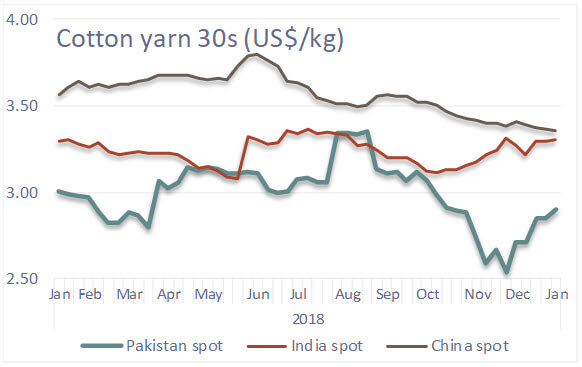
In China, 32s cotton yarn prices remained unchanged at 23 Yuan a kg (US$3.40 a kg), while 40s moderated to 24 Yuan a kg (US$3.55 a kg). Combed yarn prices of 32s were stable at 23.50 Yuan a kg (US$3.47 a kg) while 40s rolled over at 26.30 Yuan a kg (US$2.89 a kg). In Pakistan, 30s carded prices in Karachi were steady at PakRs175-180 per pound (US$2.77-2.85 a kg), while 32s cone in Faisalabad declined PakRs5 to PakRs183-191.50 per pound (US$2.90-3.04 a kg, down US cents 6). In India, 30s carded cotton yarn for knitting rolled over at INR231 a kg (US$3.25 a kg, down US cents 3 due to weak INR) in Coimbatore while export offers were unchanged at US$2.88 a kg.