Cotton Futures weakened in response to another bad week for the US export sales report. Export demand dropped in the last few weeks as the world is focused on the US cotton crop and await prices to drop further due to lost Chinese demand for US Cotton. Waters have started receding in the Carolinas, although some major flooding was reported near the rivers and coastal areas in South Carolina.
The extent of potential damage to crops is reported to be significant. It will take a little more time before the full extent of the damage in known as most producers are cleaning up after the storms. The USDA report showed slight improvement in national rankings for cotton this week, which is in contrast to the weather conditions last week. The market lost some price targets of many traders were at US cent 75 for December last week before some new buying interest was found. Futures could hit make new lows as trade war with China see no end in sight and neither side willing to give up much to make a deal happen.
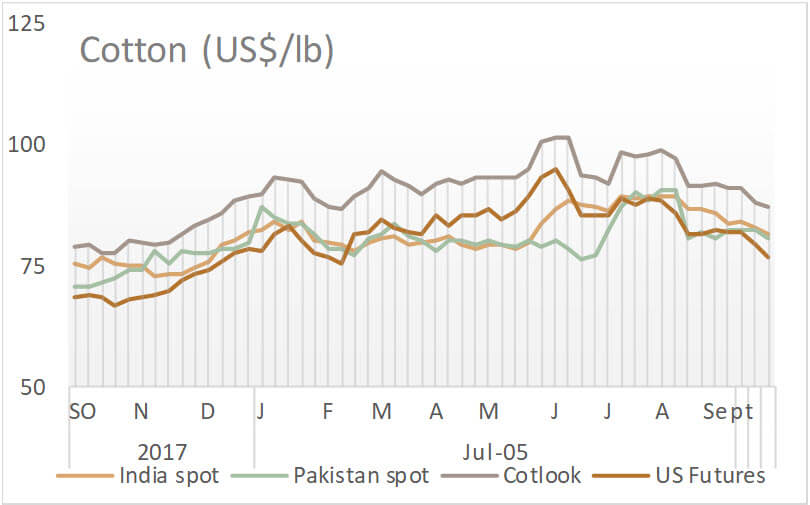
US cotton December contract lost US cents 2.76 week on week to close at US cents 76.37 per pound. March settled at US cents 77.29 per pound down from US cents 79.51 last week. Nearby October contract settled at US cents 76.76 per pound, down US cents 2.52 on the week.
Global spot benchmark, the Cotlook A Index moderated US cent 0.90 on the week to close at US cents 87.20 per pound, having lost US cent 0.75 on the weekend.
In China, buying prices for raw or seed cotton (with lint percentage at 40%) were stable in Xinjiang province while in Kuitun, prices for hand-picked goods were at 7.0-7.2 yuan a kg (US$1.02-1.05 a kg) and prices for mechanically-harvested goods were at 6.0-6.2 yuan a kg (US$.87-0.90 a kg). The China Cotton Index fell 94 Yuan on the week, to close at 16,243 a ton (US cents 107 a pound).
In Pakistan, cotton prices moved lower opening the week in line with the falling trend on the global markets. Escalting trade war between US and China over tariffs was a major factor dampening sentiments in world commodity markets. Furthermore, sluggish performance in yarn market also kept buyers away from the market. Barring few needy spinners and some exporters the market remained devoid of much activity. As the week came to a close, spot rate declined further. During the week, the Karachi Cotton Association reduced its official spot rate by almost PakRs200 to PakRs8,160 per maund ex-Karachi. Market players also pointed to the increase in arrivals as a factor for prices to decline.
In India, cotton price movements were sluggish this week with some varieties moderate and few gains. Spot prices for coarser varieties declined INR300-400 per candy week-on-week, while a finer variety of DCH-32 were up INR500 a candy. Benchmark Gujarat Shankar-6 was traded at INR46,500 per candy, down INR300 from last week. Prices also exhibited a mixed trend in central and south India due to scattered buying and selling activity.
Harvesting of new crop harvest has begun in Punjab and Haryana and arrivals will gather pace and possibly bring down prices soon. But chances of any sharp downside is limited due to dryness concerns in Gujarat. Further, if global prices remain at their current levels, a correction in domestic prices may result in achieving export competitiveness.
Cotton yarn
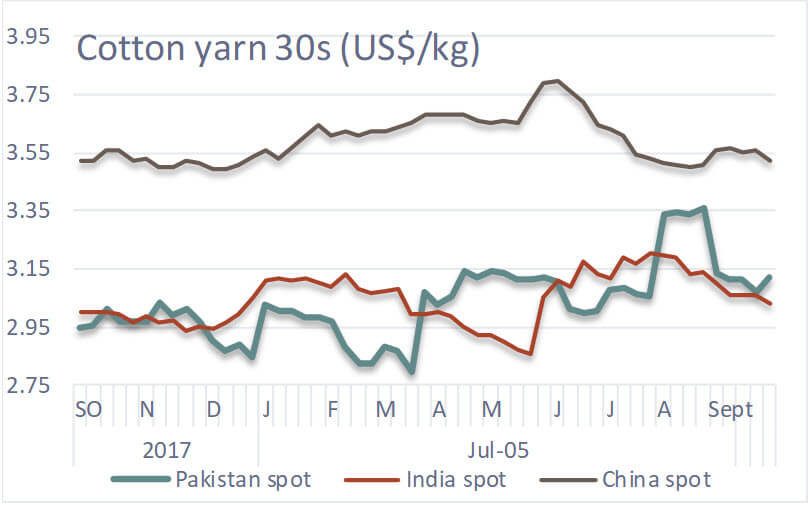
Cotton yarn markets in China saw limited changes in sales volume, and downstream demand for 32s cotton and cotton spandex blend wrapped yarn increased somewhat. Offers for 32s moderated as producers intended to balance better sales of low-count yarns amid limited orders for finer-count yarns. Offers for 21s cotton yarn were flat. As cotton yarn markets were under correction, producers did not have enough confidence on the situation in a busy season. 32s was traded at 24.25 yuan a kg (US$3.53 a kg, down US cents 3) and 40s were stable at 25.40 yuan a kg (US$3.69 a kg). Coarser yarn prices of 16s declined to 15.30 yuan a kg (US$2.22 a kg, down US cents 6) while 21s were flat at 19.60 yuan a kg (US$2.85 a kg).
In Pakistan, cotton yarn prices were stable in the Karachi market, while they fluctuated both ways in the Faisalabad market. Overall, the performance remained sluggish given the moderation in cotton prices. 30s carded prices in Karachi remained unchanged at PakRs168-170 per pound (US$3.01-3.04 a kg), while 32s combed in Faisalabad were up PakRs 3 at PakRs174.50-187 per pound (US$3.12-3.35 a kg, up US cents 5).
In India, cotton yarn prices did not move given the past hikes in cotton prices, although the market may trend lower as arrivals pick up. 30s combed cotton yarn for knitting rolled were steady at INR220 a kg (US$3.03 a kg) in Ludhiana.