Cotton US Futures hit a seven-week high in response to bullish estimates from USDA and speculators were mostly buyers. The USDA has cut estimates, larger-than-expected, for the US and world output. Demand was also trimmed, but not as much as production, so ending stocks were lower. US cotton production is estimated at 18.408 million bales, fell 1.355 million bales from the October forecast and 12% below previous season. Acreage fell 160,000 to 10.37 million acres, reflecting abandonment of 3.67 million acres or 26%. Yields are estimated to average 852 pounds per acre. Export sales for the last few weeks have been poor and showed no signs of improvement. So the market needs new demand for exports to improve and prices to rally significantly this year. However, any increase in demand has to come with no purchases from China for a while.
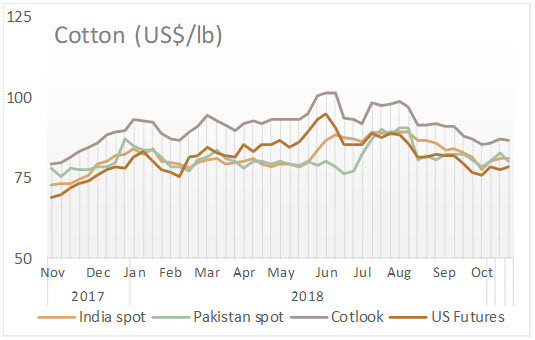
Nearby December contracts lost US cent 0.70 week-on-week to close at US cents 78.09 per pound, while March was down US cent 0.45 to finish at US cents 79.86, widening the premium over front month to US cents 1.77. December 2019 also edged down US cent 0.02 to close at US cents 78.29 per pound.
Global spot benchmark, the Cotlook A index, also moderated by US cents 0.25 on the week to close at US cents 88.35 per pound, having remained flat on the weekend.
China, which canceled orders for some US cotton bought earlier for this season and rolled some into next season, was still the second-largest US customer for 2018-19, purchasing 1.602 million running bales. It has booked 914,000 RB for next season, accounting for 49% of US 2019-20 export commitments. Meanwhile, the China Cotton Index continued to slide this week by 65 Yuan, to close at 15,606 a ton (US cents 102 a pound).
In Pakistan, cotton prices firmed up, but trading volume declined considerably as buyers preferred to stay on the sidelines. Prices increased throughout the week and the KCA rate gained PaRs250 to PakRs9,060 per maund ex-Karachi. However, there was some respite from buyers who want to see the rates roll back before further buying was committed. The market was evaluating new developments including expected market access from China for Pakistan textile goods as well as the government’s commitment over reduction in gas tariffs for the export-oriented industry. Some millers remained focused on quality cotton and continued to replenish stocks at a lower level. Meanwhile, ginners have started operating their units after the government assured withdrawal of SRO-188, which imposes Sales Tax on oilseed cake.
In India, cotton prices softened slightly, but were still firmer on higher minimum support prices. The new cotton season has commenced this year with prices up despite new arrivals, an unusual trend. Since 1 October, over 20 lakh bales have arrived in the market. The main reason is the hike in minimum support price of 26-28% this season, depending on the variety. Various trade associations have varying estimates for cotton production this year, with expectations ranging from 343 lakh bales to 380 lakh bales. The daily arrivals of cotton have already crossed one lakh bales now and are expected to go up. With the spot moderating this week, prices are above the MSP by just 1-1.5%.
Cotton yarn
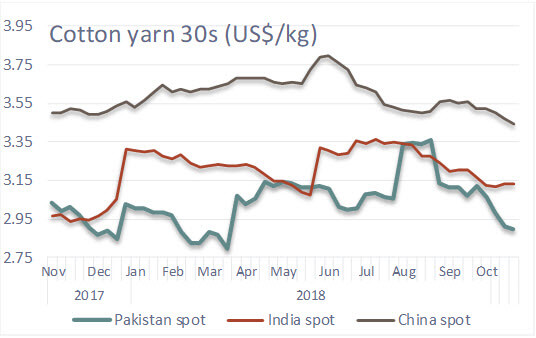
Cotton yarn prices moved down in line with falling cotton fibre prices in China this week, while they rolled over in India amid higher costs of cotton. Pakistan yarn markets were mixed as yarn prices sobered despite rising cotton cost. In China, prices of cotton yarn were adjusted downwards further, and deals mainly were mainly seen for 32s and 40s combed yarn. Major producers in Shandong offered 21s and 32s carded yarn at a reduction from last week. 32s cotton yarn prices eased to 23.70 Yuan a kg (US$3.42 a kg) while 40s fell to 24.70 Yuan a kg (US$3.56 a kg) both down US cent 1-3. Coarser yarn prices of 16s were flat at 15.20 Yuan a kg (US$2.19 a kg) while 21s moderated to 19.10 Yuan a kg (US$2.76 a kg, down US cents 3).
In Pakistan, reports suggest that cotton yarn markets were currently faced with a supply glut. Furthermore, the textile industry in Punjab has taken a cautious approach following the gas subsidy and bills issue. Yarn prices in Karachi markets were steady, while they were seen easing in Faisalabad. 30s carded prices in Karachi were stable at PakRs175-180 per pound (US$2.89-2.97 a kg), while 32s cone in Faisalabad edged down PakRs8-9 to PakRs166-180 per pound (US$2.73-2.96, down US cents 15).
In India, high costs of cotton supported yarn markets to rollover prices. 30s carded cotton yarn for knitting rolled over at INR230 a kg (US$3.16 a kg) in Coimbatore, while export offers rolled over at US$2.90 a kg.