US Cotton Futures were lifted as the market ignored a dismal weekly export sales report, and instead reacted to a message by President Trump about a conversation he had with President Xi about trade and North Korea. The market hopes for a resolution to the trade war, or at least the easing of any additional threats of more tariffs. However, trends are still mixed. The weekly crop data showed slow progress with the harvest and still poor crop conditions. Export sales for the last few weeks have been poor, showing no real signs of improvement at the moment. Export demand should improve soon for prices to rally significantly this year, but any increase in demand has to emerge without purchases by China for a while.
December contracts gained US cent 0.26 week-on-week to close at US cents 78.79 per pound while March was up US cent 0.48 to finish at US cents 80.31, widening the premium over front month to US cents 1.52. December 2019 also rose US cent 0.98 to close at US cents 78.31 per pound.
Global spot benchmark, the Cotlook A Index, however, gained sharply by US cents 1.80 on the week to close at US cents 88.60 per pound, having jumped US cents 2.20 on the weekend alone.
In China, with the rise in cotton futures on the Zhengzhou Commodity Exchange, cotton spot market trading improved, with prices stable. Raw cotton buying in Northern Xinjiang gradually came to the end, with prices at 5.60-5.80 Yuan a kg (US cents 37-38 per pound). Selling prices for spot ginned cotton were slightly above 15.50 Yuan a ton (US cents 101 per pound) but sellers were reluctant to conclude deals at lower prices. The China Cotton Index continued to slide rapidly this week by 160 Yuan, to close at 15,671 a ton (US cents 102 a pound, down US cent 1 from last week).
In Pakistan, cotton prices’ partially-regained losses suffered last week opening this week amid renewed buying interest. However, activity remained brisk to moderate and outlook was still uncertain later in the week. There was no new factor which could be attributed to recovery except that a mild correction was warranted as many spinners tried to replenish their stocks at lower prices. The KCA spot rate rolled over at PakRs8,810 per maund ex-Karachi at the close of this week.
Reportedly, the crop shortage was a major factor for small-and-medium sized spinners who largely depend on local cotton. In order to meet the shortfall, around four million bales are estimated to be imported to meet domestic demand of around 14.50-15 million bales. Sources stated that around 2 million bales are already booked by spinners largely coming from India.
In India, cotton prices were stable to soft as arrivals picked up during this week. Benchmark, Gujarat Shankar-6 was traded at INR46,700 per candy, down INR100 from last week. Prices of other varieties were down INR100-300 a candy, with some rising INR100 a candy.
Cotton yarn
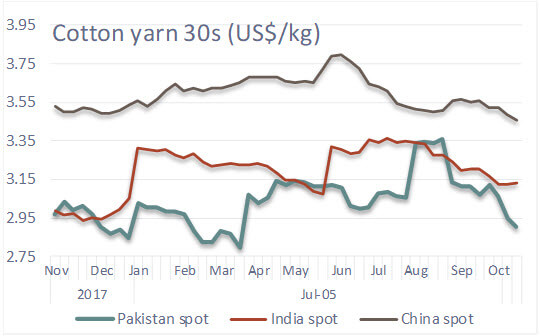
Cotton yarn sales were steady in China, and prices retreated slightly from stable. Cotton yarn 32s and 21s saw smooth sales. Producers kept offers stable, but discounts were available for actual discussions. The cotton yarn market will remain under correction given the fall in domestic cotton prices but may go down further in coming weeks. 32s cotton yarn prices fell to 23.80 Yuan a kg (US$3.43 a kg), while 40s fell to 24.90 Yuan a kg (US$3.59 a kg) both down US cent 1. Coarser yarn prices of 16s also fell to 15.20 Yuan a kg (US$2.19 a kg) while 21s moderated to 19.30 Yuan a kg (US$2.78 a kg), both down US cent 1.
In India, cotton yarn prices rolled over given the either-way movement in cotton prices. With cotton arrivals picking up, this may prompt yarn makers to maintain stable yarn prices. 30s carded cotton yarn for knitting rolled over at INR230 a kg (US$3.16 a kg, up US cents 2 due to strong INR) in Coimbatore while export offers rolled over at US$2.90 a kg.
In Pakistan, cotton yarn prices were under correction both in Karachi and Faisalabad yarn markets. 30s carded prices in Karachi were stable at PakRs175-180 per pound (US$2.89-2.97 a kg), while 32s cone in Faisalabad edged down up at lower end and rose at the upper end to PakRs175-188 per pound (US$2.89-3.10).