Cotton Futures were up on slightly lower export sales reported by USDA and some positioning before the G-20 meetings weekend. The market remained in a short-term trading range, but appeared that bottom is being formed once again. The final size of the US crop seems to be getting smaller with reduced and delayed harvest activities.
The USDA showed that there is still a lot to be harvested in its final crop updates for the season. Reports also suggest that the harvest pace is poor. Most of the delays have been in Texas due to too much rain, but some delays in the Southeast have also been reported. The delayed harvest could cause yield and quality losses. The lower quality could serve to limit export interest for the US at a time when demand is hurting due to the loss of the China business. On the ICE, certified stocks were at 145,635 bales. Four notices are posted against December contracts and that total deliveries for the month are now 670 contracts.
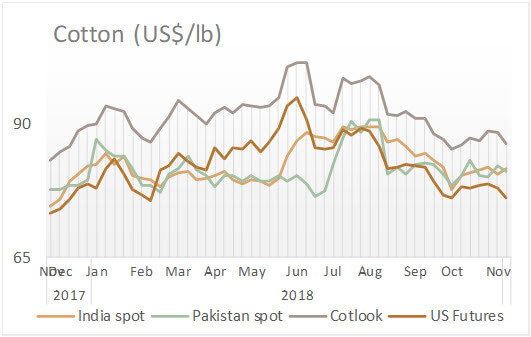
Nearby December contracts inched up US cents 2.24 week-on-week to close at US cents 77.16 per pound, while March was up US cents 1.69 to close at US cents 78.91, narrowing the premium over front month to US cents 1.75. December 2019 inched up US cent 0.48 to close at US cents 77.03 per pound.
Global spot benchmark, the Cotlook A index, edged down US cent 0.20 week-on-week to close at US cents 86.55 per pound.
In China, cotton spot market extended weakness, with thin liquidity of both fresh spot cotton. There were some on-call deals of cotton of marketing year 2017-18 at discounts to spot prices. The China Cotton Index continued to retreat this week by 85 yuan, to close at 15,423 a ton (US cents 101 a pound).
In Pakistan, the downward trend in cotton prices continued during the week but came to an end on weekend as prices slightly rebounded on expectations of higher yarn exports and rise in cotton prices in coming weeks. A steep fall in the PakRe against the dollar is expected to give some competitive edge to Pakistani textiles including cotton yarn in the global market. According to reports. cotton crop is unlikely to more than 10.5 million bales, less than 1 million bales from last season. This implies huge deficit of around 4.5 million bales which would have to be imported. The Karachi Cotton Association spot rates were revised downward by PakRs150 to PakRs8,810 per maund, ex-Karachi.
In India, spot cotton prices declined across many varieties with few posting gains during the week. Arrivals have started gaining pace seeing prices falling as farmers were rushing to sell off before prices move down further. Meanwhile, cotton yield has hit a three-year low on massive crop damage with droughts in Maharashtra and Gujarat, the major cotton growing states. The Cotton Advisory Board, in its first estimate released this week, forecasts the yield to decline to 501.47 kg per hectare for 2018–19 season from 506.07 kg the previous year. It has estimated cotton output at 36.1 million bales for 2018-19 compared with 37 million bales in the previous year.
Cotton yarn
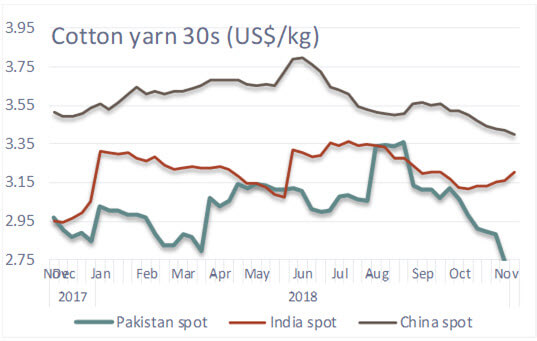
Cotton yarn markets in China moved down from stability, and deals were mainly concluded for 32s and 40s combed yarn. Producers offered for 40s and 20s combed flat on the week while offers for 21s and 32s were slightly reduced to push out volumes. However, most producers offered discounts during discussion of firm deals. In Pakistan, yarn markets in Karachi and Faisalabad saw downward correction in cotton yarn prices this week. However, the markets expect higher cotton yarn exports, which will in return trigger demand in the domestic market. However, experts believe that the gain would be short-lived since some estimates pegged imported component in exports to be higher up to 50%. In India, falling cotton prices restricted any movement in yarn prices while stronger currency made export a bit difficult.
In China, 32s cotton yarn prices edged down to 23.45 yuan a kg (US$3.38 a kg, down US cents 2) while 40s were flat at 24.60 yuan a kg (US$3.55 a kg). Coarser yarn prices of 21s declined to 18.70 yuan a kg (US$2.70 a kg, down US cents 2), while 21/2s moderated to 21.20 yuan a kg (US$3.06 a kg down US cents 2). In Pakistan, 30s carded prices in Karachi were stable at PakRs172-178 per pound (US$2.73-2.82 a kg, down US cents 9 due to weak currency), while 32s cone in Faisalabad eased PakRs2.50 at the lower end to PakRs160-177.50 per pound (US$2.54-2.82, down US cents 13). In India, 30s carded cotton yarn for knitting were stable at INR230 a kg (US$3.30 a kg, up US cents 7 due to strong INR) in Coimbatore, while export offers were flat at US$2.90 a kg.