Cotton futures retreated despite a small improvement in the weekly export sales and a weaker US$. The extent of the potential damage to crops in the Carolinas was better understood and was significant. The market succumbed to some price targets of many traders for December midweek before some new buying interest emerged. Reports indicate that much of the production in North Carolina may be lost, mostly because of the extreme rains and flooding. However, it will be quite some time before the full extent of the damage in known as waters in the Eastern part of the state are still very high. Meanwhile, the trade war with China escalated with no end in sight with neither side to give much to make a deal happen.
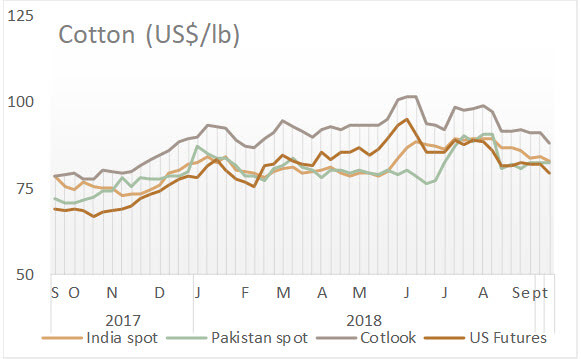
US cotton December contract lost US cents 2.70 on the week to close at US cents 79.13 per pound. March settled at US cents 79.51 per pound down from US cents 82.14 last week. Nearby October contract settled at US cents 79.28 per pound, down US cents 2.62 on the week.
Global spot benchmark, the Cotlook A Index declined US cent 3 week on week to close at US cents 88.10 per pound, having lost US cent 0.20 on the weekend.
The China Cotton Index inched up 6 yuan on the week, to close at 16,337 a ton (US cents 108 a pound).
In Pakistan, cotton trade remained firm and buyers concluded deals for better grade lint at slightly higher price. The KCA spot rates remained unchanged at pakRs8,360 per maund ex-Karachi. Leading buyers reportedly consolidated their long positions for better grade lint. The sellers holding better grades were on front and brought fine stocks at higher price. Price fixation of cottonseed would also determine the overall lint prices.
Meanwhile, irrigation water scarcity and severe hot weather was affecting standing crop quality besides volumes. Sellers were looking at cottonseed price and shrinking stocks coupled with growing demand for better grades giving them opportunity to ask higher price.
In India, cotton exports to China may see a fivefold jump to 4 million bales in the marketing year starting 1 October, as it slaps 25% additional duty on imports of fibre from the US on July 6, amid the trade war between the world’s two economies. Indian traders have already entered into a forward contract with Chinese buyers to deliver about 1.2 million bales between November and January, reports said. Though some quantities are contracted for exports to Bangladesh and Cambodia as well, maximum contracts were with China.
China is set to return as a major cotton importer, taking 10-15 million bales each year by 2019-20, Reuters had reported recently. However, a likely decline in India’s cotton production in the next season, low closing stocks and higher minimum support prices may dent export prospects, experts opined.
Meanwhile, spot cotton prices ruled lower this week. Prices were down INR100-300 per candy for coarser varieties and INR600-1,100 per candy for medium to finer varieties. Benchmark, Gujarat Shankar-6 was traded at INR46,800 per candy, down INR700 from week ago.
Cotton yarn
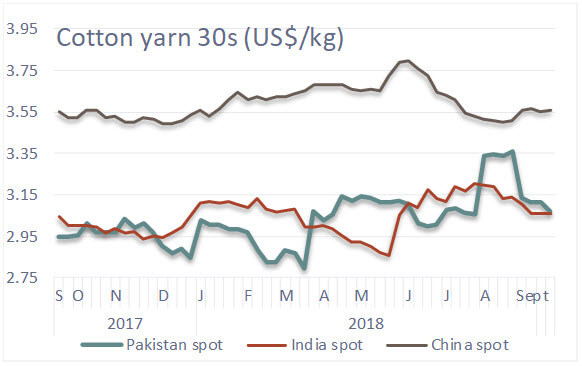
Cotton yarn market were on stable performance in China, with deals mainly concluded for 32s and 40s yarn due to good demand from air-jet-woven nylon/cotton fabric makers. Although the markets were a correction on the weekend, producers did not have enough confidence on the outlook given a busy season. Cotton yarn 32s were at 24.30 yuan a kg (US$3.55 a kg) and 40s at 25.40 yuan a kg (US$3.72 a kg). Coarser yarn prices of 16s were stable at 15.60 yuan a kg (US$2.28 a kg) and 21s at 19.60 yuan a kg (US$2.87 a kg).
In Pakistan, cotton yarn prices were stable to down in Karachi market while they moved in either directions in Faisalabad market. Cotton prices after staging a volatility were almost stable in recent weeks. The prices also reflected the expected demand to emerge after the Eid holidays last week. 30s carded prices in Karachi remained unchanged at PakRs168-170 per pound (US$3.01-3.04 a kg), while 32s combed in Faisalabad were down PakRs 2.50 at PakRs171.50-184 per pound (US$3.07-3.29 a kg, US cents 5).
In India, cotton yarn prices were almost stable, although cotton prices were down this week. 30s combed cotton yarn for knitting rolled were steady at INR220 a kg (US$3.06 a kg) in Ludhiana.