The Asian nonwovens sector has been reaping the benefits of booming demand for protective medical materials during the Covid-19 crisis. But like the pandemic, this roaring demand will end, and nonwovens producers need to prepare for a post Covid-19 market.
This will mean reining in growth, but as David Price, founding partner of US-based management consultancy specialising in nonwovens Price Hanna Consultants, says, with regional nonwovens sales per person still low in global terms, the “market penetration for disposable and durable nonwovens in Southeast Asia and China” is likely to grow regardless. Hygiene and geotextile lines have good long-term Asian market prospects, he says.
Price Hanna thinks production capacity in Asia will continue to grow. In 2019, in Southeast Asia for example, the nameplate capacity of both fine and medium denier spunbonded and spunmelt polypropylene technology stood at 264,000 tonnes, accounting for nearly 7% of the global capacity in 2019. The consultancy thinks production capacity for these products will reach 309,000 tonnes by 2022 in the region.
This is especially the case should the current détente in the US-China trade war be maintained – although that may depend on the result of the US election in November. In the meantime, with Covid-19 boosting sales, Asia-Pacific countries will ‘benefit from good export demand’ including regional purchases of imports, especially in China, Japan, says Hanna.
China
The Chinese nonwovens sector has certainly been gaining revenues from the Covid-19 pandemic thanks to an affiliated spike in global demand for nonwoven masks, protective clothing, and wipes. Data from China’s National Bureau of Statistics shows that in the first four months of this year the export value of masks and medical protective clothing sold from China increased in annualised terms by 986.4% and 565.6% respectively. There was also growth in overseas sales of nonwoven fabrics and diaper sanitary napkins, although this was significantly more modest at 3.3% and 1.6% respectively.
As a result, the output of industry-scale Chinese nonwoven fabric enterprises above a designated size increased by 2.3% year-on-year, from January to April 2019. Sales for nonwoven products also rose due to Covid-19, causing total profits in the same period to expand rapidly by 254.6% year-on-year.
Speaking to WTiN, Allen Zhang, president of Sateri, a major Shanghai-based producer of manmade cellulosic fibre and nonwovens, says that in response to the Covid-19 demand for wipes, Sateri’s existing nonwoven production lines have been operating at maximum capacity since the start of the year.
“Prior to Covid-19, the projected annual growth rate for nonwoven fibres this year was around 14%, but the pandemic has fuelled greater demand for disinfectant products and antibacterial wipes, so we expect the projection to further increase,” Zhang says.
“We have therefore modified two of our current textile fibre production lines in Jiangxi province to produce nonwoven fibres – one is already in operation in mid-June, while the other will be ready later this year,” he says.
Zhang adds that besides cost and quality consistency, safety and health advantages have become major drivers for industrial wipes used in medical and food service businesses during the pandemic. For example, using disposable nonwoven wipes lowers the risk of contamination, as opposed to using reusable laundered textiles, he points out.
This upbeat sentiment is echoed by Hangzhou Non wovens Limited, a Hangzhou-based manufacturer of spunlace nonwovens and nonwoven wipes. A senior manager at the company says that Covid-19’s increase in demand for masks has strongly lifted demand for spunbond and meltblown as well as air-through nonwoven fabrics.
“Covid-19 makes our business much busier than in recent years, and I believe the nonwoven demand will be larger than supply throughout the remainder of 2020,” says the manager.
Nevertheless, on 3 June, the China Nonwovens & Industrial Textiles Association (CNITA) cautioned its members that the global peak in demand for antivirus materials has passed, and the industry’s anti Covid-19 supply chain will have to make significant adjustments.
The CNITA statement expressed hopes that Chinese nonwovens enterprises can rationally game out the impact of the pandemic on how the industry develops, actively carrying out structural adjustments and basic capacity expansion, being able to respond to fluctuations caused by a sharp drop in demand for certain lines after the pandemic ends, ensuring the healthy and sustainable development of the industry.
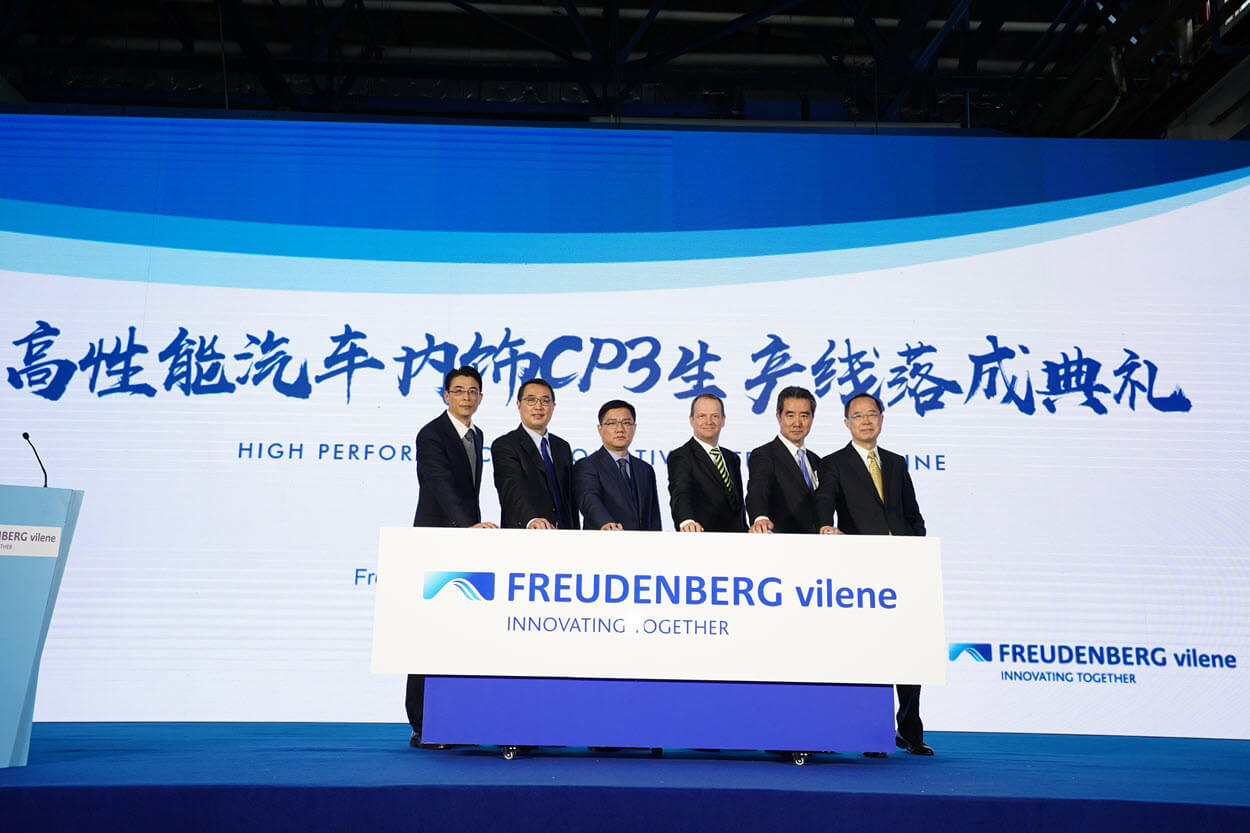
Germany-based Freudenberg Performance Materials is one company with a China presence looking at how the market is shifting. In 2019 it installed a new line in China making nonwoven automotive headliner printed materials (in Suzhou) and said signs for recovery in the auto sector are clearly visible, whereas within the apparel business it expects China domestic brands to slowly recover through the rest of the year. “However, this will not compensate the sharp drop by Western brand orders due to Covid-19,” says Freudenberg Performance Materials.
India
In India the Covid-19 pandemic gave the local nonwovens industry a completely new direction, with hundreds of new manufacturing units being launched within weeks of the pandemic taking hold in March to meet the sudden spike in demand for personal protective equipment (PPE) kits and face masks.
“Before [the virus outbreak] we had very little capacity to make [PPE] coveralls, but now we are making 500,000 of them a day,” says Anup Rakshit, executive director of India Technical Textile Association.
This quick expansion of capacity was achieved by traditional apparel makers augmenting production lines to make PPE kits. This followed an official government directive for the Covid-19 lockdown starting 24 March that only industrial units making essential commodities such as PPE kits and face masks should remain operational (and only then with special permission from regulators).
As a result, “500 to 600 apparel factories of big industrial houses bought heat sealing and ultrasonic bonding machines to gear up for this production,” says Rakshit.
Basic nonwoven fabric was already being made in large quantities in India for exports but after the increased domestic demand, 15 to 20 new units of mostly meltblown fabric have been opened in the states of Haryana, Gujarat, Maharashtra and Tamil Nadu, Rakshit says. According to him, machinery to manufacture these fabrics costs around US$3m and has been mostly installed in existing industrial units without the need to buy additional land or construct new premises.
Unsurprisingly, many companies wanting to establish larger nonwovens units have struggled to secure the necessary resources, with Arvind Sinha, president of Textile Association of India, saying: “The money is not there as bank loans are not being given.”
That said, looking ahead, India’s nonwovens industry is still hopeful of benefiting from a National Technical Textiles Mission announced in February, before the pandemic took hold, allocating Indian Rupees INR14.8bn (US$196m) in public money over the next four years for research and development, market building, export promotion and bosting skills. The mission scheme also involves setting up an Export Promotion Council for Technical Textiles, with an aim to increase these exports by an average of 10% annually until 2024, says a note issued by the Press Information Bureau of the central government in February.
At the same time, the Indian government is trying to reduce dependence on imported products. In the short term, restrictions were temporarily imposed on all imports from China after a border skirmish between the two countries’ armies in June. However, according to Sinha, “banning Chinese products will not bring any advantage but in fact harm”, because nonwoven and related input imports from China to India were not immediately replaceable by domestic production.
In Bangladesh, demand created by Covid-19 has led to major conglomerates and smaller companies ramping up production of nonwovens safety gear, although most companies have been importing nonwoven fabric.
Bangladesh
Bangladesh has a relatively undeveloped nonwovens manufacturing segment, says Mohammed Ahmed, a director of Asia Group of Industries, based in Chittagong. PPE production capacity has ramped up nationwide, with PPE export orders being received from the US, Kuwait, Nepal and Sri Lanka, for instance, and between July (2019) and May (2020), Bangladeshi manufacturers exporting PPE worth US$444m, according to the country’s Export Promotion Bureau. Its officials expect shipments to more than double by 2021.
But most manufacturers have been importing nonwoven fabric from China, Hong Kong, Taiwan, and South Korea to produce nonwoven products such as safety gear, shopping bags, diapers, and geotextiles, says Ahmed.
One exception has been Dhaka-based major Beximco, whose textiles division in May made a headline-grabbing shipment of 6.5 million medical gowns to the US clothing company Hanesbrands Inc, which has been supplying US emergency workers with PPE.
The Bangladesh textiles maker invested US$30m in building a new nonwovens factory to make PPE, opening in March, taking 2.5 months to ramp up PPE production: “We have executed things fast,” Husain says. The company now has the capacity to produce 50 million PPE items per month.
Despite the general lack of nonwoven fabric-making capacity, because of its clothing manufacturing muscle, “Bangladesh is well-positioned to become a new hub for PPE manufacturing,” says Syed Naved Husain, Beximco CEO. “Everyone in Bangladesh wants to turn the tide and help save lives. Beximco is leading the way.”
“In just two months, we’ve unleashed our world-class manufacturing, technical and design talent to switch over and start making PPE,” recalls Husain.
Meanwhile, Get Well, a subsidiary of Bangladesh’s PRAN-RFL Group, has tripled its daily production capacity of surgical masks to 150,000 since Bangladesh reported its first confirmed case on 8 March.
“We hope to produce half a million masks a day by the end of this year,” says Kamruzzaman Kamal, the group’s marketing director.
The company plans to manufacture KN-95 masks within the next two months, Kamal adds. Its other disposable nonwoven products include gowns, mop caps, bouffant caps, and shoe covers.
Dhaka-based Promixco Healthcare was one company well-placed to respond to the pandemic having broken into the production of surgical masks late last year, says Mousumi Islam, the company’s chairperson, who states that the company started medical gowns production in March “after the outbreak of the pandemic in Bangladesh”. Such nonwoven materials supply shortages can cause problems, and they have, for instance in Sri Lanka, which has struggled to produce PPE, let alone export it.
“Nonwoven fabrics are currently not produced in Sri Lanka, with the bulk coming from China,” says former president of the Sri Lanka Apparel Exporters Association, Yohan Lawrence.
Sri Lankan manufacturers who might have prospered from PPE orders could not source nonwoven fabric because of increased global demand and high prices, especially for SMS (spunbond, meltblown and spunbond) fabrics. Mr Lawrence mills in China cancelled orders or jacked up prices while India, South Korea and the Middle East stopped exporting SMS fabrics to meet local pandemic-fuelled demand. Sri Lanka’s total nonwovens imports are forecast to be down to US$14.55m in 2020 compared to total imports at US$16.18m last year, he says, despite Covid-19.
Malaysia
In Southeast Asia, however, demand for Malaysia’s nonwoven fabrics and hygiene products such as face masks and personal protective equipment (PPE) garments have increased since the beginning of the Covid-19 pandemic.
Apparel manufacturer and fashion retailing holding company Jerasia Capital Bhd announced in July 2020 that it is venturing into the healthcare industry by using production lines to produce nonwoven-based PPE for local and export markets. Its Malaysian unit Canteran Apparel Sdn Bhd and Cambodian arm Canteran Apparel Co Ltd are now developing, producing, and supplying PPE products including nonwoven isolation gowns, head covers, shoe covers, and cloth face coverings.
Another Malaysian company profiting from nonwovens PPE is NanoTextile Sdn Bhd, which has been producing high-efficiency particulate air (HEPA) masks to assist frontline medical staff during the Covid-19 pandemic. CEO Dr Thomas PS Ong explained that the company’s Nano-HEPA masks have a self-cleaning outer layer that captures microbials, restricting airborne spread of disease.
Ong adds: “We are trying to localise production in Malaysia to reduce the reliance on overseas supply.”
Ong’s company has been incorporating RFID (radio-frequency identification) tags into its product to help with linen management. A pilot project launched in 2018 with partners NanoMalaysia Bhd and MDT Innovations Sdn Bhd successfully tracked dates, locations, and washes with RFID tags on woven and nonwoven nanotechnology linens to avoid inventory losses.
And share prices have demonstrated the value of nonwovens in Malaysia during the pandemic. A good example is Oceancash Pacific Bhd, owner of Oceancash Nonwoven Sdn Bhd, which manufactures and trades air-through bonded, nonwoven thermal-bonded, and nonwoven fabric, widely used in disposable hygiene products.
Oceancash Pacific’s shares jumped US$0.07 (MYR0.30 – Malaysian Ringgit) or 41.67% on 1 June (2020), closing at an all-time high of US$0.24 (MYR1.01). On a year-to-date basis, its share value has more than doubled from the US$0.11 (MYR0.44) traded on 31 December (2019).
The extent to which these values and profits of Asian nonwovens companies and product makers will remain bullish after the Covid-19 pandemic remains to be seen, but given the long-term market potential, the new production capacity created this year is unlikely to be mothballed.